
Brick Mix Mortar: Types, Mixing and Bag Estimates
Maps Types N, S, M and O to common brick projects, then explains packaged mixing, estimates from published yield and repointing compatibility.
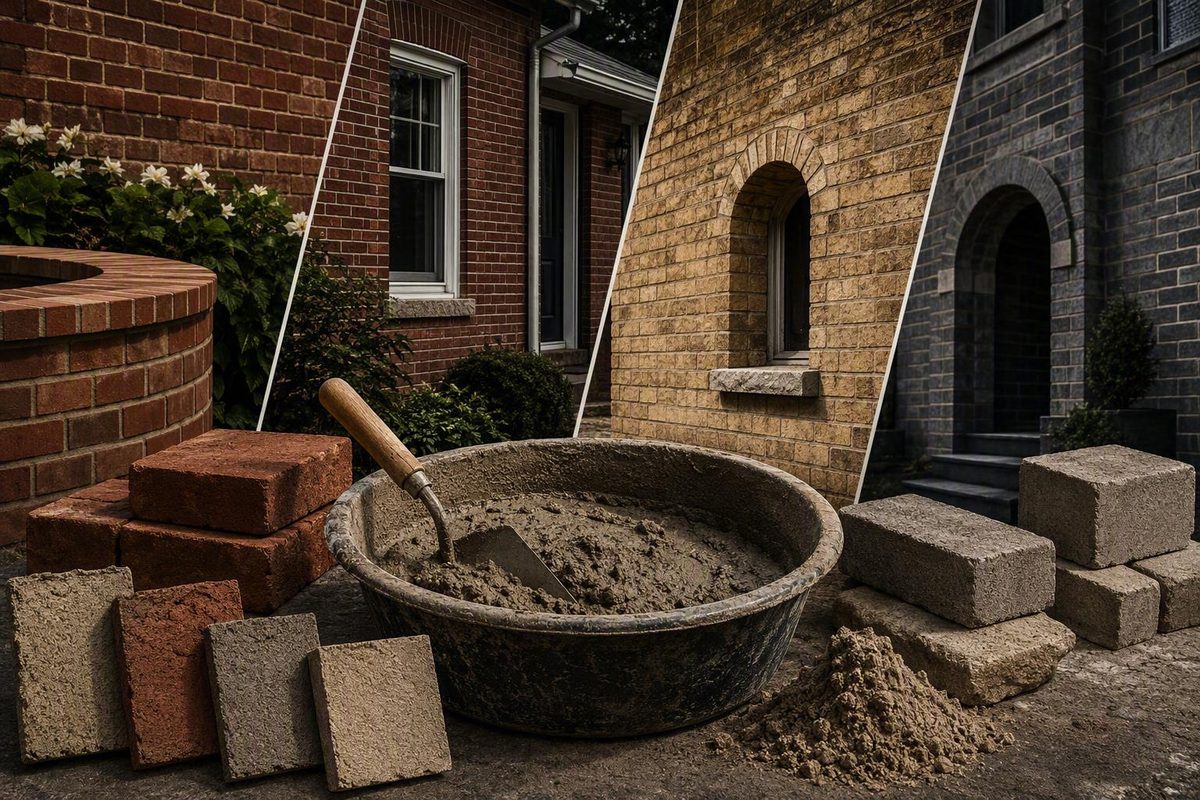
For ordinary above-grade modern brickwork, Type N is often the starting point. Reinforced or loadbearing walls commonly move the discussion toward Type S, while certain foundations and retaining walls may require Type M. Repointing—especially old or soft brick—requires a compatibility check rather than a type chosen from a generic chart.
In every case, select the lowest-compressive-strength mortar that satisfies the plans, specification, exposure, applicable code, and masonry-unit requirements. Mortar type and laboratory compressive strength are screening inputs; they do not by themselves establish bond, wall strength, durability, code compliance, or suitability for a particular project.
Quick selector: which mortar type fits the brick project?
Choose mortar according to what the wall must do, where it is located, and which masonry units it joins—not by psi alone. This table is a screening tool; the project documents and applicable code control.
| Brick project | Common starting point | Qualifications | ASTM C270 property-specification strength* |
|---|---|---|---|
| Ordinary exterior above-grade veneer or non-loadbearing brickwork | Type N | Common recommendation for normal brickwork and most anchored veneer; confirm plans, exposure, code, and product instructions | 750 psi |
| Exterior reinforced or loadbearing wall | Type S | Usually recommended for higher structural demand; Type N may be an alternate where the design and code permit it | 1,800 psi |
| At- or below-grade foundation or retaining wall | Type M, with Type S as a possible alternate | Requires project-specific review of loads, soil, water, exposure, reinforcement, and drainage | Type M: 2,500 psi; Type S: 1,800 psi |
| Interior work | Type N for many walls; Type O for limited low-demand work | Type O is used mainly for interiors and some restoration work, not as a universal interior or repair mortar | Type N: 750 psi; no Type O figure is given here |
| Repointing modern brick | Compatibility-led; sometimes Type N | Match the existing brick and mortar rather than relying on the type designation alone | Depends on the wall |
| Repointing historic or soft brick | Building-specific mortar, sometimes Type O or a custom lime-rich mix | Existing mortar, brick properties, permeability, sand, appearance, and tooling govern | Do not select by psi alone |
*The figures are minimum average 28-day laboratory compressive strengths under the ASTM C270 property specification, as reported in SPEC MIX’s masonry cement-and-sand mortar data. They are not wall design strengths, universal requirements for every mortar carrying the type designation, or proof that a mortar is suitable for a particular project. The application recommendations follow the Brick Industry Association’s selection guidance.
Selection rule: Use the lowest-compressive-strength mortar that still meets the project requirements. Stronger mortar is not automatically better.
The table should not be used as a project specification for a retaining wall, foundation, reinforced or loadbearing wall, high-wind or seismic system, chimney, fire-exposed masonry, or work subject to severe weather. Those conditions may affect mortar type, reinforcement, detailing, installation, and inspection requirements.
Type O also requires care. It is a low-strength mortar associated mainly with interior and some restoration applications. That does not make it an all-purpose repointing mix: the repair mortar must remain compatible with the particular units and existing joints.
What brick mortar mix contains—and what it is not
Brick mortar bonds masonry units such as brick, concrete block, and stone so they can act together as an assembly. A conventional brick mortar mix has three functional components:
- Fine aggregate, usually sand: supplies bulk and stability and strongly affects joint texture and color.
- Binder: may include lime, portland cement, masonry cement, or an approved combination. It influences hardness, setting behavior, workability, and vapor permeability.
- Water: makes fresh mortar workable and enables the binder to set.
The proportions and binder system vary by mortar and project. A universal cement-lime-sand recipe is therefore inappropriate: a mix suitable for new structural masonry may be incompatible with soft historic brick, while a preservation mortar may not satisfy a modern structural specification.
Mortar is not concrete. Concrete is formulated as a different material, commonly for thicker placements and structural elements; bricklaying mortar is made for relatively thin joints, adhesion, water retention, and workable placement around masonry units. The two should not be substituted. Sakrete’s comparison of mortar and concrete describes mortar as creamier, more workable, and lower in compressive strength than typical concrete.
Conventional brick mortar is also not tile-setting thin-set. A retailer may place thin-set, concrete mix, masonry cement, and brick mortar in the same broad category, but that does not make them interchangeable.
A preblended mortar mix contains dry ingredients proportioned by the manufacturer and commonly needs only clean water. This can reduce field variation in binder-to-sand proportions. Check the bag carefully, however: masonry cement alone is not the same as a complete, sanded mortar mix.
A field-batched mortar requires a project-approved binder system and compatible aggregate. Its specification should control the binder type, aggregate requirements, measured proportions, water, mixing sequence and duration, and any required batch records. Those inputs should not be improvised from a generic recipe.
Why mortar strength is only one selection factor
Compressive strength is easy to compare, but masonry performance also depends on:
- bond strength and extent of bond;
- workability and water retention;
- elasticity and accommodation of movement;
- durability under the expected exposure;
- compatibility with the brick;
- joint profile, compaction, and workmanship;
- moisture behavior;
- structural design and applicable codes.
Type S has greater compressive and flexural bond strength than Type N, but that does not make it the automatic choice. Mortar must accommodate the wall’s materials and movement without needlessly concentrating stress in the masonry units. It must also remain workable enough to produce full, compacted joints and adequate contact with the brick.
Type M provides high compressive strength but lower workability. It belongs in demanding applications that require those properties, rather than ordinary brickwork selected by habit. The Brick Industry Association’s mortar-selection guidance directs specifiers to consider design, masonry materials, exposure, workmanship, durability, and workability alongside compressive strength.
Brick absorption further complicates selection. A highly absorptive brick can draw water from fresh mortar quickly, affecting workability and bond development. Mortar with suitable water retention—and jobsite practices appropriate to the unit and weather—helps manage that interaction. This does not justify adding an arbitrary amount of water or automatically prewetting every brick; follow the unit manufacturer’s guidance, project specification, and applicable weather procedures.
Two common scenarios illustrate the difference:
- Modern above-grade veneer: For nonloadbearing veneer using contemporary brick, Type N is a common starting point because it offers a practical balance of bond, workability, and strength. Exposure, wind design, anchors, plans, and local code still control.
- Reinforced loadbearing wall: Type S may be specified where a wall carries structural demand or requires higher bond and compressive performance. Its higher strength is relevant to that application, not evidence that Type S is universally safer.
Code restrictions can override both examples. The Brick Industry Association reports that TMS 402 does not permit Type N or masonry-cement mortar in specified ungrouted or partially grouted lateral-force-resisting systems in Seismic Design Categories D, E, or F; the governing design and adopted code determine whether that restriction applies to a particular wall.
How to choose and mix a packaged mortar
Before buying packaged brick mix mortar, check the bag and the current product data sheet for:
- mortar type: M, S, N, or O;
- intended applications and stated exclusions;
- ASTM C270 and, for preblended dry mortar, ASTM C1714 claims;
- binder system and whether sand is included;
- standard or custom color;
- package weight and published yield;
- required water range;
- mechanical mixing time;
- usable period after mixing;
- retempering policy;
- acceptable temperature and weather conditions;
- joint-tooling instructions;
- protection and curing guidance;
- waiting period and method for cleaning.
A type designation alone is not a complete wall design. The Brick Industry Association also states that preblended dry mortar conforming to ASTM C1714 complies with ASTM C270.
Packaged Type N mortars are sold for laying brick, and some are complete sanded blends that require only water. For example, a 60-pound QUIKRETE Type N listing identifies a preblended product for nonstructural brick, block, stone, veneer, repair, and tuck-pointing work and states conformance with ASTM C270 and C1714. That retailer application list does not establish suitability for structural work or compatibility with historic masonry.
Use this mixing workflow:
- Read the current instructions for the exact product. Similar-looking bags may have different formulations, water requirements, use windows, and weather limits.
- Use clean equipment and potable water.
- Measure the specified water. Do not mix by guesswork, particularly when color consistency matters.
- Mix mechanically for the stated period. Brick Industry Association guidance gives a general range of approximately three to five minutes, but the selected product’s instructions control.
- Keep batches consistent. Use the same water measurement, mixer, batch size, and mixing time.
- Place mortar within its stated use window. Do not borrow the working time from another brand or mortar type.
- Tool at the specified stage. SPEC MIX, for example, directs users to tool when the joint surface is thumbprint hard.
- Protect, cure, and clean as directed. Follow the product’s stated waiting period and cleaning method rather than assuming one schedule applies to every mix.
There is no universal water quantity. Too little water can impair placement and contact; uncontrolled additional water can affect performance and joint-color consistency.
Retempering—adding water after initial mixing to restore workability—must follow the exact product and project instructions. SPEC MIX permits retempering only to replace water lost through evaporation, while other formulations may impose different restrictions. Do not use retempering to revive mortar that has begun to set.
Estimate bags from published yield—not a universal coverage number
Estimate mortar from the selected manufacturer’s yield for the actual brick size and package rather than from a generic bags-per-square-foot rule.
Use this method:
- Identify the brick’s actual size and required quantity.
- Confirm the intended joint width, depth, and profile.
- Find the selected product’s stated yield for that brick size.
- Divide the required brick count by both ends of the published bricks-per-bag range.
- Round up to whole bags.
- Add a waste allowance appropriate to cuts, staging, workmanship, wall details, and site conditions.
As a product-specific illustration, SPEC MIX publishes the following approximate yields for an 80-pound bag:
| Brick size | Approximate bricks per 80-pound bag |
|---|---|
| Modular | 40–45 |
| Queen | 34–39 |
| King | 28–33 |
| Utility | 23–28 |
For 400 modular bricks, using that cited range:
- 400 ÷ 45 = approximately 8.9 bags
- 400 ÷ 40 = 10 bags
The resulting estimate is approximately 8.9 to 10 bags before any additional project-specific waste allowance. Because bags are purchased whole, round up and then account for job conditions rather than assuming the lower result will be sufficient.
Yield changes with brick dimensions, joint width and depth, frogs or cores, wall details, workmanship, dropped material, and site conditions. The manufacturer identifies its figures as approximate. Do not transfer an 80-pound-bag estimate to another brand, formulation, package size, or joint geometry.
Repointing requires a compatibility check, especially on old brick
Repointing is not simply bricklaying with a smaller tool. New work begins with selected units and a designed mortar system. Repointing begins with an existing wall whose brick, original mortar, repair history, moisture movement, and deterioration constrain the replacement material.
The Brick Industry Association also describes a repointing procedure that produces a placement consistency drier than bricklaying mortar. The exact preparation and placement method should come from the project specification rather than being assumed from new-work practice.
For older masonry, replacement mortar must be physically and visually compatible with both the masonry units and the existing mortar. Compressive strength, permeability, movement behavior, bond, and appearance are separate considerations. In general, the replacement should not impose greater stress on the units, should permit appropriate moisture movement, and should not be harder or less permeable than the historic assembly can tolerate.
The National Park Service’s Preservation Brief on historic-masonry repointing explains that overly strong or impermeable replacement mortar can trap or redirect moisture and transfer stresses to masonry units, contributing to cracking, spalling, or delamination.
A serious historic match may require analysis of a representative, relatively unweathered mortar sample. The resulting specification may consider:
- binder type and approximate proportions;
- sand color, particle shape, and gradation;
- pigments or fine inclusions;
- cured color and surface texture;
- compressive behavior and permeability;
- joint width, profile, and tooling;
- original construction methods and later repairs.
Sand deserves particular attention because it is a major mortar component and strongly influences color, texture, workability, cohesion, and durability. National Park Service guidance recommends sand generally conforming to ASTM C144 for repointing while allowing variation where the historic particle size and gradation require a different match.
A retailer’s statement that a Type N product can be used for repointing is only a product-use claim. It does not establish compatibility with old, soft, highly absorptive, or historically significant brick.
The risk is documented rather than theoretical. At the Fredericksburg National Cemetery boundary wall, built in the 1870s, the National Park Service reported that portland cement used in earlier joint repairs damaged bricks and wall panels at that site. Its Phase 3 planning document proposed repair, repointing, and reconstruction while retaining as much historic material as possible. This site-specific finding does not mean portland cement damages every brick wall; it demonstrates the consequences that incompatible repairs can have in a particular historic assembly.
Correct active causes of deterioration before repointing. Failed gutters or flashing, leaking copings, poor drainage, rising damp, settlement, vegetation, and severe exposure will not be cured by filling the joints. New mortar may otherwise conceal continuing movement or redirect moisture into the brick.
Use a preservation specialist or experienced masonry professional when the wall has historic or soft brick, extensive spalling, widespread cracking, unidentified mortar, repeated failed repairs, or significant moisture problems. Sampling should be deliberate because removing a mortar sample is destructive.
Final pre-purchase and stop-work checklist
Before choosing or using brick mix mortar, work through these questions.
Classify the job
- Is it new nonstructural brickwork?
- Is it reinforced or loadbearing masonry?
- Is it modern repointing?
- Is it historic repointing or work on soft brick?
Verify technical suitability
- What do the plans and project specification require?
- What does the applicable local code require?
- What are the brick’s strength and absorption characteristics?
- Is the wall above grade, below grade, retaining soil, or exposed to severe weather?
- Does the current data sheet for the exact product approve the intended use?
- Are ASTM claims, weather limits, mixing instructions, and curing requirements stated?
- For repointing, is the replacement mortar compatible in strength, permeability, movement behavior, color, texture, and tooling?
Then compare shopping variables
- Bag size and published yield
- Standard or custom color
- Price per usable quantity
- Local availability and delivery
- Storage condition and package integrity
Keep shopping variables separate from technical selection. Retail prices, ratings, stock, and delivery options change with location and time; none demonstrates that a mortar is appropriate for a wall.
Seek qualified, project-specific input before proceeding with loadbearing or reinforced masonry, retaining walls and foundations, below-grade construction, or high-wind and seismic systems. The Brick Industry Association’s technical guidance identifies design, loading, exposure, masonry materials, workmanship, and applicable code requirements as mortar-selection considerations. For chimneys or fire-exposed masonry, obtain requirements specific to that assembly rather than relying on the general selector.
Pause historic repair work and obtain preservation guidance when brick is soft or irreplaceable, the mortar is unidentified, deterioration is severe, or movement and moisture problems remain active. National Park Service guidance emphasizes diagnosing those conditions and matching the existing masonry before repointing.
The decision follows four paths: ordinary above-grade modern brickwork often begins with Type N; reinforced, loadbearing, below-grade, or retaining work requires specification-led review of Type S or Type M; modern repointing requires compatibility with the existing wall; and historic repointing may require mortar analysis and preservation expertise. Follow the selected product’s water, mixing, weather, curing, cleaning, and yield instructions rather than relying on a universal recipe. The appropriate mortar is the compatible mortar that meets the project’s requirements—not necessarily the one with the highest psi.