
Masonry Mortar Types: M, S, N, O & K
Compare strength, workability and compatibility, from Type N for routine above-grade masonry to M or S for heavier structural demands.
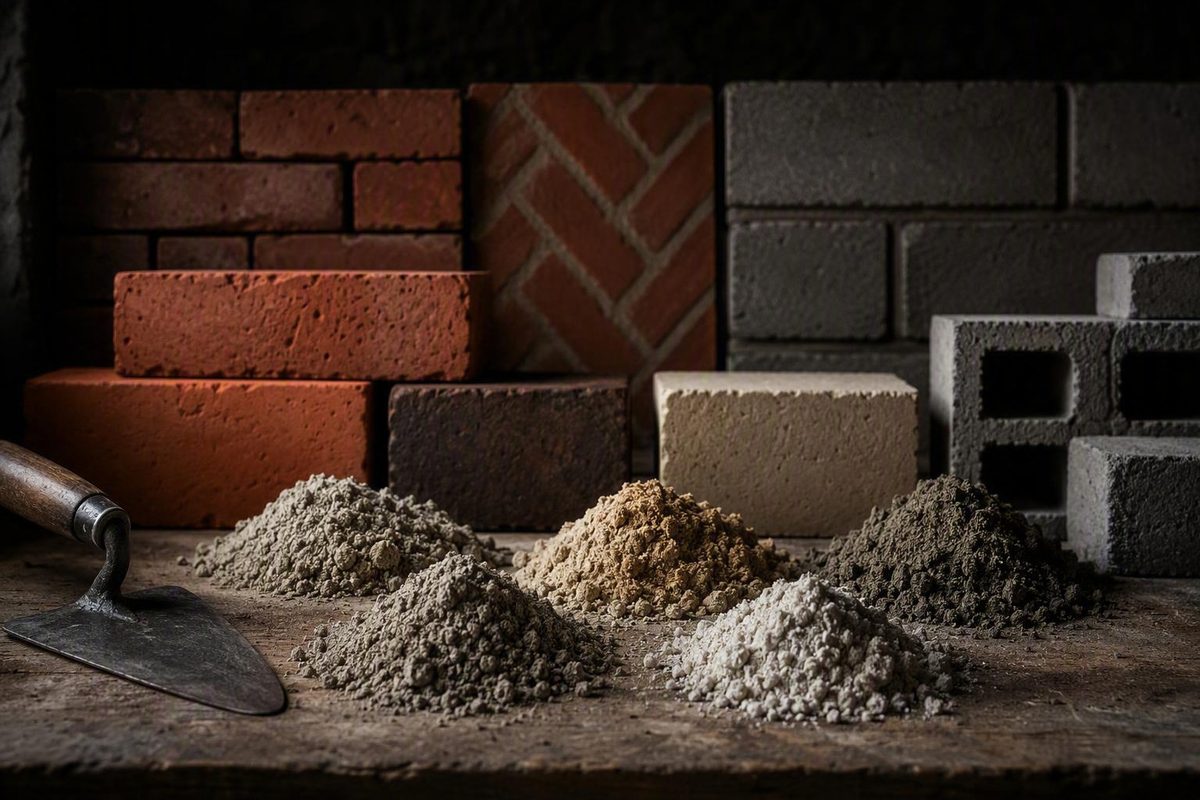
How to choose mortar by load, exposure and masonry compatibility
Choose mortar by balancing structural demand with masonry-unit properties, exposure, bond, workability, water retention, permeability, reinforcement and governing requirements—not by choosing the highest compressive strength. ASTM C270 recognizes mortar Types M, S, N and O; Type K is better treated as a traditional restoration designation rather than a fifth ASTM C270 type. The Brick Industry Association summarizes these classifications and the factors governing selection.
As an initial screen, Type N is a common starting point for routine above-grade masonry; Type S is often considered as structural or lateral demands increase; Types M and S are candidates for heavy-load or below-grade work; and Type O, traditional Type K or a custom lime-rich mortar may suit repairs after the existing wall has been assessed. The final choice must follow the project documents, current locally adopted code and material-compatibility review.
Mortar types at a glance
The practical hierarchy runs from higher compressive strength at the Type M end toward lower strength and generally greater movement accommodation at the Type O and traditional Type K end. This hierarchy is useful for comparison, but it cannot determine project suitability by itself.
| Type and status | Relative compressive strength | Workability and movement accommodation | Common starting points and principal caution |
|---|---|---|---|
| M — ASTM C270 type | Highest of the four; approximately 2,500 psi minimum under the cited 28-day property specification | Generally less workable and accommodating than lower-strength, lime-richer options | Selected heavy-load, below-grade, retaining, paving or water-exposed work. Caution: not automatically correct for every foundation or retaining wall. |
| S — ASTM C270 type | High; approximately 1,800 psi minimum | Better balance of strength and workability than M, but still relatively stiff | Reinforced or loadbearing walls and some high-wind, high-seismic or lateral-load applications. Caution: may be too strong for softer units or repairs. |
| N — ASTM C270 type | Medium; approximately 750 psi minimum | Good general workability, bond and movement accommodation | Routine above-grade brick or block, including many anchored veneers, chimneys and parapets. Caution: reinforcement, exposure or lateral loads may require another selection. |
| O — ASTM C270 type | Low; approximately 350 psi minimum | More accommodating than M, S or N | Interior low-load work and some compatible repairs to softer masonry. Caution: limited structural and exterior-exposure applications. |
| K — traditional designation | Very low relative strength | Lime-rich, soft and movement-accommodating | Specialized restoration of very soft historic masonry. Caution: do not select it by letter or building age alone; analysis may indicate a custom mortar instead. |
The values shown for M, S, N and O are approximate 28-day laboratory property-specification minimums, not actual in-wall strengths or masonry-wall capacities. Specifiers should verify values, materials and test conditions against the current governing edition of ASTM C270 before placing them in project documents. BIA’s mortar guidance identifies the four ASTM C270 types and explains why compressive strength alone should not control selection.
Type M therefore belongs at the top of the strength comparison, not at the top of every application list. The lowest-strength mortar that still meets the wall’s structural, exposure, durability and compatibility requirements is often the more appropriate selection.
A practical mortar-selection sequence
First separate new construction from repair. New work normally begins with structural design and the project specification. Repair begins with the existing wall because the replacement mortar must work with the units, mortar and construction already in place.
Then ask, in order:
- What does the masonry do? Identify veneer, partition, loadbearing wall, reinforced wall, retaining wall, paving or another role.
- Where is it located? Determine whether it is interior or exterior and above, at or below grade.
- What exposure must it resist? Consider rain, persistent moisture, soil, hydrostatic conditions, wind, seismic forces, freeze-thaw cycling, salts and chemicals.
- What are the unit properties? Brick, concrete block and stone differ in strength, absorption, surface texture and vapor behavior.
- Is the work reinforced or anchored? Reinforcement, ties and anchors introduce bond and code requirements that a generic chart cannot resolve.
- What governs the work? Check current drawings, specifications, adopted building codes and referenced ASTM and TMS standards.
- Who controls the final selection? Structural work and unusual exposures belong under the project designer’s control.
The following matrix is only an initial screen:
| Application | Common starting point | Alternative or issue | Required checkpoint |
|---|---|---|---|
| Anchored veneer | Type N | Type S where design demands greater performance | Current drawings and specifications, locally adopted codes and qualified design control |
| Exterior loadbearing or reinforced wall | Type S | Type N only where design and applicable requirements permit | Current drawings and specifications, locally adopted codes and qualified design control |
| Foundations, retaining walls, sewers and manholes | Type M or S | Depends on loads, soil, water, units and reinforcement | Current drawings and specifications, locally adopted codes and qualified design control |
| Chimneys and parapets | Type N | Type S where exposure or design demands it | Current drawings and specifications, locally adopted codes and qualified design control |
| Interior partitions | Type N | Type O may be permitted under some low-load conditions | Current drawings and specifications, locally adopted codes and qualified design control |
| Exterior mortared paving | Type M | Type S may suit some conditions; drainage and freeze-thaw exposure matter | Current drawings and specifications, locally adopted codes and qualified design control |
| Repointing | Follow the separate diagnostic path below | Analyze existing units, mortar, moisture and movement before considering a type | Current drawings and specifications, locally adopted codes and qualified design control |
These starting points reflect industry guidance, but they do not replace application-specific design.
This process avoids the misleading shorthand that N always means “above grade” and S or M always means “below grade.” Location matters, but so do loads, saturation, soil pressure, unit absorption, reinforcement, workmanship and detailing.
Why the strongest mortar is not automatically the best
Mortar bonds individual units into an assembly, seals joints, accommodates slight differences in unit size and small movements, and bonds with reinforcement, ties and anchors. Its important properties include workability, water retention, bond, compressive strength and durability. Compressive strength and bond strength are not directly proportional, even though greater compressive strength may improve bond when other conditions remain equal. CMHA explains these functions and material relationships.
A two-axis screen helps prevent selection from becoming a simple strongest-to-weakest ranking:
| Structural demand | Masonry compatibility | Initial screening implication |
|---|---|---|
| High | Robust, compatible units | M or S may be candidates |
| High | Soft, weak or highly absorptive units | Engineering and material analysis may be needed; strength alone cannot resolve the conflict |
| Moderate | Typical modern units | N or S may be candidates |
| Low | Soft or historic units | O, traditional K or a custom lime-rich mortar may warrant assessment |
This table cannot select a mortar without reviewing exposure, reinforcement, unit absorption, binder system, project specifications and current code requirements.
A mortar that is too hard can transfer movement-related stress into softer brick or stone instead of allowing deterioration to remain concentrated in the replaceable joint. A dense, insufficiently vapor-permeable mortar can also alter drying and moisture movement, contributing to cracking or spalling in adjacent units. National Park Service preservation guidance explains these compatibility risks.
The ingredients help explain the tradeoffs:
- Portland cement contributes strength and durability.
- Lime supports plasticity, workability and water retention.
- Sand gives mortar body and affects shrinkage, handling, joint texture and color.
- Water enables mixing and cement hydration; its quantity also affects consistency and performance.
- Air entrainment can reduce water demand and improve workability and freeze-thaw resistance, but increased air can reduce bond strength.
Changing cement, lime, aggregate grading, water or air affects several properties at once. A stronger bagged product is therefore not necessarily a better match for a particular brick, stone or wall.
Mortar type, binder system and specification method are different things
M, S, N and O are ASTM C270 mortar-type classifications. A letter does not, by itself, identify the binder system, packaging format or the compliance method selected by the specifier.
| Concept | What it identifies | Examples | What it does not establish |
|---|---|---|---|
| Mortar type | Required classification | M, S, N or O | Exact binder or package format |
| Binder system | Materials used to produce mortar | Portland cement-lime, masonry cement, mortar cement | Suitability for every application |
| ASTM compliance method | How C270 requirements are specified | Proportion or property specification | Actual wall capacity |
| Delivery format | How materials arrive | Separate materials or preblended dry mortar | A separate mortar type |
Masonry cement is a formulated hydraulic cement containing cementitious and plasticizing materials used to make designated mortar types. Mortar cement is similar but has an additional minimum bond-strength requirement. None of these terms is synonymous with a mortar type.
Its binder may be portland cement and lime, masonry cement or mortar cement. Preblending may improve batching consistency, but the product must still provide the mortar type, binder system and compliance required by the project.
ASTM C270 provides two specification routes:
- The proportion specification controls permitted ingredient proportions.
- The property specification controls laboratory-tested properties of prepared mortar.
The project specifier should select one route in the project documents rather than combine requirements from both. Commercial cement-lime-sand ratios are not universal recipes because acceptable proportions depend on the materials, measurement method, chosen route, product instructions and project specification. CMHA explains the two ASTM C270 methods and states that project specifications should include only one.
An illustrative purchasing instruction might read: “Provide Type N mortar using the binder system or approved preblended product identified in the project documents, complying with the ASTM C270 method selected by the specifier.” By contrast, “Buy masonry cement” is inadequate because the binder name alone does not establish mortar type or suitability.
Historic repointing starts with the wall, not a letter
Repointing is not simply new masonry with weaker mortar. Before considering Type O, traditional Type K or another lime-rich formulation:
- Diagnose roof, flashing, drainage, rising damp and other moisture sources.
- Investigate settlement, cracking and continuing movement.
- Inspect masonry units and existing mortar in sound as well as deteriorated areas.
- Research original construction methods and subsequent repairs.
- Evaluate physical and visual compatibility.
- Match the sand’s color, particle shape, texture and gradation.
- Match the joint profile, finish and workmanship where appropriate.
Correct water entry, drainage, settlement or movement problems before repointing. Where strength, absorption, permeability or mortar composition is uncertain, a preservation professional should determine whether appropriate laboratory or specialist analysis is needed—particularly for significant historic fabric, unusually soft units or unidentified mortar.
Replacement mortar should generally be softer and more vapor-permeable than the masonry units and no harder or less permeable than the sound historic mortar. Otherwise, stress and moisture-related deterioration may shift from the sacrificial joint into adjacent brick or stone. Sand also strongly affects color, texture, workability, cohesion and durability. Preservation Brief 2 sets out these investigation and compatibility principles.
Type O, traditional Type K and custom lime-rich mortars are possibilities following analysis, not prescriptions based on age. Some masonry from the first half of the 20th century was originally built with portland-cement mortar, so an old construction date does not prove that pure lime mortar is correct.
Use a preservation specialist, architectural conservator or experienced restoration mason when the building is historically significant, the units are unusually soft, recurring moisture damage is present or the existing mortar cannot be identified confidently.
Conditions that can override the usual type chart
General recommendations become unreliable when a wall has unusual structural, material or exposure demands.
Seismic design is one example. BIA’s cited TMS guidance reports restrictions on Type N and masonry-cement mortars in certain ungrouted or partially grouted portions of lateral-force-resisting systems in Seismic Design Categories D, E and F. This is a code example, not a universal current rule: cited editions may not match the latest locally adopted requirements, so the applicable TMS 402/602 edition, building code and structural documents must be checked.
Brick absorption can also change the result. Such combinations may require testing, adjusted construction procedures or a different binder system rather than an automatic change from Type N to Type S.
Other conditions requiring application-specific review include:
- continuous moisture or saturation;
- soil or hydrostatic pressure;
- freeze-thaw cycling;
- soluble salts;
- industrial or chemical exposure;
- reinforced masonry;
- glass-unit masonry;
- exterior mortared paving;
- very dense or highly absorptive units; and
- unusual stone or historic brick.
Types N and S may sometimes be interchangeable, but only when both satisfy all applicable strength, bond, durability, compatibility and code requirements. Substituting S merely because it is stronger can change workability, stiffness and compatibility; substituting N can fail a structural or code requirement.
Refer structural, reinforced, seismic, foundation and retaining-wall applications—and severe or unusual exposures—to the project designer. A generic table cannot account for load paths, reinforcement development, drainage details or local amendments.
Do not confuse mortar test results with wall strength
Five different quantities are often collapsed into one “psi” number:
- ASTM property-specification minimum: a threshold established under prescribed laboratory conditions.
- Manufacturer product result: a value for a particular formula tested under stated conditions.
- Field mortar specimen result: a quality-control result affected by field materials, water, handling and specimen preparation.
- Actual in-wall mortar behavior: mortar cured between absorptive units under site conditions.
- Masonry-assembly capacity: performance of the complete wall, including units, mortar, grout, reinforcement, geometry and workmanship.
These quantities are not interchangeable. The familiar mortar-type strengths are laboratory properties, not direct measurements of in-wall strength or wall capacity.
ASTM C780 field compressive-strength testing is principally used to monitor the consistency of materials and procedures. It should not be represented as proof of ASTM C270 property-specification compliance, actual in-wall mortar strength or complete masonry-assembly capacity.
For quality control, batch site-mixed ingredients consistently by volume, maintain a consistent loading sequence and mechanically mix for the cited three-to-five-minute range. Follow governing product instructions and project requirements when they differ.
General CMHA guidance calls for placement within approximately 2.5 hours after initial mixing unless an approved set-retarding admixture is used; weather procedures, product instructions and project specifications may impose different requirements.
A complete mortar specification should identify:
- mortar type;
- acceptable binder system;
- ASTM C270 compliance method;
- current referenced standard edition;
- masonry-unit type and relevant properties;
- environmental exposure;
- reinforcement and anchorage conditions;
- color, sand and joint appearance; and
- batching, mixing, testing and other quality-control requirements.
Can Type N and Type S mortar be substituted for each other?
Sometimes, but not merely because both are common choices. A substitution is appropriate only when the proposed mortar satisfies the project’s requirements for compressive strength, bond, workability, durability, permeability, masonry compatibility and code compliance.
Type N is a common starting point for ordinary above-grade masonry and many anchored veneers. Type S may be appropriate where lateral loads, reinforcement or exposure demand greater performance. Moving from N to S without review can produce a less compatible mortar; moving from S to N can fail a structural or code requirement.
Can the same building use more than one mortar type?
Yes. Different portions of a building can face different loads, exposures or compatibility requirements. A reinforced structural wall, anchored brick veneer and repair to soft historic brick may therefore justify different mortars.
Does preblended mortar still have to meet ASTM C270?
Yes, when the project requires ASTM C270 compliance. “Preblended” describes how the materials are supplied, not a separate mortar classification or an exemption from the specification.
Some qualifying dry preblended mortars are also manufactured to ASTM C1714, but that does not replace the need to identify the required M, S, N or O type and the applicable ASTM C270 compliance route in the project documents. BIA reports the relationship between conforming C1714 preblended mortar and C270; current editions and project requirements should still be verified.
As a compact screening rule, use Type N as a common above-grade starting point, consider Type S as structural or lateral demands increase, evaluate M and S for heavy-load or below-grade work, and approach O, traditional K or lime-rich mortars through a compatibility assessment for repairs. That hierarchy is only a screen: the masonry units, exposure, reinforcement, project specification, current local code and qualified designer determine the final choice.