
Mortar and Cement Are Not Interchangeable in Masonry
Formulated mortar contains fine aggregate and provides the body, workability, water retention, bond and compatibility needed for masonry joints.
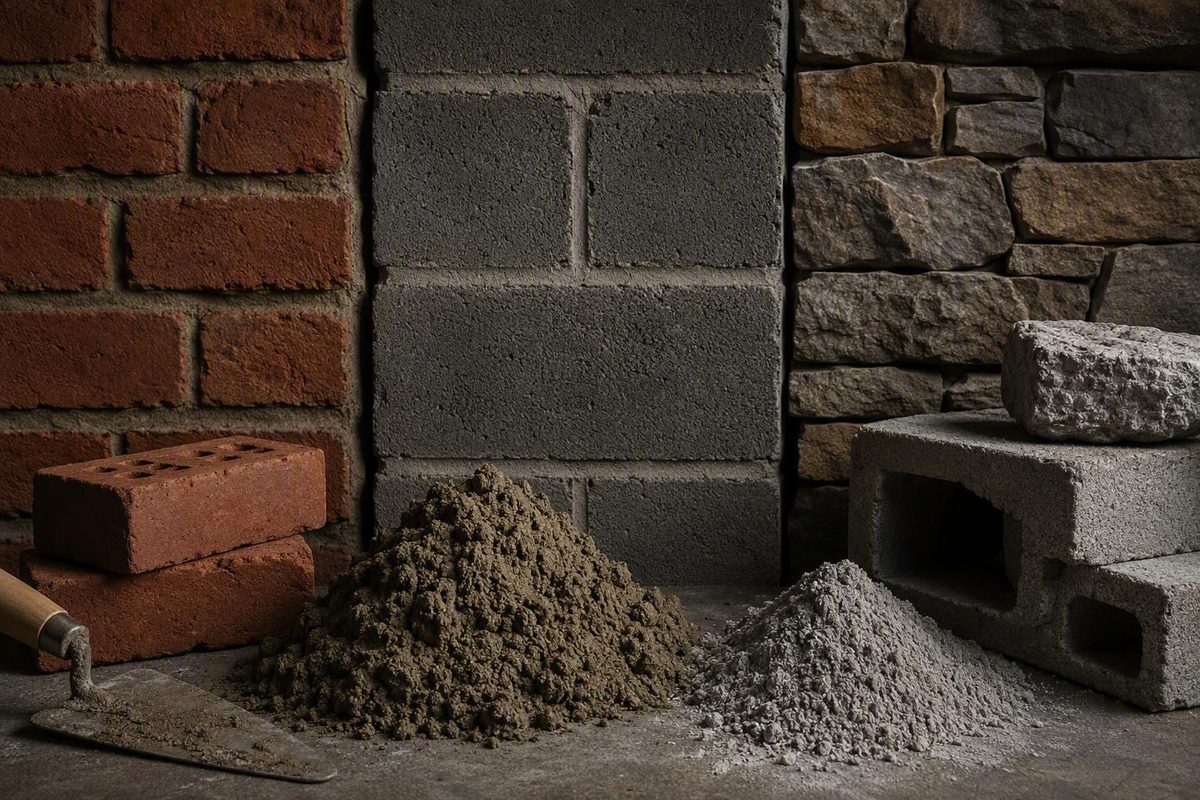
The short answer: use mortar to bond masonry
For ordinary bricklaying, concrete-block construction, stonework, or repointing, use a properly formulated masonry mortar, not cement paste by itself.
Cement is usually one of mortar’s binding ingredients. It is a fine hydraulic powder that reacts with water and hardens through hydration. Masonry mortar combines a cementitious binder with water and fine aggregate, usually sand. Depending on the formulation, it may also contain lime, pigments, air-entraining ingredients, water repellents, or other additives. In practical terms, cement is primarily an ingredient; mortar is the workable mixture used to bed and joint masonry units (Northshore Cement & Sand).
Because sand is a fine aggregate, it is incorrect to say that mortar contains no aggregate.
Cement paste—cement mixed only with water—is not an interchangeable substitute for masonry mortar. It may become hard, but hardness alone does not make it suitable for bedding brick or filling ordinary masonry joints.
The answer changes when “masonry project” is being used to describe a different operation:
- Laying brick, block, or stone: Use compatible masonry mortar.
- Repointing existing joints: Use replacement mortar compatible with the existing mortar and masonry.
-
Pouring a slab, footing, or similar mass element: Use the specified concrete.
-
Setting tile: Use the thinset or tile-setting mortar specified for the tile, substrate, and exposure.
-
Patching damaged concrete or masonry: Use a repair product intended for the substrate, repair depth, movement, and exposure.
This does not mean cement is never used by itself in any construction process. It means cement paste is generally not the correct finished material for laying or repointing ordinary masonry. Start by identifying the operation rather than choosing a bag merely because its label includes the word “cement.”
Cement, mortar, and concrete compared
Cement, mortar, and concrete are related materials, but they are not interchangeable. The practical distinctions involve their ingredients, aggregate size, workability, placement thickness, and intended role.
| Material | Typical composition | Aggregate | Primary role | Common applications | Ingredient or finished project material? |
|---|---|---|---|---|---|
| Cement | Hydraulic binding powder that hardens when mixed with water | None in the dry cement itself | Binds other ingredients | Ingredient in mortar, concrete, grout, screeds, and specialized products | Primarily an ingredient |
| Mortar | Cementitious binder, water, and fine aggregate; may include lime or additives | Fine aggregate, usually sand | Bonds masonry units and forms joints | Bricklaying, blockwork, stonework, joint filling, and repointing | Finished masonry-jointing material |
| Concrete | Cement, water, and graded aggregate, normally including coarse aggregate | Fine and coarse aggregate, such as sand and gravel | Forms mass or structural placements | Slabs, footings, foundations, beams, columns, and other specified elements | Finished placement material |
Concrete normally contains coarse aggregate and is formulated for different placement and structural demands. Mortar uses fine aggregate and is intended to spread in comparatively thin beds, fill small irregularities, adhere to masonry units, and be tooled into joints. It is generally creamier and more workable than concrete (EasyMix Concrete).
Concrete should not replace mortar in ordinary brick or block joints. Its coarse aggregate and placement characteristics are unsuitable for thin, tooled joints. Conversely, mortar should not be assumed to replace concrete in a slab, footing, foundation, or structural element.
A quick task check prevents many purchasing mistakes:
- If you are laying or repointing brick, block, or stone, begin in the masonry-mortar category.
- If you are pouring a slab or footing, begin with the specified concrete.
- If you have only loose cement powder, you have a binder, not a complete mortar or concrete mix.
- If you are setting tile, choose a compatible tile-setting product.
- If you are filling masonry cells, identify the specified grout.
- If you are making a specialized repair, identify the substrate, depth, moisture conditions, temperature, and movement before choosing a product.
Thinset, masonry grout, refractory mortar, and proprietary repair mortars are separate product categories. Their names may contain “mortar” or “cement,” but that does not make them substitutes for ordinary bricklaying mortar. Tile work, for example, commonly requires an appropriate thinset mixed and installed according to its manufacturer’s instructions (The Home Depot).
Start with the job, not the bag label
A product label makes sense only after the work has been defined. Use the following sequence before comparing mortar types or buying materials.
1. Identify the operation
Are you:
- Laying new masonry units?
- Repointing existing joints?
- Pouring a mass element?
- Setting tile?
- Filling masonry cells?
- Patching a localized defect?
- Working around high heat, chemicals, salts, or persistent moisture?
Different operations may require entirely different materials, even when they occur on the same building.
2. Identify the masonry or substrate
Determine whether you are working with fired-clay brick, concrete brick, concrete masonry units, dense stone, porous stone, manufactured stone, historic soft brick, or another material. Masonry units differ in hardness, absorption, surface texture, and response to moisture. A mortar suitable for a hard modern unit may be poorly matched to soft or weathered masonry.
3. Determine whether the work is structural
Garden edging and a load-bearing wall are not equivalent projects. Structural walls, reinforced masonry, retaining structures, foundations, and seismic construction may be governed by engineering documents, product requirements, and local rules. A consumer-facing mortar chart cannot establish the correct material for those conditions.
4. Check location and exposure
Ask whether the work is above or below grade and whether it will experience:
- Persistent dampness or soil contact
- Wind-driven rain
- Freeze-thaw cycling
- High heat or rapid drying
- Salt or coastal exposure
- Large temperature changes
- Significant structural or thermal movement
These conditions can affect the required bond, durability, moisture behavior, and installation procedure.
5. Check the controlling documents
Project drawings, specifications, engineering requirements, product technical data, applicable standards, and local codes take priority over general guidance. Do not substitute another mortar merely because its bag carries a similar name or advertises greater strength.
Four common scenarios
Above-grade brick wall
Type N is commonly presented as a general-purpose starting point for above-grade masonry. It is not an automatic specification for every brick wall or veneer. Unit properties, exposure, wall design, local requirements, and product data still control.
Concrete-block wall
A lightly loaded, above-grade wall and a reinforced or load-bearing block wall do not necessarily require the same mortar. General commercial guidance associates Type N with many ordinary above-grade applications and Type S with more demanding exterior or structural work, but project documents must determine the actual selection (Discount Contractor Supply).
Old-brick repointing
Do not automatically use a high-strength “general-purpose” mortar. First investigate the existing joints, brick hardness, moisture behavior, wall construction, and original binder and aggregate. A softer, lime-rich mortar may be appropriate, but neither the building’s age nor a mortar letter proves compatibility.
Footing
A footing generally calls for specified concrete rather than bedding mortar or cement paste. Its dimensions, reinforcement, bearing conditions, placement, and curing may all be structural matters. If concrete blocks are later built on the footing, that separate phase will require the mortar specified for the blockwork.
The decision sequence is therefore:
- Define the operation.
- Identify the masonry or substrate.
- Establish whether the work is structural.
- Determine grade and environmental exposure.
- Consider movement and moisture.
- Determine whether the building is old or historically significant.
- Review the project documents and product data.
- Select the mortar type and binder system only after those questions have been answered.
Why stronger mortar is not always better
Mortar does more than glue masonry units together. It beds units that are not perfectly uniform, fills gaps, transfers loads, develops bond, contributes to weather resistance, and accommodates limited movement. Its workability affects whether full, consistent joints can be formed without voids.
Compressive strength is therefore only one selection factor. Other relevant properties may include:
- Bond to the masonry units
- Workability and ease of placement
- Water retention during installation
- Flexibility and movement accommodation
- Permeability and moisture behavior
- Air content
- Resistance to the expected exposure
- Compatibility with unit hardness and absorption
- Ability to form full, well-compacted joints
- Practical repairability
Mortar is normally easier to remove and replace than brick or dressed stone. When it is compatible with—and often weaker than—the adjacent units, movement or weathering is more likely to affect a repairable joint than an irreplaceable masonry unit. Manufacturer guidance likewise describes mortar as intentionally lower in strength than concrete and emphasizes matching it to the units, loads, and exposure (Sakrete).
That principle does not mean the weakest available mortar is always best. Mortar still has to carry the required loads, establish adequate bond, withstand the exposure, and remain sufficiently durable.
The opposite mismatch also matters. A hard, rigid, relatively impermeable mortar used with soft or highly absorbent brick or stone can concentrate stress in the units or alter how moisture leaves the wall. That combination can contribute to cracking, edge damage, or surface deterioration, although damage is not inevitable in every assembly. Results depend on the masonry, wall design, moisture source, workmanship, exposure, and existing condition.
A high compressive-strength figure cannot by itself answer:
- Will the mortar bond properly to these units?
- Can it retain sufficient water when placed against absorbent brick?
- Is it workable enough to form full joints?
- Can it accommodate the expected movement?
- How will moisture move through and leave the wall?
- Can the joint later be removed without damaging the units?
- Is it suitable for the structural load and environmental exposure?
Use this compatibility checklist before selecting a mortar:
- Unit material: Brick, concrete block, concrete brick, stone, or manufactured unit
- Unit condition: Sound, cracked, weathered, salt-contaminated, or previously repaired
- Unit properties: Relative hardness, strength, surface texture, and absorption
- Structural demand: Nonstructural, veneer, load-bearing, reinforced, retaining, or engineered
- Movement: Thermal, structural, settlement-related, or moisture-related
- Exposure: Interior, exterior, below grade, wet, salt-exposed, or freeze-thaw-exposed
- Moisture behavior: Water source, drainage, evaporation route, and relative permeability
- Repairability: Whether joints can later be removed without sacrificing the masonry
- Project controls: Specifications, product data, applicable standards, and local codes
The objective is not maximum mortar strength. It is an appropriate balance of strength, bond, workability, durability, moisture behavior, and compatibility.
Mortar Types M, S, N, O, and K
M, S, N, and O are widely used mortar type designations associated with different performance and general strength levels. Type K also appears in preservation and general-reference literature as an especially low-strength mortar, but the supplied secondary material does not establish that all five designations have identical status under every current standard or specification.
For that reason, treat the following as a terminology guide rather than a specification. In particular, confirm how Type K is defined or permitted in the governing project documents instead of assuming that a retail or historical label establishes current compliance.
| Mortar type | General strength level | Common association in general guidance | Main caution |
|---|---|---|---|
| M | High | Selected heavy-load or below-grade masonry | High strength can be incompatible with softer units; structural selection requires project documents |
| S | Medium-high | Structural, exterior, load-bearing, or moderately loaded masonry | Not automatically correct for every foundation, retaining wall, chimney, or exterior wall |
| N | Medium | General-purpose above-grade masonry, including many walls and veneers | Not universally suitable for every unit, exposure, or structural condition |
| O | Low | Selected interior nonstructural work and some repair or preservation applications | A restoration association does not establish compatibility |
| K | Very low | Specialized or historically described preservation work involving very soft masonry | Current status, availability, formulation, and suitability require project-specific verification |
Secondary sources do not report Type S strength consistently, so a single universal compressive-strength figure should not be used to select it. More broadly, published strength figures must be checked against the governing specification, test basis, product technical data, and applicable project requirements.
A safer way to use the type designations is to ask what still needs to be verified:
| Project factor | Questions to resolve before selecting a type |
|---|---|
| Structural load | What mortar is named by the engineer or project specification? Are bond or reinforcement requirements involved? |
| Above or below grade | What moisture exposure, drainage, soil contact, and loading conditions apply? |
| Exterior exposure | What rain, salt, temperature, and freeze-thaw conditions must the complete wall assembly resist? |
| Unit hardness and absorption | Is the proposed mortar compatible with the brick, block, or stone rather than merely stronger than another type? |
| Movement | What thermal, structural, settlement, or moisture-related movement is expected? |
| Historic masonry | What were the original binder, aggregate, joint profile, and moisture behavior? |
| Product category | Is the selected material cement-lime mortar, masonry-cement mortar, mortar-cement mortar, or a complete preblend? |
| Governing documents | Do the product data and current project requirements permit the proposed material and installation method? |
Type M may be associated with heavy-load work, Type S with stronger structural or exterior applications, Type N with general above-grade masonry, and Types O and K with lower-strength or preservation contexts. None of those associations is an automatic recommendation.
Project specifications, engineering requirements, current product data, applicable standards, and local codes take precedence over this general terminology table. Structural, retaining, foundation, seismic, chimney, and severe-exposure work should not be selected from a consumer chart alone.
Mortar types are not the same as mortar product categories
Two classification systems are often confused:
- Mortar types—such as M, S, N, and O—describe performance classifications or general strength levels.
- Binder systems or product categories—such as cement-lime mortar, masonry cement, and mortar cement—describe how the mortar is produced and the cementitious binder used.
A project can specify both a mortar type and a binder category. “Type N” by itself does not necessarily tell you whether the mortar is cement-lime, masonry-cement, or mortar-cement mortar.
| Product category | General description | What may be added on site? | Important point |
|---|---|---|---|
| Cement-lime mortar | Generally made with Portland cement, hydrated lime, water, and fine aggregate | Ingredients may be separately proportioned or supplied in an approved preblend | Proportions must follow the approved design or product instructions |
| Masonry cement | Packaged proprietary cementitious binder formulated for mortar | Commonly sand and water | It is a binder product, not necessarily a complete sand-containing mortar mix |
| Mortar cement | Separate packaged cementitious-binder category with provisions distinct from masonry cement | Commonly sand and water | It should not be treated as interchangeable with masonry cement merely because the names are similar |
| Preblended mortar mix | Packaged blend that may already contain binder, sand, and selected additives | Often only the specified amount of water | Confirm that the bag is a complete mix rather than binder only |
An engineering consultancy’s overview similarly separates mortar types from masonry cement, cement-lime mortar, and mortar cement, while explaining that the categories differ in composition and performance provisions (CTL Engineering).
Read the entire package rather than relying on the largest words on the front. A bag labeled mortar mix may already contain binder and graded sand. A bag labeled masonry cement or mortar cement may require measured sand and water. Products can also differ in permitted uses, proportioning, mixing sequence, water demand, pigments, and compatibility with other additives.
Before substituting one product for another, ask:
- Is this a complete mortar mix or only a binder?
- Which mortar type does it produce when mixed as directed?
- Does it require sand, and what grading and quantity are specified?
- Is the product permitted by the project documents?
- Are additional additives allowed?
- Does the technical data cover the intended masonry and exposure?
- Are structural, bond, reinforcement, or seismic requirements involved?
Do not convert historical code discussions, old specifications, or online forum interpretations into universal current rules. Structural and seismic requirements depend on the governing documents and applicable editions. Follow the specified product category rather than substituting masonry cement, mortar cement, or a cement-lime system solely because the resulting mortars carry similar type letters.
Old and historic masonry needs a compatibility-first approach
Historic or unusually soft masonry is a distinct selection problem. A generic strength chart cannot identify the correct repointing mortar because walls of similar age may contain different bricks, stones, binders, aggregates, joint profiles, and construction systems.
Lime mortar is generally described as softer, more flexible, and more permeable than Portland-cement-rich mortar. Those characteristics can matter in older mass-masonry walls, where the joint may provide an evaporation route and a comparatively accommodating interface between units.
A hard or relatively impermeable replacement mortar can change that balance. It does not follow that every cement-rich repair will fail, but the potential mismatch warrants investigation before repointing.
A lime-rich mortar may be appropriate for some older walls, but “use lime” is not a universal prescription. The correct binder and proportions depend on the original material, masonry units, wall construction, exposure, structural conditions, and required setting behavior.
Do not select Type O, Type K, or Type N solely because a chart associates it with restoration. A nominal designation does not establish a match. Mortars within the same broad classification can differ in binder, aggregate grading, air content, permeability, color, texture, and moisture response. Building-restoration guidance likewise emphasizes matching mortar to the masonry’s strength, flexibility, and environmental conditions rather than choosing by type letter alone (Building Restoration Corporation).
A repointing investigation should consider:
- Existing binder characteristics
- Aggregate mineralogy, grading, particle shape, and color
- Joint color and surface texture
- Joint width, depth, and profile
- Brick or stone hardness and absorption
- Existing cracks, spalls, salts, and staining
- Sources of rising damp, leaks, or wind-driven rain
- Temperature and freeze-thaw exposure
- Previous repairs and coatings
- Whether the wall is solid, cavity, rubble-filled, or otherwise traditionally constructed
- The significance of preserving original material and appearance
The replacement mortar must also perform appropriately in the present wall.
Seek qualified preservation or masonry input for a significant historic building, soft handmade brick, deteriorated stone, or a wall with persistent moisture and salt problems. Final selection should follow a project-specific investigation and written mix or product specification—not a blanket ban on Portland cement or an assumption that every old wall requires the same lime mortar.
Mixing and using mortar without undermining the specification
The following is a conservative checklist, not a universal recipe. Products and approved mix designs differ, and their instructions take priority over general advice.
Follow the controlling instructions. Use the proportions, water quantity, mixing sequence, equipment, timing, and placement method stated on the package, technical data sheet, approved mix design, or project specification. Do not replace them with a fixed cement-to-sand or water-to-dry-mix ratio from a general article.
Review safe-handling information before mixing. Cementitious products can create dust during handling and wet mixtures should not be treated as harmless. Consult the product label and safety data sheet for required eye, skin, respiratory, ventilation, cleanup, and first-aid precautions. Where workplace rules apply, follow the relevant occupational-safety requirements rather than relying on this article as a safety procedure.
Measure consistently. Changes in sand volume, sand moisture, cementitious material, additives, or water can produce visible and performance differences between batches. Use clean equipment and a repeatable measuring method.
Add water gradually. Too much water can reduce strength and contribute to shrinkage or cracking. Too little can produce dry, poorly workable mortar that does not spread, compact, or bond properly. The correct consistency is product-specific but should generally be uniform and workable while retaining its shape rather than flowing like a liquid.
Mix until uniform. Dry pockets, clumps, or unevenly distributed pigment and binder indicate an inconsistent batch. Required mixing time depends on the product, mixer, batch size, and specification.
Apply slaking only when required. Others use a different procedure. Follow the instructions for the selected product rather than assuming that every mortar must be slaked.
Do not add water casually after the mortar begins to stiffen. Extra water can alter the intended proportions and affect strength, bond, shrinkage, color, and consistency. Whether limited retempering is permitted depends on the product instructions and project specification; it is neither universally prohibited nor universally acceptable.
Understand preblended and jobsite-batched mortar.
- Preblended mortar can improve consistency and convenience because its dry ingredients are proportioned under controlled conditions. Correct storage, water measurement, mixing, and use are still essential.
- Jobsite batching can accommodate an approved design or a particular aggregate needed for historic appearance. It places greater demands on proportioning, sand control, equipment, and operator technique.
Neither method excuses deviation from the specification. A consistently produced but incorrect mix remains incorrect, while an appropriate jobsite design can still perform inconsistently if every batch is measured differently.
Account for weather. Heat and wind can accelerate moisture loss; cold can delay hardening and create freezing risks; rain can add water to an exposed batch or wash fresh joints. General supplier guidance identifies excess water, rapid drying, cold conditions, and wet weather as factors that can undermine mortar performance (Consolidated Aggregates).
Weather procedures are product- and project-specific. Check the approved instructions for material temperatures, protection, placement limits, and curing rather than improvising additives or assuming ordinary methods remain suitable in extreme conditions.
Distinguish four time concepts:
- Working time is the period during which mixed mortar can be placed and tooled as intended.
- Drying is moisture loss and does not prove that chemical development is complete.
- Curing is the development of mortar properties under suitable moisture and temperature conditions.
- Design-strength development is the longer-term attainment of specified performance.
Mortar that feels hard or looks dry is not necessarily fully cured or at design strength. A general drying estimate must not be treated as a universal full-cure period.
Obtain current, project-specific direction when the work is:
- Structural or load-bearing
- Below grade
- Part of a foundation or retaining system
- Reinforced or seismic masonry
- A chimney, fireplace, or high-temperature assembly
- Persistently wet or salt-exposed
- Subject to significant freeze-thaw exposure
- Built with unusual, weak, or highly absorbent units
- Historically significant
- Governed by an engineering or preservation specification
The task-based conclusion is straightforward: cement is usually the binder, mortar is the material used in masonry joints, and concrete serves different mass-placement purposes. Identify the exact operation and masonry before selecting a product. Prioritize compatibility over maximum strength, follow the controlling product or project specification, and obtain qualified guidance for structural, below-grade, highly exposed, or historic work.
Can I use cement by itself between bricks or blocks?
Cement paste is not a suitable general substitute for masonry mortar between ordinary bricks or blocks. Formulated mortar contains fine aggregate and is designed to provide the body, workability, water retention, bond, and compatibility required for bedding and jointing masonry. Use the mortar specified for the units and project rather than mixing cement with water alone.
Is mortar the same as concrete?
No. Mortar normally contains cementitious binder, water, and fine aggregate such as sand and is used in comparatively thin masonry joints. Concrete normally includes coarse aggregate and is formulated for mass placements such as slabs, footings, and structural elements. Neither should replace the other merely because both contain cement.
Is Type S mortar always better than Type N?
No. Type S is generally associated with a higher-strength classification, but stronger does not mean better for every wall. Type N is a common starting point for ordinary above-grade masonry, while Type S is often considered for more demanding structural or exterior work. Unit properties, load, grade, exposure, movement, bond requirements, and governing documents determine the appropriate choice.
What mortar should I use to repoint old brick?
Use a mortar demonstrated to be compatible with the existing brick, original mortar, wall construction, and moisture conditions. Investigate the binder, aggregate, color, texture, joint profile, brick hardness, absorption, salts, and exposure. A lime-rich mortar may be appropriate for soft historic brick, but Type O, Type K, Type N, or any other nominal designation should not be selected from age alone. Significant or deteriorated masonry warrants qualified preservation or masonry input.
Can I add more water when mortar starts to stiffen?
Do not add water casually. Extra water can alter the intended proportions and affect strength, bond, color, shrinkage, and consistency. Some products or specifications may permit limited retempering under defined conditions, while others restrict water addition after a stated stage or period. Follow the package instructions, technical data, approved mix design, or project specification.