
Concrete Masonry Unit Sizes and Selection
See what CMU labels reveal, why 4x8x16 may not be actual dimensions, and which drawings, specifications, and test reports verify a unit.
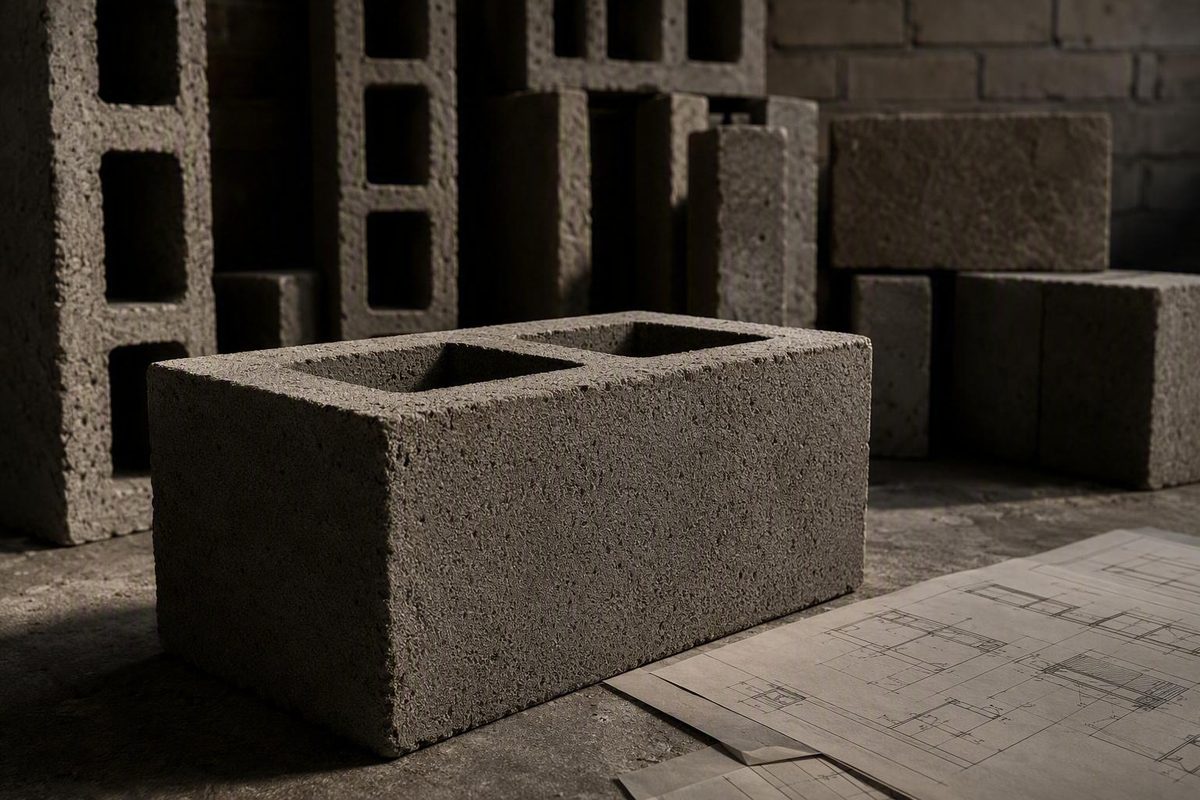
Its catalog label can identify a candidate by stated size, configuration, SKU, and listed weight, but it cannot establish actual dimensions, performance, structural suitability, or code compliance. Before selecting or approving a CMU, verify the exact product against current manufacturer data, configuration drawings, the applicable product specification, and relevant test reports.
What a concrete masonry unit label tells you
Names such as “standard,” “solid,” “bullnose,” “scored face,” and “bond beam” help distinguish entries in a seller’s inventory. A SKU can identify a listing more precisely when several products share the same size label.
Catalog identity and technical verification are different. A name or SKU may tell a supplier which item you mean, but it does not establish:
- Actual width, height, or length
- Dimensional tolerances
- Compressive strength
- Absorption, density, or moisture content
- Fire resistance
- Structural capacity
- Compliance with a product specification or building code
Product categories must also remain distinct. ASTM C140/C140M provides separate product-specific annexes for CMUs, concrete and calcium silicate brick, segmental retaining-wall units, interlocking paving units, grid paving units, roof pavers, and dry-cast articulating concrete block. Separate annex treatment should not be interpreted as evidence that these products are interchangeable.1
Kings Material provides one limited catalog example. Its four-inch CMU category contains 14 listings with size labels including 4x8x16, 4x8x12, 4x4x16, and 4x8x8. The category includes standard, solid, scored-face, bullnose, bond-beam, and IWR-labeled variants. Prices require sign-in, and the category page does not establish current stock, lead time, or availability.Kings Material’s four-inch CMU category
Common CMU sizes and configurations in a four-inch catalog
The following comparison reproduces the retailer’s catalog labels, supplied SKUs, and numerical weight entries. Every figure in the final column is a retailer-listed weight, and the retailer does not identify the unit of measurement. Do not assume the values are pounds, kilograms, or any other unit.
| Catalog size label | Catalog configuration | SKU where supplied | Retailer-listed weight; unit unstated |
|---|---|---|---|
| 4x8x16 | Standard | 10040000000 | 26.00 |
| 4x8x16 | Standard with IWR | 10040000030 | 26.00 |
| 4x8x16 | Solid standard | 10040010000 | 35.00 |
| 4x8x16 | One score, one face | 10040016000 | 26.00 |
| 4x8x16 | Single-bullnose listing 1 | — | 27.00 |
| 4x8x16 | Single-bullnose listing 2 | — | 27.00 |
| 4x8x16 | Double-bullnose variant | — | 28.00 |
| 4x8x16 | Bond beam | 10040025000 | 26.00 |
| 4x8x12 | Standard | — | 22.00 |
| 4x8x12 | Single bullnose | — | 23.00 |
| 4x4x16 | Standard | — | 13.00 |
| 4x8x8 | Standard | — | 14.00 |
| 4x8x8 | Bullnose listing 1 | — | 15.00 |
| 4x8x8 | Bullnose listing 2 | — | 15.00 |
The two single-bullnose 4x8x16 rows and two bullnose 4x8x8 rows represent separate retailer listings. The available evidence does not supply wording, orientation details, face designations, or SKUs that would distinguish the paired entries further.
These figures can help compare listings within this particular catalog, but they should not be generalized to similarly named CMUs from other manufacturers. Before using a weight for estimating, handling, transportation, or procurement, confirm the exact product, the measurement unit, and whether the value applies to one unit, a package, or another quantity.
The configuration names are also limited catalog descriptors. “Standard,” “solid,” “one score, one face,” “bullnose,” and “bond beam” may indicate visible or geometric differences, but the names alone do not prove structural function, strength, reinforcement arrangement, or suitability for a particular application. Those questions require manufacturer drawings and project-specific requirements.
The designation IWR should remain undefined unless the supplier or manufacturer explains it in documentation for the exact product. Assigning a meaning or performance benefit based only on the abbreviation would be unreliable.
Nominal labels are not verified actual dimensions
A label such as 4x8x16 may appear to provide three complete measurements, but the retailer does not state whether its labels represent nominal dimensions, actual dimensions, or another catalog convention. The label therefore should not be converted into exact physical measurements without supporting product documentation.
Actual dimensions are needed when coordinating:
- Wall thickness and overall layout
- Course heights and joint patterns
- Door, window, and service openings
- Corners, returns, and intersections
- Adjacent cladding, insulation, flashing, or framing
- Specialty-unit profiles and reinforcement clearances
Use dimensions for the exact manufacturer, product, and configuration rather than transferring measurements from a generic chart or similarly named unit.
Dimension verification
Before coordinating the work, request:
- Actual width, height, and length
- Applicable dimensional tolerances
- A current dimensional drawing, profile, or section
- The product specification governing the unit
For related reading, Isodomos lists “Concrete Block (CMU) Sizes: The Real Dimensions Behind the Names”, dated August 6, 2026. The supplied listing confirms the title and date, not the article’s technical details; manufacturer documentation remains necessary for the selected unit.
What ASTM C140/C140M testing can establish
ASTM C140/C140M provides sampling and testing methods for concrete masonry units and related concrete products. The characteristics addressed include dimensions, compressive strength, absorption, unit weight or density, and moisture content. It also covers flexural load and ballast weight for applicable products, although not every method applies to every unit type.
The cited historical edition places general requirements in the main body and product-specific testing and reporting provisions in annexes. Annex A1 addresses CMUs associated with ASTM C90 and ASTM C129; other annexes address the other concrete-product categories identified above. For products without a dedicated annex, the cited material directs users to seek more specific guidance from manufacturers, suppliers, product specifications, or other appropriate resources.
Appendix X1 of that edition provides a CMU worksheet and test report. The same material states that SI and inch-pound values are separate standards and should not be combined, and that testing laboratories should be evaluated in accordance with ASTM C1093. The detailed source is historical edition C140/C140M-17b, while ASTM identifies C140/C140M-26A as active. Requirements should not be assumed unchanged between editions; check which edition the project requires and confirm that submitted product data and laboratory reports cite it.ASTM C140/C140M-17b
A test-method standard explains how applicable characteristics are sampled, measured, tested, and reported. It does not by itself provide universal product acceptance limits, structural design rules, or proof that a particular catalog unit complies with ASTM C90, ASTM C129, or a building code.
That distinction affects how submittals should be reviewed:
- A catalog page identifies a seller’s product listing.
- A dimensional drawing establishes documented product geometry.
- A laboratory report provides results for identified samples under stated methods.
- A product specification sets applicable requirements.
- A compliance statement must connect the exact proposed unit and supporting results to those requirements.
A generic worksheet or report format cannot replace a complete submittal from the manufacturer or testing laboratory. The report should identify the tested unit, applicable methods, testing organization, dates, results, and standard editions so that reviewers can determine whether it corresponds to the proposed product.
CMU selection and submittal checklist
Use catalog information to create a shortlist, then verify each candidate systematically:
-
Identify the manufacturer and exact unit. Record the full product name, SKU or other identifier, and plant or production source where relevant. Check that drawings, data sheets, and reports refer to the same product.
-
Obtain actual dimensions. Do not coordinate construction solely from a label such as 4x8x16. Request actual width, height, length, tolerances, and a current drawing or profile.
-
Clarify every weight entry. Confirm the measurement unit and whether the value applies per unit, package, pallet, or another quantity. If density classification matters, request it directly rather than inferring it from weight or from the word “solid.”
-
Request the governing product specification. Identify the specification and edition applicable to the exact unit. A reference to ASTM C140/C140M establishes a test-method context; it does not independently prove compliance with a separate product specification.
-
Obtain a current test report. Confirm that the report identifies the tested unit, production source where applicable, methods, dates, results, standard editions, and testing organization. Verify that the tested product corresponds to the proposed product.
-
Review project geometry. Check the project drawings and specifications for face treatment, edge profile, scoring, finish, reinforcement accommodation, openings, corners, returns, and other required characteristics.
-
Verify required performance. When relevant to the project, request documented strength, absorption, density, moisture, fire-resistance, and compliance information. Do not infer these properties from configuration names.
-
Resolve unexplained terminology. Ask the manufacturer or supplier to define IWR and any other abbreviation in writing for the exact product.
-
Confirm purchasing terms. Obtain a current quotation covering price, quantity, stock, lead time, delivery area, freight, minimum order, packaging, and return conditions. Kings Material requires users to sign in to view the cited category’s prices, and its catalog page does not establish availability.Kings Material’s catalog
Use this decision table to match each selection question with the evidence needed:
| Selection question | Evidence to request |
|---|---|
| What are the unit’s dimensions? | Current dimensional drawing with actual dimensions and tolerances |
| Does it meet required performance? | Current test report tied to the exact product |
| Does it comply with the project requirement? | Applicable product specification and edition, plus documented compliance |
| Does the specialty shape fit the detail? | Manufacturer profile and configuration drawings |
| Can it be purchased on the required terms? | Current quotation covering price, quantity, stock, and delivery |
A concrete masonry unit should ultimately be selected using verified dimensions, configuration drawings, current product specifications, and applicable test reports—not from a size label or product name alone. Confirm commercial terms separately before ordering.