
Type N Mortar: Uses, Strength and Mix Proportions
Type N mortar has a 750 psi laboratory strength minimum. Learn its uses, a common 1:1:6 mix, packaged mixing and limits for historic repairs.
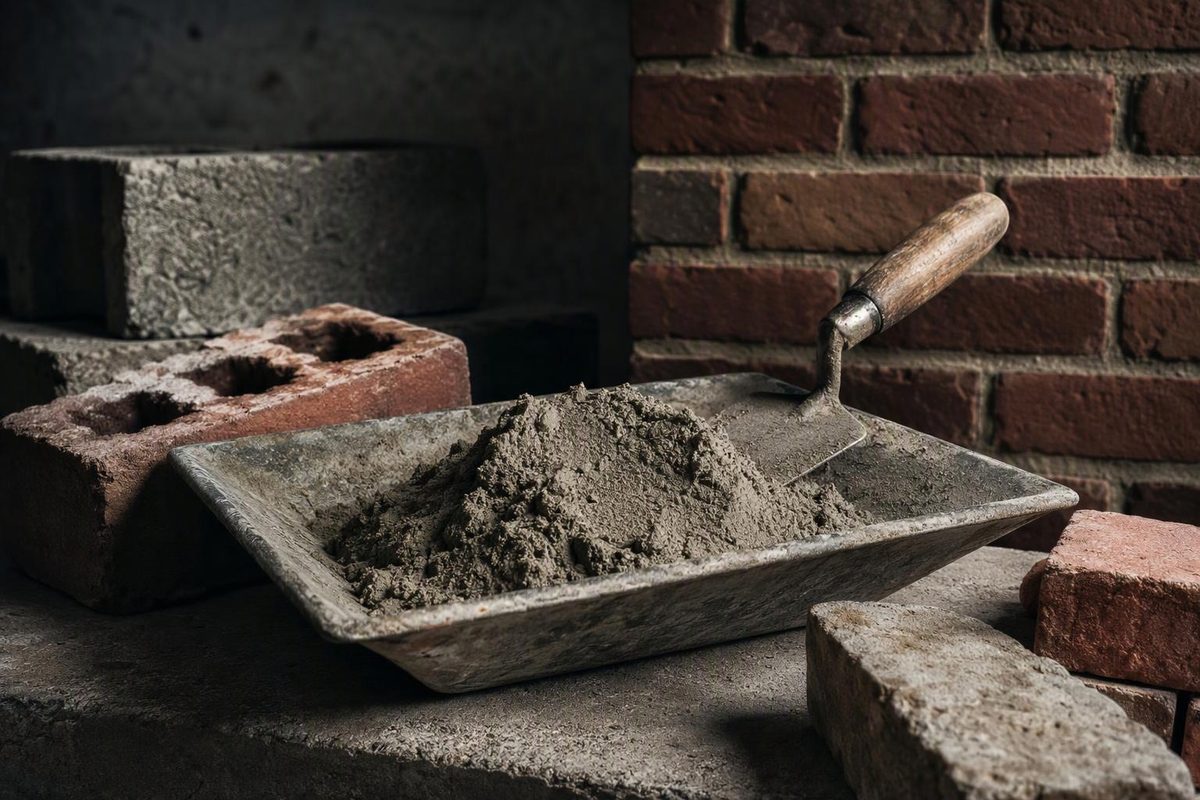
Type N mortar is a general-purpose masonry mortar commonly selected for normal above-grade brickwork, including most anchored brick veneer. It offers good bonding capabilities and workability. Brick Industry Association, Technical Note 8B
Under the ASTM C270 property specification, its minimum average compressive strength at 28 days is 750 psi (about 5.2 MPa) for laboratory-prepared mortar. The designation is not a wall load rating. BIA Technical Note 8, Table 2
Where Type N fits
Mortar selection depends on the units, exposure, structural requirements and compatibility—not simply which mix has the highest compressive strength. BIA recommends choosing the lowest-strength mortar that meets the project requirements. Its brickwork guidance distinguishes these applications: BIA Technical Note 8B, Table 1
| Brickwork application | Place of Type N in BIA guidance |
|---|---|
| Exterior above-grade veneer or non-loadbearing walls | Recommended type |
| Exterior above-grade reinforced or loadbearing walls | Alternate to recommended Type S; verify the design requirements |
| Exterior parapets and chimneys | Recommended type, with Type S as an alternate |
| Interior loadbearing walls and partitions | Recommended type |
| Foundation and retaining walls at or below grade | Not the recommended choice; BIA lists Type M, with Type S as an alternate |
These are selection recommendations, not permission to substitute for a specified mortar. High wind, seismic demands and particular unit properties can change the selection. BIA Technical Note 8B Packaged Type N products are also sold for laying concrete block and stone, but that intended use does not establish suitability for every wall or stone. QUIKRETE Mortar Mix product data
Type S has a higher laboratory compressive-strength minimum—1,800 psi (12.4 MPa)—but higher strength alone does not make it a better replacement for Type N. BIA Technical Note 8, Table 2 For the wider comparison, see masonry mortar Types M, S, N and O.
What the 750 psi figure means
ASTM C270 provides two separate routes to compliance:
- Proportion specification: use approved materials in prescribed volumetric proportions.
- Property specification: establish a mix through laboratory testing for compressive strength, water retention and air content, then follow the established proportions in construction.
The 750 psi minimum belongs to the second route. Do not apply it as a pass/fail threshold to field-sampled mortar or interpret it as the compressive strength of the completed wall. CMHA explains that field mortar testing primarily evaluates consistency, and its results are not directly comparable with ASTM C270 laboratory property requirements. CMHA, Masonry Mortar Testing
Type N mix proportions
A common cement-lime Type N mix is 1:1:6 by volume:
| Ingredient | Parts by volume |
|---|---|
| Portland cement | 1 |
| Hydrated masonry lime | 1 |
| Mortar sand | 6 |
This is one permitted proportion, not the only Type N formulation. BIA’s ASTM C270 proportion table allows more than ½ up to 1¼ parts lime per part cement, with sand measured in damp, loose conditions at 2½ to 3 times the combined separate volumes of cementitious materials. With one part cement and one part lime, six parts sand is the upper end of that sand range. BIA Technical Note 8, Table 1
Type N mortar does not mean Type N hydrated lime. For cement-lime masonry mortar, BIA recommends Type S hydrated lime complying with ASTM C207. The mortar classification and lime classification describe different materials. BIA Technical Note 8
Before mixing a bagged product, identify what it contains:
- Type N masonry cement: a binder to be mixed with the specified sand and water—not a complete sanded mortar. BIA Technical Note 8
- Preblended, sanded Type N mortar mix: already contains sand; follow its water-only mixing instructions. QUIKRETE product data
For example, QUIKRETE’s No. 1102 data sheet specifies approximately 5 US quarts (4.7 L) of clean water per 80 lb (36.2 kg) bag, at least 5 minutes of mixing, and small water adjustments to reach a firm, workable consistency. Those quantities are product-specific, not a universal Type N recipe. Follow the instructions and safety precautions for the exact product; this data sheet calls for impervious gloves, such as nitrile, when handling it. QUIKRETE product data
Is Type N suitable for repointing?
Type N may suit newer brickwork, but it is not an automatic choice for old brick or stone. BIA identifies compatibility with the existing masonry and mortar as the principal concern in repointing. BIA Technical Note 8B
For historic masonry, the National Park Service calls for replacement mortar that is softer and more vapor-permeable than the units, and as soft or softer and as vapor-permeable as the historic mortar. A bag marked “Type N” does not establish those qualities for a particular building. Identify the existing materials and correct the source of deterioration before choosing the repair mix. NPS Preservation Brief 2
Mortar type also does not specify the finished joint shape. For tooling and rain-shedding profiles, see mortar joint types.