
Terracotta Bricks: Material, Sizes and Suitable Uses
Distinguish fired-clay brick, architectural terra-cotta and terracotta-coloured concrete; check dimensions, mortar joints and intended use.
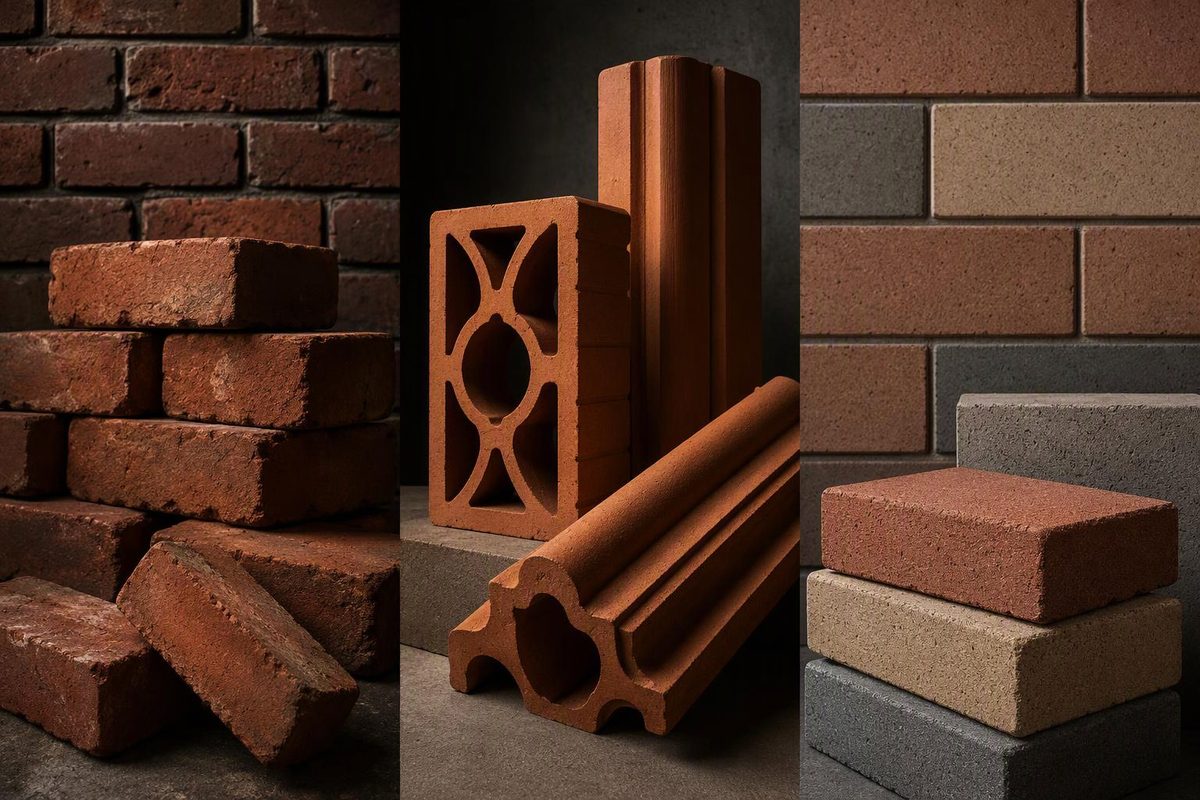
“Terracotta bricks” is not a complete material specification. The term may refer to fired-clay masonry, architectural terra-cotta, or simply a terracotta-coloured product. Confirm the base material, unit dimensions and intended application before choosing mortar or estimating quantities.
The distinction is practical: Marshalls’ UK product Pembridge Terracotta, for example, is a red concrete facing brick—not fired clay. Its manufacturer datasheet, dated March 2024, identifies vibro-compacted pressed concrete manufactured and tested to BS EN 771-3.
Which kind of unit is it?
In architectural usage, terra-cotta is molded and fired clay. It is not necessarily orange-red: the National Park Service describes clay bodies ranging from red and brown to white, with glazes providing additional colours and stone-like finishes. Historic architectural units were commonly hollow, open-backed blocks with internal stiffening webs. See Preservation Brief 7.
| Product being described | What to verify | Construction implication |
|---|---|---|
| Full-depth fired-clay facing brick | Clay/shale material declaration, dimensions, applicable brick standard and exposure classification | It may serve in structural or nonstructural masonry, including veneer; the wall design establishes its role. |
| Thin clay brick or brick slip | Thickness, substrate and specified installation system | It is a finish, not a substitute for a full-depth masonry unit. |
| Historic architectural terra-cotta | Profile, glaze, hollow sections, bedding and anchors | Replacement must account for the unit’s construction and attachment, not only its visible colour. |
| Modern terracotta façade tile | Manufacturer’s support, fastening and water-control details | It may be a mechanically fastened rainscreen rather than mortar-laid brickwork. |
The brick distinctions follow BIA Technical Note 9A; historic terra-cotta construction is described in the NPS brief. As a modern example, Glen-Gery’s SK1N system uses fired-clay tiles fastened to horizontal furring over an air/water-control membrane. It requires a weather-resistant structural wall behind it.
Dimensions: include the mortar joint
There is no single dimension to order under the label “terracotta brick.” For mortar-laid brick, distinguish:
- Specified dimensions: the intended manufactured size used in specifications and purchase orders.
- Actual dimensions: measurements of the manufactured unit, subject to permitted tolerances.
- Nominal dimensions: for modular brick, the specified unit dimension plus the intended mortar joint.
These definitions come from BIA Technical Note 10.
For example, a US modular clay brick can be specified as 3⅝ × 2¼ × 7⅝ in.—width × height × length—or approximately 92 × 57 × 194 mm, as shown in Technical Note 10. Its 7⅝-in. length plus a ⅜-in. head joint gives an 8-in. horizontal module. The 8-in. figure is not the measured brick length. Bed-joint thickness and vertical coursing must also be stated; see the modular brick dimensions guide.
For existing work, measure several units and the joints separately. Record the bond, course heights, finished faces and any corner or special shapes before requesting a match.
Match the product to its exposure and use
For US fired-clay facing brick within its solid-unit scope, ASTM C216-26 covers structural or facing components and classifies resistance to freezing damage into Grade SW and Grade MW. Hollow brick has a separate specification, ASTM C652, as identified in BIA Technical Note 9A. Colour does not establish compliance. Request documentation for the exact product and the grade required by the project specification.
Do not assume a facing brick is also a paving or firebox brick. BIA lists separate specifications for facing brick, thin veneer, pedestrian paving and residential firebox brick in Technical Note 9A. Nor should fired-clay detailing recommendations automatically be transferred to terracotta-coloured concrete: BIA explicitly limits its Technical Notes to fired-clay products.
For historic glazed terra-cotta, spalling, missing units or loose projecting pieces require investigation of the whole assembly. The NPS brief identifies water entry, deteriorated mortar and corroding metal anchors as significant failure mechanisms; loose units can present a falling-material hazard. Seek prompt professional assessment of loose projecting pieces. Repointing alone does not establish that concealed anchors are sound; a colour-matched brick alone does not establish a suitable replacement.