
Premixed Mortar: Dry Bags, Ready-to-Use Products and Uses
Distinguish dry preblended masonry mortar from ready-to-use tile adhesives and repair compounds, then check type, compatibility and mixing instructions.
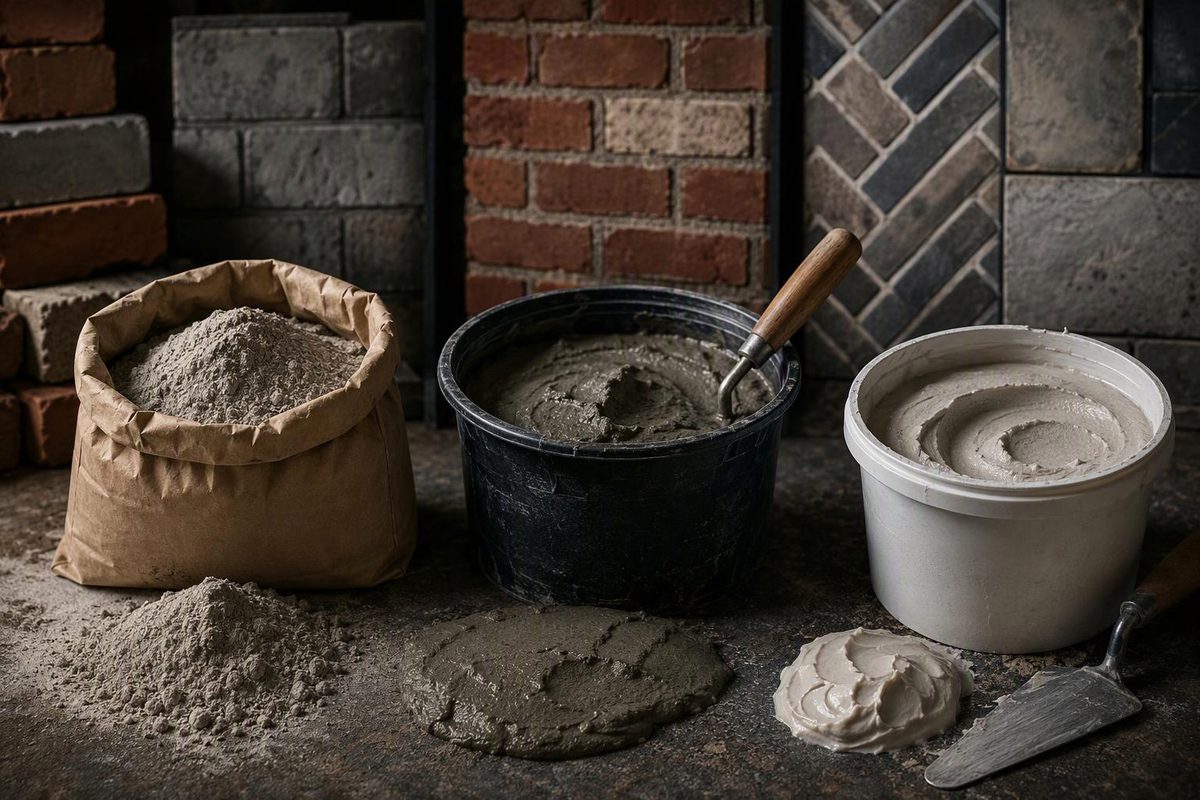
For laying brick or concrete block, choose a masonry mortar of the specified type—not simply a product labeled “premixed mortar.” A dry preblended masonry mix already contains its binder and sand but still needs water. A ready-to-use tile adhesive or acrylic joint-repair compound serves a different purpose.
What the packaging may contain
These products illustrate why similar wording does not establish interchangeability:
| Product category | Preparation | Intended work and important limits |
|---|---|---|
| Dry preblended masonry mortar | Add the specified amount of water and mix | Bedding masonry units in mortar joints; verify the required mortar type. QUIKRETE Mortar Mix No. 1102 is a sanded product for laying brick, concrete masonry units and stone. Its standard formulation meets ASTM C270 and ASTM C1714 as Type N mortar. Product data |
| Ready-to-use tile adhesive sold as premixed mortar | No water mixing required | Tile installation within the product’s stated limits. MAPEI Premium Mortar is not permitted outdoors, in submerged applications or over waterproofing membranes. Manufacturer guidance |
| Acrylic mortar-repair compound | Apply from a tube | Sealing cracks and mortar joints. QUIKRETE Mortar Repair No. 8620 is textured to resemble masonry mortar; it is not for structural repair of badly damaged walls or for control/expansion joints. Product data |
The table is not a rule that every wet product has the same limitations. Check the exact formulation and approved application rather than judging by a bag, bucket or tube.
Choose the mortar type separately
For US unit masonry, ASTM C270 classifies mortars as Types M, S, N and O. ASTM C1714 addresses factory-preblended dry mortar mixes for unit masonry. The Brick Industry Association explains that C1714-compliant preblended mixes also comply with C270; factory blending supplies consistent proportions without on-site batching of individual ingredients. BIA Technical Note 8B
Neither “premixed” nor “contractor grade” tells you which type the wall needs. BIA recommends Type N for normal brickwork, including most anchored veneer, but advises selecting the lowest compressive-strength type that meets the project requirements. Unit compatibility, exposure, workability and structural requirements matter; stronger mortar is not automatically better. See the masonry mortar types comparison for the distinctions between M, S, N and O. BIA selection guidance
For repointing older brickwork, do not select a standard bag solely because it is convenient. BIA identifies compatibility with the existing brick and mortar as the primary consideration and notes that ASTM C1713 may be appropriate for historic masonry rather than C270. BIA repointing guidance
Mixing a dry preblended bag
Follow the instructions for the exact product and bag size. Do not apply one brand’s water ratio to every packaged mortar.
As a product-specific example, QUIKRETE No. 1102 calls for approximately 5 US quarts (4.7 L) of clean water per 80 lb (36.2 kg) bag initially. Add the dry mix slowly to the water and mix for at least 5 minutes. If necessary, add small amounts of water to reach a firm, workable consistency. Its data sheet says the maximum water content is expected to be below 6 US quarts (5.7 L) per 80 lb bag. The instructions also require impervious gloves. Mixing instructions
A complete sanded mix is not a bag of cement awaiting a sand addition. Keep the specified formulation intact, and use admixtures only when approved by the specifier. Consistent water quantities, mixing time and finishing also help control mortar color. BIA mixing requirements; QUIKRETE precautions
Before buying, confirm the product’s intended application, mortar type, standards claim, bag size and published yield. For quantities, use the selected manufacturer’s coverage assumptions rather than treating all bags as equivalent; the brick mix mortar guide explains estimates from published yield.