
Control Joint vs Expansion Joint in Masonry
Compare control and expansion joints in masonry: movement, materials, construction details, and why slab saw cuts are not wall joints.
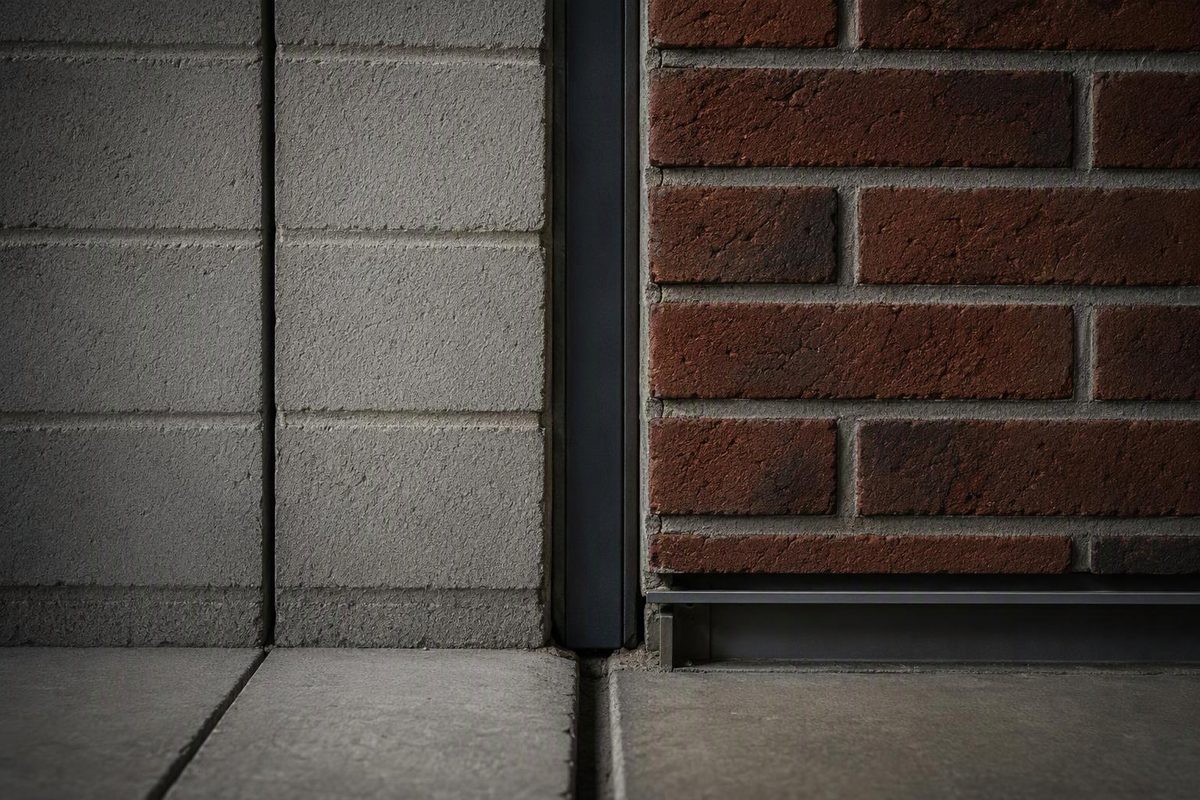
A control joint allows concrete masonry to shrink; an expansion joint leaves room for clay-brick masonry to expand. Both divide masonry into panels to reduce cracking from restrained movement, but their details are not interchangeable. Concrete masonry generally undergoes net shrinkage over time, while clay brick generally expands. Both also move with temperature changes. These are long-term tendencies—not a claim that either material moves in only one direction. CMHA, Crack Control Strategies for Concrete Masonry Construction
The main differences
| Feature | Control joint in concrete masonry | Expansion joint in clay-brick masonry |
|---|---|---|
| Primary purpose | Reduce restraint and accommodate shrinkage | Accommodate expansion without building up compressive stress |
| Typical material | Concrete block (CMU), concrete building brick and concrete facing brick | Fired-clay brick |
| Expected long-term joint movement | Tends to widen as masonry shrinks | Tends to close as masonry expands |
| Basic construction | A vertical bond break through the masonry wythe, with detailing that permits movement | A continuous, unobstructed opening through the brick wythe, optionally containing highly compressible filler |
| Orientation | Generally vertical in CMU walls | Vertical between wall panels; horizontal at locations such as below shelf angles |
| Exposed surface | Commonly sealed with sealant over backer rod | Commonly sealed with sealant over backer rod |
These distinctions follow CMHA’s concrete-masonry guidance and BIA Technical Note 18A, Accommodating Expansion of Brickwork. “Brick” describes a unit form, not necessarily its material: concrete brick belongs with concrete-masonry crack-control guidance, not automatically with clay-brick expansion-joint guidance.
A wall control joint is not a slab saw cut
In cast concrete, a control joint is commonly a partial-depth cut or formed indentation that encourages a shrinkage crack to occur along a planned line. In a CMU wall, it is a vertical gap or bond break through the wythe—a single layer of masonry units. A shallow groove in the wall face is not the equivalent detail. BIA Technical Note 18A
A masonry movement joint also differs from an ordinary mortar joint and its tooled profile. Changing the visible profile does not create the separation needed for movement.
What each detail must preserve
For a CMU control joint, preserve longitudinal movement while providing any required load transfer. Details may use preformed gaskets, shear keys or sleeved/debonded dowels. Horizontal reinforcement is generally discontinued at the joint unless required for structural purposes; some structural bond beams must remain continuous. Do not cut reinforcement simply because a drawing labels a joint “CJ”—the structural detail governs. CMHA, section 3.3
For a clay-brick expansion joint, preserve space for the gap to close. Mortar, ties or wire joint reinforcement bridging the opening can restrain movement. BIA describes highly compressible foam or neoprene filler and warns that fiberboard and similar, less-compressible materials are unsuitable for that purpose. Exterior sealant and backer rod control water and air entry without replacing the movement space. BIA Technical Note 18A
Joint width and spacing are separate design decisions. For brickwork, BIA relates them to anticipated movement, restraint, construction tolerances and the movement capacity of the sealant, backing and filler. Do not select the width solely to match a neighboring mortar joint or apply one spacing rule to both materials. BIA Technical Note 18A For placement guidance, see brick expansion joints.
When brick and block share a wall
A clay-brick veneer over CMU backing combines materials with different movement tendencies. A control joint in the backing does not automatically determine an expansion-joint location in the veneer. CMHA distinguishes rigidly bonded finishes, through which control joints should extend, from anchored veneers with flexible ties, whose movement needs are considered separately. CMHA, section 3.3
Finally, a building expansion joint is a different-scale separation: it extends through the wall assembly, other envelope components and underlying structure. A movement joint in one masonry wythe is not a substitute for it. BIA Technical Note 18A