
Breeze Blocks vs Concrete Blocks: Names, Uses and Sizes
“Breeze block” may mean a UK lightweight building block or a decorative screen unit. Compare dimensions, structural roles, standards, and uses.
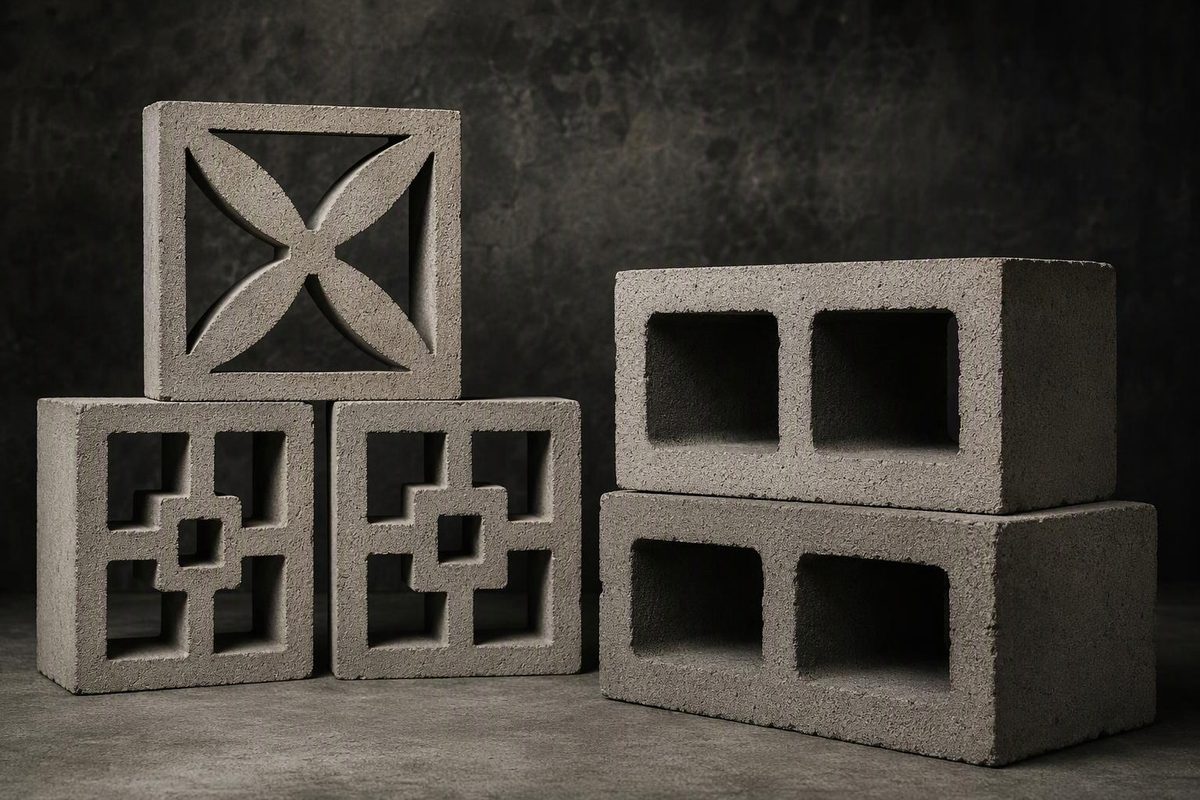
Concrete block is the broad material category; breeze block is an informal, region-dependent name. In traditional UK usage, it means a lightweight concrete building block. In some North American catalogs, it means an open-pattern decorative screen block. The name alone does not establish strength, dimensions or whether the unit can carry structural loads.
Choose what you are building; the comparison identifies the appropriate block type and checks.
Match the Name to the Intended Wall
Select the wall type. The cards retain the dimensions and limitations that must be checked against product data.
Concrete Block or CMU
UK Lightweight Block
Decorative Screen Block
Sources: Cambridge Dictionary, The Concrete Centre, CMHA guidance, Angelus product data and Modern Masonry Alliance. Examples are market- or manufacturer-specific, not universal sizes.
Why “Breeze Block” Is Ambiguous
The traditional British definition is material-based. Cambridge defines a breeze block as a light concrete building unit made with burned coal and gives cinder block as the US equivalent (Cambridge Dictionary).
Current UK block production is broader than that historical definition. Concrete blocks are divided into aggregate blocks and aircrete blocks, while aggregate products may be ultra-lightweight, lightweight or dense. Lightweight aggregates can include expanded clay, pumice, shale, slag and furnace ash. A modern lightweight block therefore need not contain the coal cinders implied by the older name (The Concrete Centre).
In North America, breeze block also appears as a catalog name for decorative screen block. CMHA describes screen walls as open assemblies used for privacy, diffused shade and space division. It also notes that screen units are produced in an extensive range of shapes and sizes (CMHA unit guide).
That gives the term at least two materially different meanings:
- A closed-face lightweight building block in traditional UK usage.
- An open-pattern decorative concrete unit in some North American catalogs.
Neither meaning should be assumed without checking the product literature and project jurisdiction.
Lightweight, Aircrete and Dense Blocks Are Different Products
A lightweight block can still be a concrete block, but lightweight aggregate, aircrete and dense aggregate units are not interchangeable.
Lightweight aggregate block contains cement and low-density aggregate. The aggregate may be expanded clay, pumice, shale, slag, furnace ash or another specified material.
Aircrete, commonly autoclaved aerated concrete, contains deliberately formed air pores rather than coarse aggregate. It is not simply another name for a cinder or lightweight aggregate block.
Dense aggregate block uses denser aggregate where greater mass or other specified properties are required.
Low weight does not automatically mean nonstructural. One UK manufacturer, for example, markets sub-20 kg lightweight aggregate blocks as loadbearing and supplies different strengths for different applications (Thomas Armstrong). That example applies to the manufacturer’s declared products, not to every lightweight block.
Product data and the wall design—not the nickname—determine suitability. A specification should identify the unit type, declared strength, density, dimensions and intended application.
Product Compliance Does Not Make Every Wall Loadbearing
In the US, ASTM C90 is the standard specification for loadbearing concrete masonry units. It covers hollow and solid units. CMHA notes that C90 units may be used in loadbearing or nonloadbearing applications and reinforced where design loads require it (CMHA).
A decorative screen unit can meet that product standard. Angelus, for example, lists 4 × 12 × 12 in. breeze-block screen units and states that its units meet ASTM C90 (Angelus data sheet). This does not establish that a wall assembled from those units can carry floors, roofs or other building loads.
CMHA’s screen-wall guidance addresses predominantly nonloadbearing assemblies. Because their faces contain substantial open area, these walls must resist applicable wind and seismic forces through reinforcement, limited spans, anchorage or a separate support system. Loadbearing screen walls require an applicable engineering analysis (CMHA screen-wall guidance).
The distinction is between the unit and the completed assembly:
- Unit compliance describes the manufactured masonry product.
- Wall design establishes load paths, reinforcement, grout, mortar, foundations, allowable spans and lateral support.
Do not substitute a decorative breeze block for specified structural CMU—or structural CMU for a decorative unit—because their outside dimensions appear similar.
Actual Dimensions and Installed Modules Are Not the Same
In US CMU work, an 8 × 8 × 16 in. unit describes a common nominal face module. The unit itself is typically specified 3/8 in. smaller in each direction. A 3/8 in. mortar joint brings the masonry back to the nominal module.
CMHA lists common nominal CMU thicknesses from 4 to 16 in., while noting that shapes and availability vary locally (CMHA). See nominal and actual CMU sizes for the dimensional convention.
For UK general building work, a common block has actual dimensions of 440 × 215 × 100 mm. With 10 mm joints, its face coordinates to a 450 × 225 mm module. Other widths and face sizes are available. Proprietary thin-joint aircrete systems may use 2–3 mm joints (Modern Masonry Alliance).
Decorative breeze blocks have no universal module. A published 4 × 12 × 12 in. product establishes only that manufacturer’s format, not a standard size for all screen blocks. Confirm whether catalog dimensions are actual or nominal, then include the specified mortar joint. See breeze-block dimensions for worked examples.
Specify the Unit and the Complete Wall Assembly
Using breeze block as the controlling product description leaves too many variables unresolved. An order or project specification should record:
- Jurisdiction and governing standard: Include the edition referenced by the code or project specification.
- Unit type: State whether the product is dense aggregate, lightweight aggregate, aircrete, conventional hollow CMU or decorative screen block.
- Intended use: Identify a loadbearing wall, partition, cavity-wall leaf, exterior screen or interior divider.
- Dimensions: Record actual width, height and length, mortar-joint thickness and the resulting installed module.
- Declared properties: Include compressive strength, density or weight classification, absorption and exposure suitability where required.
- Assembly details: State the bond, mortar, reinforcement, grout, supports, movement joints, foundations and connections.
- Handling and appearance: Record unit weight, finished faces, color range and an approved sample for exposed work.
For structural or enclosure work, specify the exact block or CMU rather than relying on a regional nickname. For an open patterned wall, specify the screen unit and its complete supported assembly. Breeze block remains useful as a search term or informal description, but it is not a complete technical specification.