
What Are Bricks Made Of? Clay, Shale & More
Water and sometimes sand or other additions may be used in ordinary fired brick; exact materials differ for mudbrick, concrete brick, and other units.
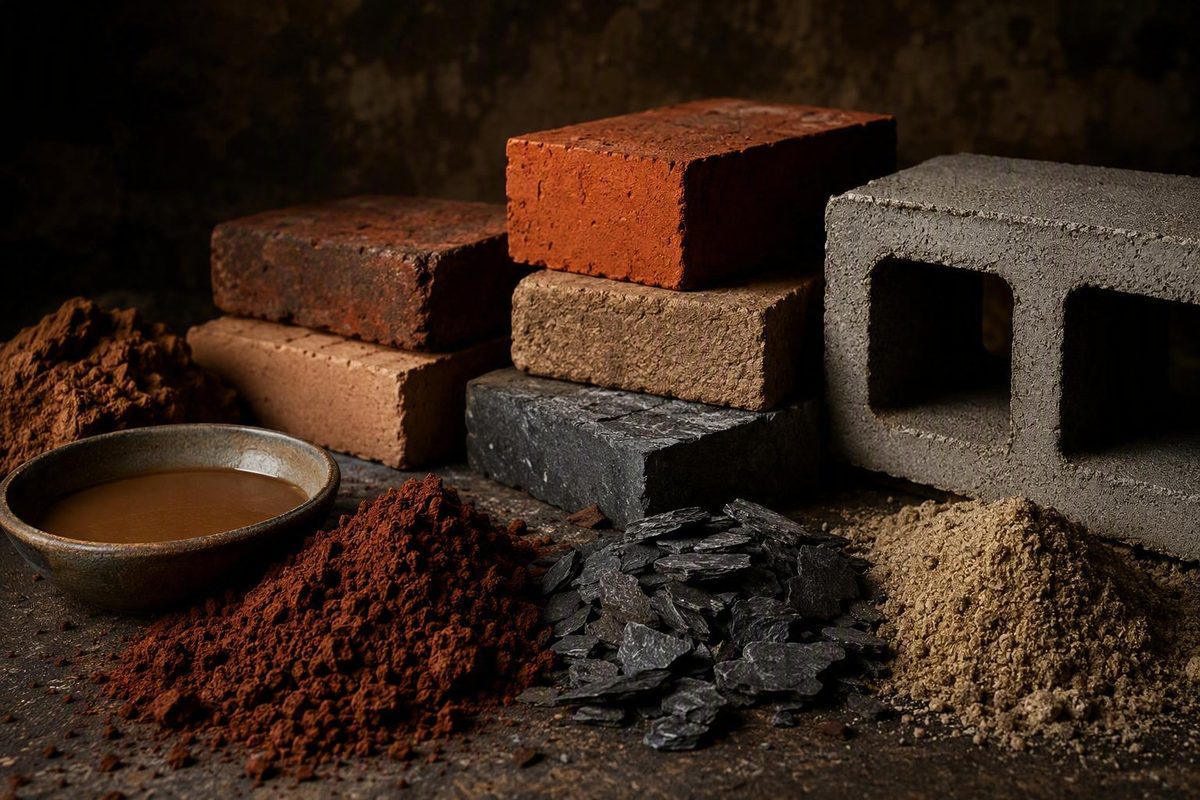
Most conventional fired bricks are made primarily from clay or shale mixed with water. Sand and formulation-specific additives may also be included. The mixture is shaped, dried, and kiln-fired until it becomes a hard ceramic material. Mudbricks, concrete bricks, and other masonry units use different materials and manufacturing processes.
The short answer: most bricks are made from clay or shale
An ordinary building brick is usually a fired-clay product. Clay or shale forms its main body, while water makes the prepared material workable enough to shape. Sand may be mixed into some formulations or applied to the surface, but it is not a universal ingredient.
For a standards-based example, ASTM C216 covers facing brick described as solid masonry units made from clay or shale, as identified in ASTM Committee C15’s masonry fact sheet.
There is no single recipe for every fired brick. Manufacturers may blend raw materials to obtain suitable forming and firing characteristics.
The word brick is also used more loosely for masonry units that are not made from fired clay. A precise answer therefore depends on whether the product is a fired-clay brick, mudbrick, concrete brick, or another type of masonry unit.
Brick ingredients: body materials, additives, and finishes
It helps to distinguish the materials that form the brick body from optional additions and surface treatments.
| Category | Examples | Role or limitation |
|---|---|---|
| Basic body materials | Clay or shale; water | Clay or shale forms the ceramic body. Water aids mixing and shaping; controlled drying removes excess moisture. |
| Material that may be included | Sand | May be incorporated into a formulation or applied to the surface; it is not present in every brick body. |
| Formulation-specific additions | Grog, ash, sawdust, lime, iron oxide, magnesia | Used only in certain recipes. Sawdust may serve as a burnout material and may be consumed during firing. |
| Surface finishes | Surface sand, engobes, coatings, ceramic glazes | Add color or texture but are distinct from the primary body material. A ceramic glaze is fused to the body of glazed brick. |
Brickmaking clays principally contain silica and alumina, together with varying metallic oxides. These constituents influence how the body behaves during firing and can affect its finished color.
Optional materials should not be treated as a checklist for every brick. Some formulations may include grog or ash. Sawdust may be introduced as a burnout material rather than remain in the finished product. Lime, iron oxide, and magnesia may also occur where a particular raw-material blend or product calls for them.
Surface treatments require a separate distinction. Sand can be applied to a brick face, while engobes, coatings, and glazes can produce particular colors or textures. These treatments do not necessarily describe what makes up the underlying brick body. The Brick Industry Association’s technical guide to clay-brick manufacturing discusses body materials, forming, firing, coatings, sand finishes, and glazes.
Because raw materials and formulations differ, a universal list of ingredient percentages would be misleading. For a particular product, the manufacturer’s technical documentation is the more appropriate source.
How clay and shale become fired brick
A typical fired-clay brick passes through four main stages:
-
Prepare and mix the raw materials. Clay, shale, or a blend is crushed or ground, screened or cleared of unwanted material as needed, and mixed with water. Sand or other additions may be introduced according to the formulation.
-
Form the units. The prepared mixture is shaped by extrusion, molding, or dry pressing. These are forming methods rather than completely different ingredient recipes. Extrusion pushes a workable column of material through a die before it is cut into units; molding and dry pressing form individual units by other means.
-
Dry under controlled conditions. Newly formed bricks contain excess moisture. Gradual, controlled drying removes that moisture and helps reduce the risk of cracking during firing.
-
Fire and cool. The dried units enter a kiln and are subsequently cooled. Kiln heat causes partial vitrification: components within the clay body react and begin to fuse, transforming the formed material into a hard ceramic mass.
These steps describe fired-clay brick production.
Not every brick is a fired-clay brick
A rectangular shape does not establish what a masonry unit contains. The specific material name matters because different products may be fired, dried, or cured in fundamentally different ways.
| Product or material system | Main materials | How it hardens |
|---|---|---|
| Fired-clay brick | Clay or shale, water, and sometimes sand or other additions | Formed, dried, kiln-fired, and cooled |
| Mudbrick | Clay-bearing earth or mud, sometimes with straw | Air- or sun-dried rather than kiln-fired |
| Other manufactured masonry systems | Concrete, calcium-silicate, or autoclaved aerated concrete | Manufactured and cured using processes specific to the material |
Mudbrick is made from clay-bearing earth or mud and may contain straw. Unlike conventional fired brick, it is dried without kiln firing.
ASTM Committee C15’s scope includes manufactured masonry units formed from fired clay and shale, concrete, calcium-silicate, and autoclaved aerated concrete. The committee also addresses brick and structural clay tile separately from concrete masonry units and other material systems, according to the ASTM Committee C15 scope. This broad scope does not mean every unit made from those materials is technically classified or marketed as a brick.
The clearest terminology rule is to use the product’s specific name: fired-clay brick, mudbrick, concrete brick, or concrete masonry unit. An ordinary fired brick is mainly clay or shale and water, sometimes with sand or other additions, but the exact material list depends on the type of brick.