
Can Desert Sand Be Used to Make Bricks? DuneCrete Facts
See why wind-polished dune sand fails in standard brick mixes, how DuneCrete changes the binder, and what strength and approval evidence exists.
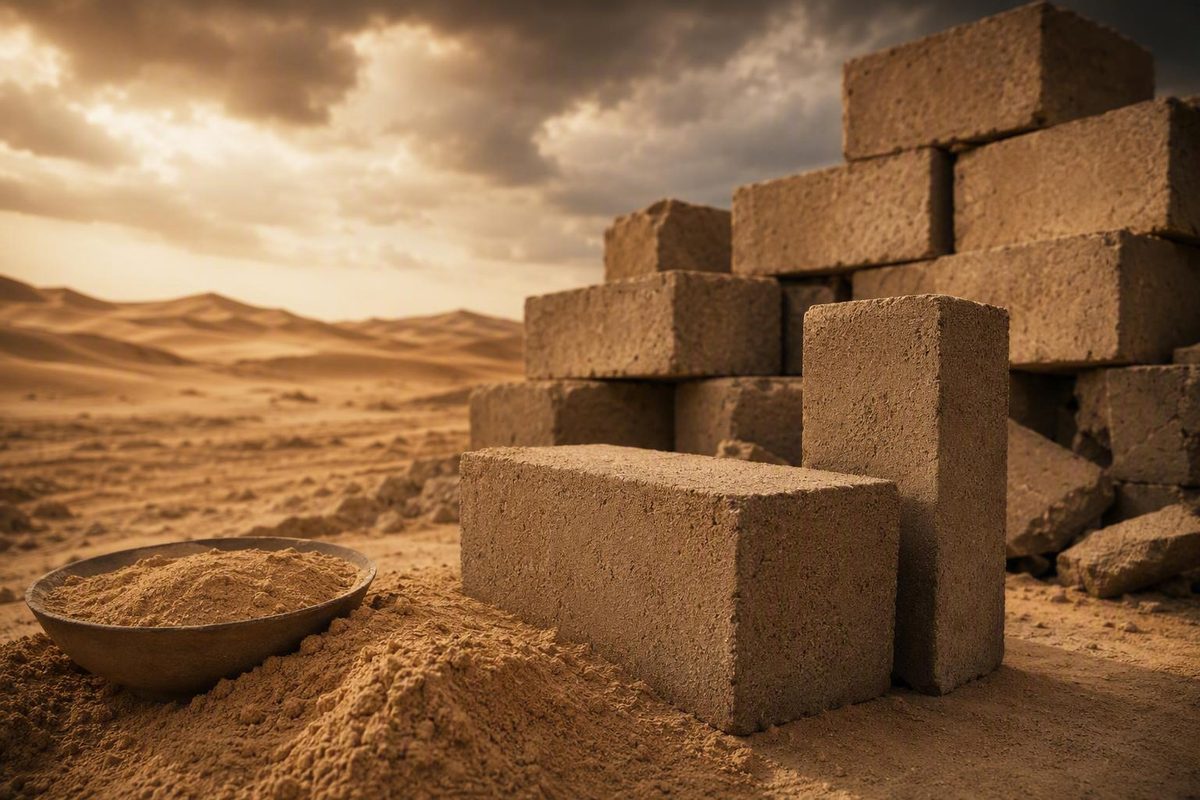
Can desert sand be used to make bricks? Yes, but dune sand is not a drop-in replacement for river or manufactured sand. Its fine, rounded, wind-polished grains usually require a redesigned binder, controlled grading, compaction, or pressure-and-heat treatment. DuneCrete is a current commercial example: its developer reports architectural blocks and pavers with about 5,660 psi compressive strength and up to 50% less cement, but the complete formulation and unrestricted structural approval are not public.
Choose an application and cement-reduction claim; the tool compares sand types and shows what the published figures do—and do not—prove.
Compare aggregate characteristics, filter by intended use, and test what can be concluded from DuneCrete’s published cement-reduction claim.
| Sand Type | Typical Grain Character | Fineness | Grading | Direct Use in Ordinary Mix | Best-Supported Route |
|---|---|---|---|---|---|
| River sand | Rounded to subangular; deposit-dependent | Variable | Can be selected and graded for construction | Generally suitable when compliant | Conventional tested concrete or mortar mix |
| Crushed manufactured sand | Angular, rough crushed surfaces | Controlled but process-dependent | Can be manufactured to a specified distribution | Generally suitable when compliant | Designed conventional mix with fines control |
| Beach sand | Rounded; source-dependent | Variable | Variable | Conditional; salts and contamination require assessment | Characterization, processing, and project-specific testing |
| Dune sand | Fine, rounded, smooth, wind-polished | Commonly very fine | Often narrow or unfavorable for a direct substitution | Poor one-for-one substitute | Modified binder, blended grading, compaction, alkali activation, or autoclaving |
Sources: ARDH Collective and cited DuneCrete coverage; University of Sharjah and ASCE alkali-activated research; peer-reviewed Xinjiang autoclaved-brick study. ~ marks an approximate reported value; — marks unavailable public data.
The term “brick” needs qualification. A fired-clay brick is different from a cement-based brick, autoclaved sand-lime unit, perforated breeze block, or facade element. Each uses different manufacturing methods and may fall under different tests and building-code provisions.
Desert sand has been used in laboratory bricks, concrete prototypes, marketed breeze blocks, pavers, and reported installations. In every credible example, it acts as aggregate or mineral feedstock inside an engineered system. The sand does not bind itself into a durable unit.
Why Dune Sand Is Not a Direct Aggregate Substitute
Wind transport repeatedly moves and abrades dune grains. Dune deposits are therefore commonly dominated by fine, smooth, rounded particles. Conventional masonry aggregate is selected for a suitable distribution of particle sizes and surface characteristics.
Rougher grains can provide greater mechanical interlock. A well-graded aggregate also lets smaller grains occupy spaces between larger ones. Fine, narrowly graded sand can increase the binder paste needed to coat particles and fill voids, while affecting compaction and mixture consistency.
Rounded grains are not automatically unusable. Their effect depends on the complete mixture. Binder chemistry, water or liquid content, particle-size distribution, forming pressure, curing, and quality control all influence the finished unit.
“Desert sand” is not one standardized material. Deposits in the UAE, Algeria, Xinjiang, and other regions can differ in grading, mineralogy, fines, salts, clay content, and moisture. A formulation developed for one deposit cannot be copied safely with another sand source without characterization and testing.
This produces two compatible conclusions:
- Untreated dune sand is generally a poor one-for-one replacement in an ordinary concrete-brick mix.
- The same sand can work in a brick or block designed around its properties.
The second approach may blend particle sizes, alter binder chemistry, increase compaction, add lime, use chemical activation, or apply controlled heat and pressure. The resulting unit must be evaluated as a distinct material rather than ordinary concrete with an incidental sand substitution.
DuneCrete Changes the Mix Rather Than the Sand
ARDH Collective markets DuneBlock, a perforated breeze or claustra block made from its proprietary DuneCrete material. Reported products also include pavers and facade elements.
Coverage of the UAE development attributes two prominent figures to the company: approximately 5,660 psi compressive strength and up to 50% lower cement use. ARDH also attributes an embodied-carbon reduction of up to 50% to DuneCrete (report on DuneCrete’s figures and limitations).
Those figures do not establish a general mathematical relationship between cement content and strength. Public information supplies a reported product result and a maximum cement-reduction claim, not a series of mix designs from which strength at 10%, 20%, or 40% reduction can be calculated. The interactive tool therefore displays the reported endpoint without inventing intermediate strengths.
The company does not disclose the complete formulation or a comprehensive certification package on its homepage. That is not unusual for a proprietary material, but it prevents readers from treating DuneCrete as a reproducible recipe.
ARDH identifies applications involving partitions, facades, furniture, landscape features, and architectural screens. It also reports installations at The Grove in Liwa and modular projects associated with Dubai Design Week 2025. These projects demonstrate manufacture and installation. They do not by themselves establish unrestricted load-bearing use, universal exterior durability, or approval under every building code.
Three Processes Have Successfully Bound Desert Sand
Alkali Activation Can Avoid Kiln Firing
University of Sharjah researchers combined local desert sand with fly ash and ground granulated blast-furnace slag. Sodium hydroxide and sodium silicate activated those precursor materials, forming binding phases around the sand grains.
The reported units cured at ambient temperature without traditional kiln firing or dedicated heat curing. That may simplify production, but it does not establish a lower total environmental impact. Activator production, precursor supply, sand preparation, plant operation, transport, and rejected units still count.
The chemical activators also make this an industrial manufacturing process, not a do-it-yourself brick recipe. Storage, dosing, mixing, and incident response must follow applicable safety data sheets and workplace controls.
Autoclaving Uses Lime, Pressure, and Heat
A peer-reviewed Xinjiang study combined desert sand with lime, formed the units under pressure, and treated them in an autoclave. The selected process targeting China’s MU15 grade used 20 MPa forming pressure and eight hours at 180°C (peer-reviewed autoclaved-brick study).
This route uses different chemistry and equipment from ambient-cured alkali activation. Its energy and cost profile depends on factory heat, electricity, throughput, production yield, service life, and the conventional masonry product used as the comparison.
Cementitious Systems Redesign the Aggregate Framework
DuneCrete retains a proprietary cementitious system but adapts it to desert sand. Earlier Algerian research used another cement-based route to produce concrete-brick prototypes containing Saharan sand.
Contemporary reporting said the Algerian units still required validation under national building-material codes for relevant compression and thermal-resistance requirements (report on the Algerian prototypes). That distinction matters: producing a recognizable brick is not the same as qualifying it for routine construction.
These three routes solve the problem differently. Alkali activation changes the binder chemistry. Autoclaving uses lime, pressure, moisture, and heat. Proprietary cementitious systems redesign the mixture while keeping some formulation details confidential. None shows that untreated dune sand can simply replace ordinary construction sand.
Published Tests Show Formulation-Specific Performance
The peer-reviewed alkali-activated research reported three-point flexural strengths of 0.8 to 3.5 MPa. A formulation with a binder made from 100% ground granulated blast-furnace slag achieved 30% greater flexural strength than the ordinary Portland cement alternatives tested.
The study also examined unconfined compressive strength and long-term durability. Its tested alkali-activated units showed better sulfate-attack resistance than the Portland-cement comparators (Journal of Materials in Civil Engineering abstract).
The available abstract does not provide every formulation, sample size, numerical compressive result, or methodological detail. The 30% difference applies to the comparators in that study, not to every clay brick, concrete masonry unit, or cement-based product.
University reporting says the Sharjah program also examined water absorption, wet-dry cycling, efflorescence, sulfate exposure, and severe-weather conditions. It reports that tested formulations met the ASTM criteria evaluated, but the public summary does not identify every standard, classification, specimen condition, result, or acceptance threshold (University of Sharjah research summary). The defensible finding is favorable laboratory performance, not universal ASTM approval.
The autoclaved Xinjiang product provides a separate durability result. Under the GB/T 11945-2019 framework, researchers reported 7% strength loss after 30 freeze-thaw cycles, with mass loss remaining below 1%. Those results apply to the tested autoclaved unit in its stated conditions, not to DuneCrete or alkali-activated bricks.
Flexural and compressive strength are not interchangeable. Compressive strength also does not establish wall capacity by itself. Unit geometry, mortar, reinforcement, connections, workmanship, load eccentricity, moisture, and exposure affect the complete assembly.
Likewise, sulfate resistance does not establish freeze-thaw resistance, and water absorption does not resolve shrinkage or dimensional movement. Meeting selected laboratory criteria does not automatically confer building-code approval.
Architectural Uses Are Further Along Than Structural Masonry
The strongest current commercial evidence concerns architectural and non-load-bearing products: breeze or claustra screens, partitions, facade elements, pavers, landscape features, furniture, temporary pavilions, and modular installations.
These uses are not interchangeable. An indoor furniture component does not face the abrasion and saturation conditions of a paver. A sheltered screen has different moisture, wind, anchorage, and fire requirements from an exposed facade.
A perforated screen block may support its own weight and resist project-specific wind loads as part of an engineered assembly without qualifying as a general-purpose load-bearing masonry unit. Marketing phrases about structural appearance are not engineering classifications.
The Xinjiang study shows that an engineered desert-sand unit can target a wall-brick strength grade. Moving from a tested specimen to a safe wall still requires declared product properties, production consistency, assembly design, and acceptance in the project’s jurisdiction.
Current evidence does not establish universal suitability for foundations, retaining walls, high-rise structural systems, or unrestricted load-bearing masonry. Those uses cannot be inferred from laboratory flexural values, a reported compressive figure, or photographs of installed screens.
Sustainability Depends More on the Binder and Process
Using a nearby dune deposit may reduce demand for river, marine, or manufactured aggregate and shorten transport. The larger environmental result depends on how the sand is prepared and what binds it.
Dune sand may require screening, grading, washing, or blending. Alkali-activated units avoid kiln firing but use sodium hydroxide, sodium silicate, slag, or fly ash. Those materials are not impact-free. Autoclaved production requires high pressure and prolonged elevated temperature.
ARDH’s claims of up to 50% lower cement use and up to 50% lower embodied carbon are product-specific manufacturer claims. The reviewed public information does not include a complete independent life-cycle assessment validating those percentages.
A meaningful comparison needs a defined functional unit and baseline. One square meter of wall over a stated service life is more informative than one loose block if the competing units differ in size, strength, replacement rate, or installation requirements. Electricity, heat, transport, binder production, manufacturing losses, maintenance, and end of life also belong within the stated system boundary.
Abundant raw sand does not guarantee a cheap brick. Commercial cost also depends on testing the deposit, preparing the sand, purchasing binders or activators, operating forming or autoclave equipment, controlling batches, rejecting defective units, obtaining certification, and transporting finished products.
Evidence to Request Before Using a Desert-Sand Unit
Start by identifying the exact product category: breeze block, paver, facade component, non-load-bearing brick, or structural masonry unit. “Desert-sand brick” describes an ingredient, not an approved function.
Request the named test standard and edition, laboratory identity, specimen dimensions, sample quantity, conditioning, age at testing, individual results, averages, variability, and acceptance criteria. Confirm whether values apply to individual units or complete wall assemblies.
For exterior or structural work, the evidence may need to address compressive strength, water absorption, dimensional tolerances, shrinkage, thermal movement, fire behavior, wet-dry cycling, sulfate or salt exposure, freeze-thaw resistance, abrasion, and long-term weathering. The required set depends on the application and climate.
The tested sand source must match production. The manufacturer should define limits and monitoring procedures for grading, mineralogy, fines, clay, soluble salts, and moisture, with a retesting procedure when the extraction zone or supplier changes.
Production controls should cover batching, mixing, activator composition where applicable, forming pressure, moisture, curing, dimensions, and rejected units. A successful laboratory batch is not a factory quality-control program.
For regulated work, request an independent certification, technical assessment, product listing, or other acceptance route recognized by the local authority. Verify whether it covers interior or exterior use and load-bearing or non-load-bearing construction.
Installation instructions should address compatible mortar or adhesive, joints, reinforcement, anchors, movement accommodation, flashing, drainage, coatings, cutting, cleaning, and repair. An unfamiliar unit should not automatically inherit details intended for fired clay or standard concrete block.
Desert sand is therefore a viable masonry feedstock only when the binder, grading, manufacturing process, test evidence, and intended use are designed together. DuneCrete advances that approach into marketed architectural products, but it does not turn raw dune sand into a universal replacement for conventional construction aggregate.