
What Is Cream City Brick? Milwaukee's Pale Clay Brick Explained
Milwaukee's calcium-rich lake clay fired buff, not red. How to tell real Cream City brick from lookalikes, why it darkens, and what the 2026 collapse showed.
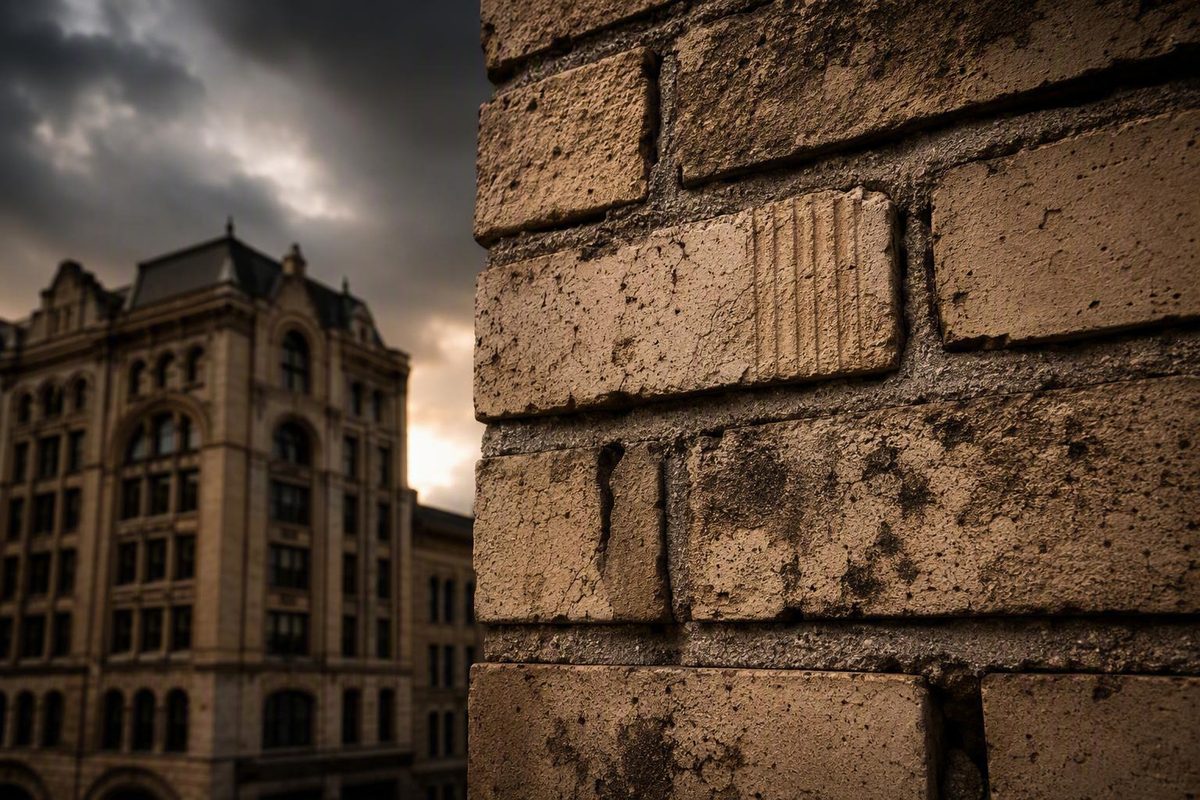
Cream City brick is the pale cream-to-yellow fired-clay brick made in Milwaukee from at least 1846 into the 1920s. The local lacustrine clay carried elevated calcium and magnesium, so it fired buff instead of the red most clay produces, and enough of the city was built with it that Milwaukee took the nickname “Cream City.” It is a porous brick that darkens with grime, spalls when abused and cannot be sandblasted clean without damage. Color alone does not prove a brick came from Milwaukee: pale brick was made elsewhere in Wisconsin, the United States and abroad, so a credible identification also needs the building’s location, construction date and paper trail.
The name has nothing to do with Wisconsin dairy or Milwaukee beer. It describes the masonry. Rows of pale houses, churches, factories, warehouses and commercial blocks made the association strong enough for the brick and the city to share the name, and the label later spread to organizations, businesses, advertisements and sports teams.
Calcium-Rich Lake Clay Fired Cream Instead of Red
Milwaukee’s brickmaking clay contained elevated levels of calcium and magnesium. The raw clay could look red or red-brown, yet firing turned it soft cream or golden yellow. The Encyclopedia of Milwaukee describes the local lacustrine clay and its color change in the kiln.
The evidence supports a relationship among mineral content, firing and finished color. It does not fix one firing temperature, one formula or one chemical reaction that applied to every yard. Some heritage accounts describe early makers blending local red and blue clays; those same accounts call that an oversimplification. The defensible version is that the color emerged in firing rather than being the visible color of the raw material.
“Cream” is a color family, not a shade. Surviving units run from light cream and buff through yellow to muted gold, and quality varied among the many yards that made them. Two bricks that differ in tone are not evidence that one is fake or that a wall came from a single producer. Nor should fired color be confused with later staining: the body can stay pale while the exposed face has gone gray, brown or nearly black.
Milwaukee Made It From at Least 1846 Into the 1920s
Production was underway by at least 1846, grew with the nineteenth-century building boom and continued into the 1920s. Older municipal accounts put the first local brickyard at 1835 or 1836, but that date is qualified, and the last year of production is not settled. The Menomonee River Valley’s Burnham Brickyard, run by George and Jonathan Burnham, became the city’s largest producer, and twelve brickyards were operating across Milwaukee by 1892, according to the Encyclopedia of Milwaukee’s production history.
Clay came from the Menomonee Valley and along Lake Michigan. Before rail made distant standardized brick cheap to ship, an abundant local material was a practical advantage, and mechanization let the yards keep pace with a city adding population and buildings fast. The brick went into every building type rather than one.
Milwaukee brick also left the city. It shipped to other parts of the United States and reportedly to Europe. A municipal preservation report records brick samples sent to Hamburg in 1859 and Milwaukee brick imported there afterward for ornamental work; it does not say whether any European building containing that brick survives. Milwaukee’s historic-designation study documents the qualified Hamburg account.
The industry faded through overlapping changes, not one event. Harder, cheaper, standardized red brick arrived from national manufacturers; rail erased the local-clay advantage; taste moved on; and historical accounts mention possible depletion of accessible clay. The buildings stayed. Surviving walls are now most of the visible evidence for a trade that shaped Milwaukee’s economy and its look.
Color Alone Cannot Prove a Brick Is Cream City
Start with the building, not an isolated brick. Location, approximate construction period, alteration history, permits, historic photographs, fire-insurance maps and salvage records all carry more weight than the shade of the face.
Set the location, construction year and fired color; the verdict updates beside the controls.
Is This Brick Plausibly Cream City?
Verdict
Possible
Consistent so far, but not shown. A construction year or documentation would move it.
Why
- Milwaukee or southeastern Wisconsin: fits the material's home range.
- Construction year unknown: the era check is missing.
- Cream, buff, yellow or gold fired body: fits, but the same colors were made elsewhere.
Check next
- Find the construction date (permits, fire-insurance maps, historic photographs).
- Look for documentation: permits, brickyard or builder records, or a recorded salvage location.
- Assess condition separately: cracking, spalling, powdering and open joints need their own inspection.
Optional details
Qualitative check built from the identification clues in this article (Encyclopedia of Milwaukee; Milwaukee HPC designation reports). Production range: at least 1846 into the 1920s; 1835–36 first-yard date is qualified. Not a lab test and says nothing about condition.
| Useful clue | What it cannot prove |
|---|---|
| Cream, buff, yellow or muted-gold fired body | Milwaukee manufacture; similar colors were made elsewhere |
| Nineteenth- or early-twentieth-century Milwaukee or southeastern Wisconsin building | That every wall, addition or replacement unit is original |
| Lighter masonry in sheltered spots | A specific clay source, maker or date |
| Documentary tie to a local brickyard, builder or salvage site | Present strength or fitness for reuse |
| Gray, brown or black face with pale material beneath | That the discoloration is superficial or safe to remove |
Color is the most immediate clue and the easiest to overread. A pale brick far from Milwaukee may be an exported Milwaukee product, a comparable regional brick or something else entirely. Location and age narrow it: pale brick in a nineteenth-century Milwaukee building is a far better candidate than a similar unit in a much later structure, though repairs and additions can still carry replacement brick from another source.
Dark masonry does not rule it out. Historic units are consistently described as porous and quick to hold grime and pollutants, so an originally pale facade can end up nearly black. Sheltered areas under cornices or behind later additions often show the lighter color; that helps, but it does not authenticate the brick on its own.
Documented examples of the tradition include Old St. Mary’s Church, the Pabst Brewery Complex, the Pritzlaff Building and buildings in Walker’s Point. They show the material’s range across religious, industrial, commercial and neighborhood architecture; they are not dimensional templates for judging an unknown unit. Contemporary reporting gives a visual overview of these Milwaukee Cream City brick buildings and districts.
The reviewed historical sources describe no definitive field test based on dimensions, color or marks. That is a gap in the evidence, not proof that no test exists. Loose salvaged bricks are harder still: a recorded salvage location beats a seller’s label, and even good provenance does not tell you every unit in a mixed pile shares it.
Porous Does Not Mean Unsafe; Condition Is a Separate Question
Cream City brick is porous, but that does not make every unit weak, fragile or dangerous. Many makers, uneven quality, and a century or more of differing exposure, alteration and maintenance mean two walls with the same label can be in very different shape. The label never substitutes for looking at the masonry.
Cracking, spalling, powdering, displaced units, open joints and dark deposits are different conditions and should not be assigned one cause. Cleaning a dark facade will not fix structural movement or deterioration elsewhere in the wall, and a dark facade may hide damage that cleaning cannot correct.
Repointing needs the same judgment. This article does not prescribe a universal mortar for Cream City brick; the historical label alone cannot tell you the right repair material, and the draft sources do not supply one.
Sandblasting Damages It, So Test Any Cleaning First
Sandblasting is not an acceptable routine way to bring back the cream color; it strips the historic surface. Milwaukee’s preservation documentation contrasts the chemical cleaning used at Bethel Baptist Church with sandblasting, which it describes as damaging to historic cream brick. That case does not make chemical washing universally safe: the right treatment depends on the masonry, the deposit, the cleaner, the application and the existing condition. The same municipal preservation report supports a cautious, condition-specific approach.
Before cleaning or repointing, have a historic-masonry or preservation professional name the condition and test the proposed treatment in a small, hidden area, judging the wall rather than individual bricks. A uniformly pale finish is not the goal; tone differences reflect age, exposure, repairs and the original variation in the units. One building’s successful cleaning is not a transferable specification for the next.
What the 2026 Warehouse Collapse Shows
On August 31 and September 1, 2026, part of the National Warehouse complex at 531 S. Water St. in Milwaukee’s Harbor District came down in two phases. An initial report said the structure was believed to have been built of Cream City brick. “Believed” matters: no report presented a confirmed material identification.
Accounts also differ on the building’s dates. Historical maps show earlier use of the footprint, city records date the current structure to 1925, and another account gives 1910 construction with a 1925 expansion. The honest description is early-twentieth-century construction with later expansion, not a single date for every part.
The Milwaukee Fire Department attributed the collapse to structural failure tied to the building’s deteriorating condition, not to Cream City brick as a material. The affected section was vacant and no injuries were reported, per local coverage of the fire department’s findings. On September 3 the city ordered facade inspections of the structures on both National Warehouse properties and approved a $483,000 emergency demolition permit; the report on the permit and inspection orders describes a site-specific response, not a finding that cream-brick buildings are unsafe.
Even a confirmed Cream City identification would not establish cause. The official explanation was deterioration and structural failure. One neglected building cannot support a general performance claim about a brick type that survives in structures of every age, construction type and maintenance history.
Reclaimed Cream City Brick Is Still Sold
Yes, you can buy it. Salvage dealers list reclaimed full bricks identified as Cream City brick, salvaged from historic structures. Availability, price, dimensions, condition and quantities change, so a product page is a current listing, not a historical or technical certification.
Thin veneer cut from reclaimed brick is also sold. One listing describes roughly half-inch-thick pieces sliced from the sides of reclaimed Milwaukee Cream City bricks, which establishes the product’s existence and stated form, not the provenance or performance of every item sold under the name; see the reclaimed Cream City brick veneer listing.
A seller’s description does not prove where a brick was made. Ask for the salvage location and any documentation, inspect units for deterioration, and have the intended use evaluated where performance matters. Full brick and thin veneer are not interchangeable, and an intact full brick is not automatically fit for a load-bearing or weather-exposed job because it carries the Cream City name.