
How Is Brick Manufactured? From Clay to Fired Unit
Follow fired-clay brick from raw-material preparation through forming, drying, kiln firing and inspection, with the three main forming methods compared.
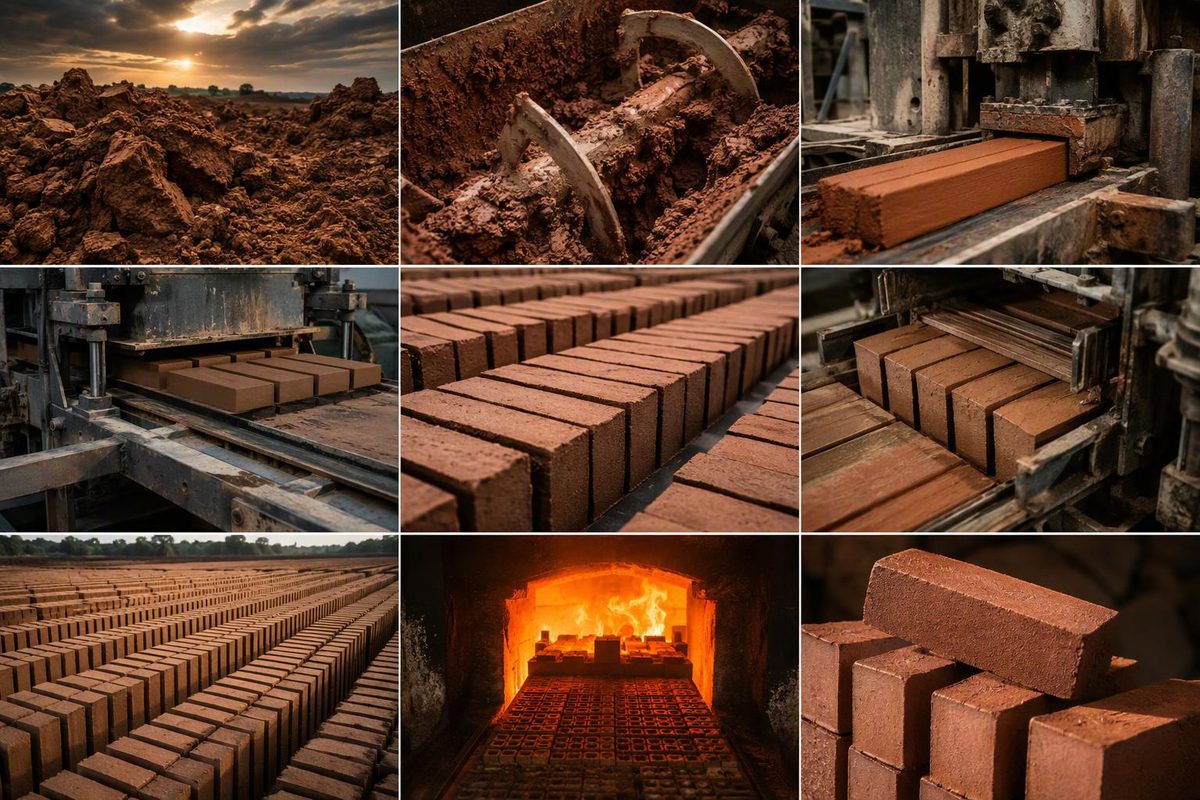
Fired-clay brick is manufactured by preparing clay or shale, mixing it with water, forming individual units, drying them, and firing them in a kiln. Controlled firing partially fuses the clay particles into a durable ceramic body; the cooled bricks are then sorted and packaged. The Brick Industry Association identifies six general production phases, from raw-material extraction to finished-product storage. BIA Technical Note 9
This is the process for fired-clay masonry brick—not concrete brick or unfired mudbrick. For those material distinctions, see what bricks are made of.
1. Extract and blend the raw materials
Clay and shale are mined and moved to storage areas at the plant. Manufacturers blend material from different sources or parts of a deposit to reduce variations in composition and help control the finished brick’s color and properties.
The raw material must be workable when mixed with water, retain its shape before firing, and fuse appropriately when heated. Not every clay behaves the same way. BIA Technical Note 9
2. Crush, screen and mix
Size-reduction equipment breaks up large lumps and stones; screens control particle size. The prepared material is mixed with water to obtain the consistency needed for forming.
For plastic-clay processes, this mixing is called tempering and commonly takes place in a pug mill—a chamber with rotating shafts and blades. The aim is a homogeneous clay mass rather than pockets of material with different moisture contents. BIA Technical Note 9
3. Form the brick
There are three principal forming methods. Their names describe how the unfired unit takes shape, not its bond pattern or orientation in a wall.
| Forming method | How the unit is shaped | Surface implications |
|---|---|---|
| Extruded, or stiff-mud | Plastic clay is de-aired under vacuum, forced through a die as a continuous column, and cut into individual bricks. | The die can produce a smooth surface; equipment can also scratch, roll, brush or otherwise texture the clay before firing. |
| Molded, or soft-mud | A wetter clay mixture is placed in molds, by machine or hand. | Sand or water keeps clay from sticking, producing sand-struck or water-struck finishes. |
| Dry-pressed | Clay with relatively little water is compressed into steel molds. | The mold forms the unit’s shape and surface. This method suits clays with low plasticity. |
The die dimensions and cutter spacing must allow for later shrinkage; the newly formed brick is not yet its finished size. BIA Technical Note 9
4. Dry the unfired units
Most free water is removed before kiln firing. Dryer chambers regulate heat and humidity to limit cracking; kiln exhaust heat can supply the drying heat.
Drying and firing are distinct operations: drying removes moisture, while firing develops the ceramic body. Poorly controlled drying can damage a unit before it reaches the kiln. BIA Technical Note 9
5. Fire and cool
Bricks are arranged to permit hot gases to circulate. In a tunnel kiln, loaded kiln cars move through controlled temperature zones. A periodic kiln instead handles a batch that is loaded, fired, cooled and unloaded.
Firing removes remaining water and brings about fusion and partial vitrification. BIA’s December 2006 guidance places vitrification broadly at 1,600–2,400°F (871–1,316°C), depending on the clay or shale. This is not a universal kiln setting: the firing schedule must suit the material and unit geometry. Excessive melting would deform the brick.
Cooling is also controlled and affects the finished color. BIA Technical Note 9
6. Inspect, sort and package
After cooling, bricks are unloaded, sorted and packaged for storage or delivery. Quality control can include testing as well as sorting. For example, Glen-Gery describes internal and third-party checks for strength, durability and color consistency. Glen-Gery’s manufacturing overview
What manufacture tells you about the finished brick
Forming helps determine texture, while raw-material chemistry, firing conditions and surface treatments influence color. Drying and firing cause shrinkage, so finished units have dimensional variation. Color alone is not a reliable indicator of strength or absorption when comparing bricks made from different raw materials. BIA Technical Note 9
For ordering and wall layout, use the selected product’s published dimensions and properties—not its appearance or forming-method name alone. See modular brick dimensions and mortar-joint coordination for the separate question of how a finished unit fits an installed masonry module.