
Concrete Block Weight by Size and Type
A common hollow, normal-weight 8 × 8 × 16-inch CMU is 36-42 lb. One published 10-inch hollow example is about 46 lb. Exact figures require product data.
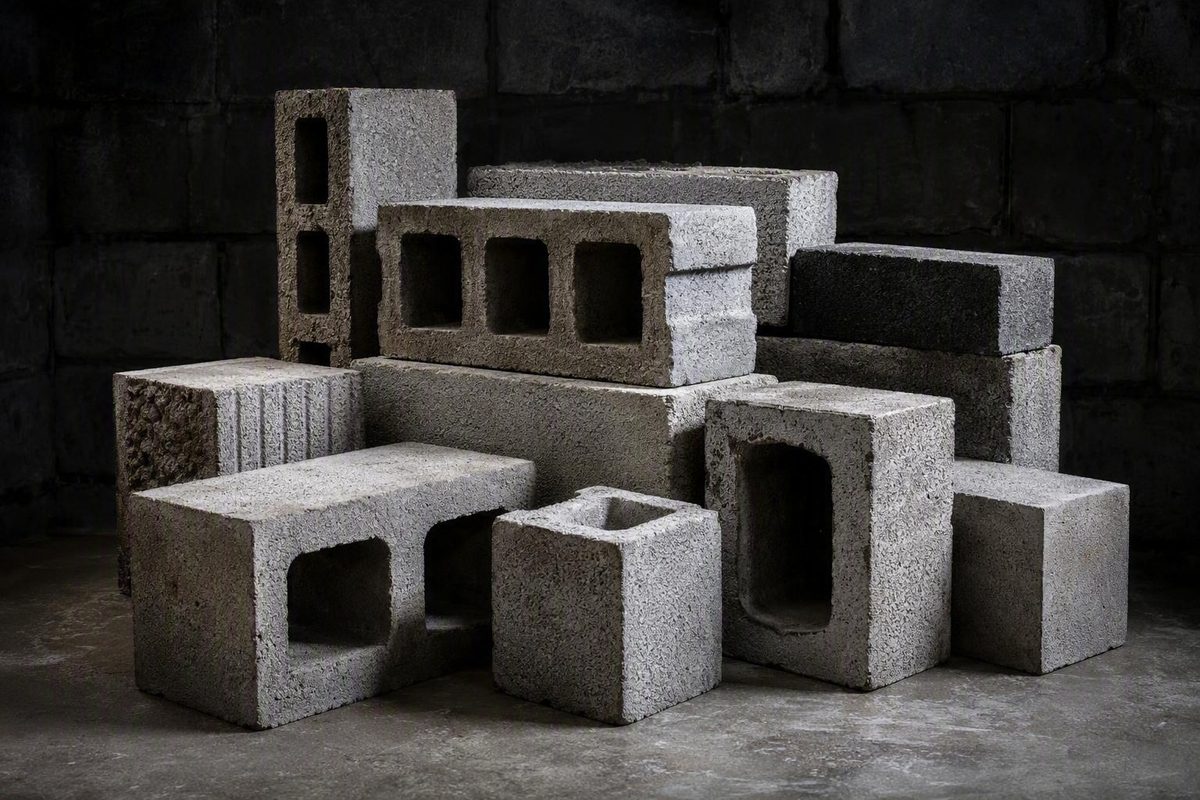
The short answer: about 38 lb for a common 8-inch hollow block
Quick answer
A common nominal 8 × 8 × 16-inch hollow, normal-weight concrete masonry unit (CMU) weighs approximately 36–42 lb (16–19 kg). For preliminary planning, 38 lb (17.2 kg) per block is a useful estimate—not an exact product specification. These figures are published as ranges or averages rather than universal weights in a size-and-density comparison of hollow CMUs.
That answer changes when the block is not a typical hollow, normal-weight unit. Published estimates place some lightweight hollow blocks with the same nominal dimensions around 20–28 lb, while solid 8-inch units commonly fall around 50–55 lb and certain specialty configurations may exceed 50 lb. These are approximate categories rather than guaranteed product weights, as reflected in a comparison of hollow, solid, and lightweight concrete blocks.
The reason is simple: “8 × 8 × 16” identifies a nominal size, not a unique product. Blocks sold under that size can differ in aggregate, concrete density, core geometry, face-shell thickness, web arrangement, end profile, and percentage of solid material.
Before choosing an estimate, identify four characteristics:
- Nominal unit size: such as 4, 6, 8, 10, or 12 inches wide.
- Hollow or solid construction: including percent solid or net area, if available.
- Density class: lightweight, medium weight, or normal weight.
- Configuration: line block, corner, bond beam, solid-top, split-face, half block, or another specialty profile.
If all you know is that the product is a “standard 8-inch concrete block,” use 38 lb only for a first-pass calculation. Replace that estimate with the selected product’s documented unit weight before making decisions involving freight, lifting equipment, vehicle capacity, pallet loading, or structural loads.
Concrete block weight chart by nominal size
The chart separates normal-weight hollow ranges from individual hollow and solid examples. It does not combine lightweight, solid, hollow, and specialty products into one ambiguous range.
The normal-weight hollow ranges below come from a published CMU weight guide organized by nominal size and density.
| Nominal size (W × H × L) | Construction or density category | Approximate weight | Rounded kilograms | Nature of figure |
|---|---|---|---|---|
| 4 × 8 × 16 in. | Hollow, normal weight | 22–26 lb | 10–12 kg | Reported general range |
| 6 × 8 × 16 in. | Hollow, normal weight | 28–34 lb | 13–15 kg | Reported general range |
| 8 × 8 × 8 in. | Hollow half block | About 23 lb | About 10.4 kg | Reported average example |
| 8 × 8 × 16 in. | Hollow, normal weight | 36–42 lb | 16–19 kg | Reported general range |
| 10 × 8 × 16 in. | Hollow | About 46 lb | About 20.9 kg | Reported average example |
| 12 × 8 × 16 in. | Hollow, normal weight | 52–58 lb | 24–26 kg | Reported general range |
| 4 × 8 × 16 in. | Solid | About 33 lb | About 15 kg | Reported average example |
| 6 × 8 × 16 in. | Solid | About 56 lb | About 25.4 kg | Reported average example |
| 8 × 8 × 16 in. | Solid | About 54 lb | About 24.5 kg | Reported average example |
The half-block, 10-inch hollow, and solid-unit entries are reported averages from a separate comparison of concrete-block weights by size.
Table note: Nominal size and construction type do not uniquely determine weight. An 8-inch line block from one producer may differ from another producer’s line block and from an 8-inch corner, bond-beam, split-face, solid-top, or lightweight unit.
How to interpret the chart
Use a range only after confirming that the block belongs to the stated category. If a supplier identifies a unit as a hollow, normal-weight 8-inch line block, the 36–42 lb range is a reasonable preliminary allowance. “8-inch block” by itself does not provide enough information.
The 10-inch entry is deliberately labeled as an average example. A published comparison reports about 46 lb for one general hollow 10 × 8 × 16-inch category, but that value should not be treated as a universal range for every 10-inch CMU.
The solid entries also stand apart from the hollow ranges. A solid 4-inch unit can outweigh a hollow 6-inch unit because exterior width is only one part of the calculation. What matters is how much concrete the finished block contains and how dense that concrete is.
Kilogram values are rounded for practical comparison. When exact mass matters, use the manufacturer’s stated value rather than converting an already rounded estimate.
Why an 8 x 8 x 16 block can weigh anywhere from about 25 to more than 50 lb
The familiar 8 × 8 × 16-inch CMU demonstrates why there is no single answer to “How much do concrete blocks weigh?”
Depending on construction and density, published figures include:
- About 21–28 lb for some lightweight hollow units.
- About 36–42 lb for a commonly reported normal-weight hollow range.
- About 50–55 lb or more for solid and certain specialty units.
These categories describe different products, even though their nominal exterior dimensions match.
An industry article reproducing study-based examples lists a nominal 8-inch lightweight unit at 25.3 lb and a denser example at 34.3 lb. Its modeled weight-class thresholds are based on an 8-inch block that is 50% solid, so the figures illustrate the combined effects of density and geometry rather than universal limits for every 8-inch CMU. The assumptions and examples appear in the Expanded Shale, Clay and Slate Institute’s lightweight-CMU article.
The exterior envelope does not reveal the concrete volume
A hollow CMU contains face shells—the long exterior walls—and internal webs connecting them. Its cells occupy much of the exterior envelope. Changing the cell dimensions, web layout, face-shell thickness, or end configuration changes the net volume of concrete without changing the nominal size shown in a catalog.
Percent solid is one way to describe this difference. An 8-inch unit that is 50% solid does not contain the same amount of material as one that is 60% solid. If both use concrete of equal density, the unit with more net concrete volume will normally weigh more.
Configuration can matter as much as the size label
A conventional line block is not interchangeable with every unit in an 8-inch product family. Common configurations include:
- Open- and closed-bottom units
- Corner and double-end units
- Bond-beam blocks
- Solid-top or solid-bottom units
- Split-face blocks
- Lintel or floor-slab profiles
- Half blocks and half-high blocks
- Units with knockouts or specialized webs
One manufacturer’s concrete-block product table assigns different approximate figures to nominal 8 × 8 × 16-inch line, bond-beam, corner, split-face, solid-top, and lightweight-aggregate products. Because the supplied table does not explicitly identify the unit used in its weight column, its numbers should be treated as evidence of product-to-product variation—not imported as universal pound values.
These configurations are distinct products intended for different masonry details. A specialty block should not be treated as a minor variation of a standard line block when estimating a shipment or assembly.
Individual units can differ from a published average
In one reported example, an 8 × 8 × 16-inch block associated with a 38 lb listing weighed 35.4 lb on the writer’s scale. That individual measurement illustrates the difference between an approximate listing and a measured unit; it does not establish 35.4 lb as a more representative standard. The example appears in Prepper Press’s block-weight comparison.
Aggregate characteristics, moisture condition, product design, and rounding can all contribute to differences. An average may be adequate for rough planning but not for declaring the weight of a shipment or installed assembly.
The factors that determine concrete block weight
Finished unit weight depends primarily on:
Net concrete volume × concrete density
Exterior dimensions establish the block’s general envelope, but they do not reveal how much of that envelope is concrete.
Unit dimensions and width
A wider or longer unit can contain more material, so weight generally rises with size when density and geometry remain comparable. This is why a normal-weight hollow 12-inch block will usually weigh more than an otherwise similar 8-inch block.
The relationship is not perfectly linear. Increasing width can also change the core arrangement, number of webs, face-shell geometry, and percentage of solid material.
Hollow versus solid construction
A solid unit occupies most of its exterior volume with concrete, while a hollow unit removes substantial volume through its cells. Published estimates commonly place a solid nominal 8 × 8 × 16-inch block around 50–55 lb, compared with lower typical values for hollow units of the same nominal size.
“Hollow” is not a complete specification. Hollow blocks can have different cell sizes, numbers of cells, web arrangements, and end shapes. Two hollow units may therefore contain materially different amounts of concrete.
Core dimensions, face shells, and webs
Cores are the voids running through or partly through a block. Larger cores generally mean less concrete, while thicker face shells and webs add material.
For a defensible volume estimate, obtain at least one of the following:
- Published net cross-sectional area
- Published percent solid
- Manufacturer-supplied core dimensions
- Direct measurements from a representative unit
Do not assign one universal void percentage to every hollow CMU. Similar exterior appearances do not prove that the internal geometry is the same.
Aggregate and mix density
Concrete density depends partly on its aggregates. Lightweight CMUs may use expanded clay, expanded shale, expanded slate, or another documented lightweight aggregate. Denser mixes commonly use conventional aggregates such as sand and gravel.
Material density and geometry must be considered together. A lightweight unit containing more concrete could approach the weight of a denser unit with larger cells. Conversely, blocks with the same percent solid may weigh differently because their concrete mixes have different densities.
Specialty configuration and manufacturer design
Manufacturers design CMUs for particular wall details and production systems. A bond-beam unit may remove or add material in different locations than a line block. A corner block may have a closed end, while a solid-top profile may contain substantially more concrete than an open-cell unit.
The correct comparison is product to product—not merely “8-inch block” to “8-inch block.”
Moisture condition
A dry bare block may not weigh the same as a block exposed to rain, stored in wet conditions, or carrying surface moisture. When requesting a product weight, ask whether the stated figure is:
- A nominal dry weight
- An approximate production average
- A measured unit weight
- A pallet or shipping weight
Do not assume that an approximate catalog value represents the maximum weight of a moisture-conditioned shipment.
Bare block versus completed masonry
A listed CMU weight generally refers to the individual unit. An installed masonry assembly can also contain:
- Mortar in bed and head joints
- Grout in some or all cells
- Steel reinforcement
- Joint reinforcement or embedded items
- Coatings, adhered finishes, or cladding
- Retained or absorbed moisture
Estimate those materials separately. A 38 lb bare-block allowance is not a 38 lb allowance for that unit’s complete share of a reinforced, grouted, and finished wall.
Weight is also not a substitute for structural design. A heavier block is not automatically stronger or more suitable for structural work. Unit strength, assembly design, reinforcement, grout, mortar, support conditions, and project requirements remain separate considerations.
Nominal dimensions, actual dimensions, and density classes
Nominal size is a masonry module
The term 8 × 8 × 16 inches generally describes a nominal masonry module, not the exact physical dimensions of a block. A common nominal 8 × 8 × 16-inch CMU measures approximately 7 5/8 × 7 5/8 × 15 5/8 inches. The dimensional allowance accommodates a typical mortar joint so the installed block and joint fit the nominal module, as explained in a retailer’s guide to standard cinder-block dimensions.
That 3/8-inch difference in each direction matters in a volume calculation. Treating nominal dimensions as exact measurements enlarges the assumed exterior envelope. For a hollow block, the error becomes greater if the calculation also fails to subtract the cores.
Use actual product dimensions whenever possible. Then subtract measured or published void volume before applying the appropriate density.
Density class describes the mix, not the whole block
CMU mixes are commonly grouped into three density classes:
| Density class | Mix density |
|---|---|
| Lightweight | Less than 105 lb/ft³ |
| Medium weight | 105 to less than 125 lb/ft³ |
| Normal weight | At least 125 lb/ft³ |
These thresholds and their meaning are described in Basalite’s explanation of CMU density and strength.
The classifications describe the density of one cubic foot of the concrete mix. They do not mean that a lightweight block weighs less than 105 lb or that an individual normal-weight block weighs at least 125 lb. A finished CMU contains only a fraction of a cubic foot of net concrete, with the amount determined by its dimensions and voids.
Density and compressive strength are also separate properties. A denser or heavier unit is not automatically stronger than a lighter unit; strength also depends on mix design and unit design.
Density class narrows the possible estimate, but it does not establish unit weight by itself. You still need the block’s net concrete volume or a documented product weight.
Terminology can vary among older articles and regional sources. Some use “heavyweight” for the upper density category, while current product literature may use “normal weight.” Follow the terminology in the selected product’s current documentation instead of assuming every source uses the labels identically.
How to estimate the weight of a custom block or multiple units
When a documented unit weight is unavailable, a volume-and-density calculation can provide a preliminary estimate.
Step 1: Find the exterior volume
For rectangular dimensions measured in inches:
Exterior volume (ft³) = length (in.) × width (in.) × height (in.) ÷ 1,728
There are 1,728 cubic inches in one cubic foot.
For a solid rectangular unit, exterior volume may be adequate for a rough calculation if the dimensions are actual and the unit has no recesses, voids, or special shaping.
Step 2: Subtract the hollow spaces
For a hollow block:
Net concrete volume = exterior volume - total core volume
Calculate each core from measured or published dimensions and add the core volumes together. For tapered, rounded, or irregular cells, manufacturer-published net area or percent solid will usually be more dependable than a simple hand measurement.
Do not multiply the full exterior envelope by concrete density and call the result the block weight. That method treats every hollow cell as concrete and can substantially overstate the result.
Step 3: Apply an appropriate density
Once net concrete volume is known:
Estimated unit weight (lb) = net concrete volume (ft³) × concrete density (lb/ft³)
The density must correspond to the actual mix or density class. Do not automatically apply a generic density for poured concrete to a lightweight CMU, and do not treat the normal-weight threshold as the exact density of every normal-weight product.
If neither density nor net concrete volume is known, the result will be speculative. A clearly labeled category estimate is more honest than a precise-looking calculation based on unsupported assumptions.
Step 4: Multiply by quantity
For multiple identical units:
Total bare-unit weight = unit weight × quantity
Using 38 lb per block as a provisional value for a typical hollow 8 × 8 × 16-inch CMU:
| Quantity | Estimated bare-block weight |
|---|---|
| 10 blocks | About 380 lb |
| 50 blocks | About 1,900 lb |
| 100 blocks | About 3,800 lb, or approximately 1,724 kg |
The 38 lb input is consistent with reported approximate values for common hollow 8-inch CMUs; the totals are direct arithmetic from that assumption. A general block-weight calculation discussion likewise emphasizes subtracting voids and using manufacturer data when an exact weight is needed.
This example excludes pallets, straps, packaging, mortar, grout, reinforcement, coatings, and moisture. It is a preliminary quantity estimate—not a freight declaration, engineering load, or guaranteed shipment weight.
Small unit-weight errors become significant across a large order. If a block actually weighs 35 lb rather than 38 lb, the difference across 100 units is 300 lb. If it weighs 42 lb, the order is 400 lb heavier than the estimate.
When an average is sufficient—and when to verify the exact product
A general chart is useful for:
- Early comparison of block types
- Rough material takeoffs
- Preliminary handling discussions
- Initial delivery planning
- Classroom calculations
- Determining whether an order will weigh hundreds or thousands of pounds
An average is not a substitute for product documentation when a modest error could change a loading, lifting, or design decision.
Verify the exact unit whenever weight affects:
- Lifting or material-handling equipment
- Freight quotations
- Trailer or vehicle loading
- Pallet and rack capacity
- Procurement quantities
- Crane or forklift planning
- Structural dead-load calculations
- Existing floor or platform capacity
Product-weight verification checklist
Before relying on a final figure, confirm:
- Nominal size
- Actual dimensions
- Hollow or solid construction
- Net area or percent solid
- Density class
- Aggregate or mix type
- Exact configuration, such as line, corner, bond beam, split-face, or solid-top
- Dry or moisture-conditioned status
- Documented unit weight
- Quantity per pallet or cube
- Pallet, packaging, and restraint weight
- Total documented shipping weight
Obtain this information from the product data sheet, pallet label, manufacturer, or supplier. Ask whether the figure is an average, approximate catalog value, measured unit weight, or total shipping weight.
For an installed wall, calculate the masonry assembly rather than multiplying bare-block weight alone. Include mortar, grout, reinforcement, finishes, and other permanent materials required by the design. Where structural compliance is involved, use project-specific documentation and qualified engineering.
The practical rule is:
Use 38 lb provisionally for a typical hollow, normal-weight nominal 8 × 8 × 16-inch CMU. Once the product is selected, replace that estimate with its documented unit weight.
Frequently asked questions
How much does an 8 x 8 x 16-inch hollow concrete block weigh?
For preliminary planning, use about 38 lb (17.2 kg) for a typical hollow, normal-weight nominal 8 × 8 × 16-inch CMU. Depending on geometry and density, published figures for 8-inch units can vary substantially; one industry article’s modeled examples extend from 20.1 lb at 75 lb/ft³ to 38.9 lb at 145 lb/ft³ for the geometry it evaluates. Those are model-specific examples, not universal limits, as shown in the lightweight-CMU study discussion.
Lightweight units, different percentages of solid material, specialty profiles, and moisture can move the actual product outside a general planning range.
How much does a solid 8 x 8 x 16-inch concrete block weigh?
A solid nominal 8 × 8 × 16-inch concrete block is commonly estimated at approximately 50–55 lb (23–25 kg). Published comparisons include an average example near 54 lb.
“Solid” products may still have recesses or manufacturer-specific geometry. Obtain the selected product’s documented weight when handling, freight, or load calculations require precision.
Are cinder blocks lighter than normal-weight concrete blocks?
A block properly described as a cinder block generally belongs to the lightweight-CMU category and can weigh less than a comparable normal-weight concrete block. Historically, the term referred to blocks made with lightweight cinder aggregate. Contemporary lightweight units may use other lightweight aggregates.
The phrase “cinder block” is also used casually for many hollow concrete blocks that do not contain cinders. The label alone therefore does not establish weight. Confirm the density class, aggregate, geometry, and product weight. A retailer’s cinder-block dimensions guide likewise distinguishes dimensional terminology from the characteristics needed to identify a specific unit.
How much do 100 standard concrete blocks weigh?
At the provisional estimate of 38 lb per hollow 8 × 8 × 16-inch block, 100 blocks weigh:
100 × 38 = 3,800 lb
That is approximately 1,724 kg, or 1.9 U.S. short tons, of bare block. The calculation uses an approximate 38 lb unit value consistent with the upper end of the range discussed in this block-weight calculation overview.
The total excludes pallets, packaging, straps, mortar, grout, reinforcement, coatings, and moisture. Use the supplier’s documented pallet or shipment weight for transport and lifting decisions.
Does a listed block weight include mortar, grout, rebar, or moisture?
Usually, a listed block weight refers to the individual bare unit, but reporting conditions can vary. Do not assume that it includes mortar, grout, reinforcing steel, coatings, pallets, packaging, or absorbed moisture.
For an installed assembly, add all permanent materials separately. For delivery planning, request the supplier’s total pallet or shipment weight—including packaging and restraints—rather than relying solely on an approximate dry unit weight.
The practical takeaway
A common hollow, normal-weight nominal 8 × 8 × 16-inch CMU can reasonably be estimated at about 38 lb during early planning, but nominal size alone does not establish weight. Construction type, net concrete volume, density class, aggregate, configuration, and moisture all matter.
Use the chart to select an appropriate preliminary category, multiply the estimated unit weight by quantity, and keep pallets and installed materials separate. Before making lifting, freight, vehicle-loading, pallet-capacity, or structural decisions, replace the estimate with documentation for the exact product being supplied.