
Where Does Granite Come From? Geology and Quarries
It crystallizes from magma underground, but a block may be quarried in one country, processed in another and fabricated near the final project.
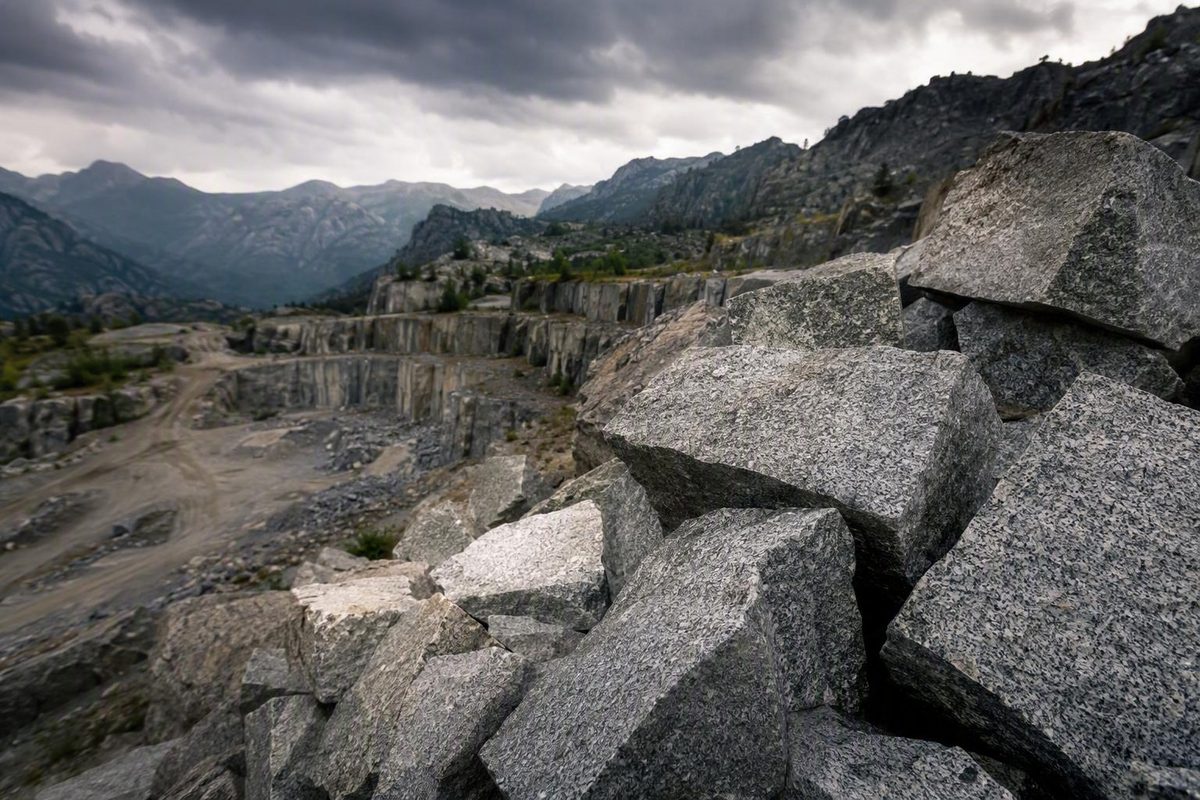
The short answer: granite has a geological origin and a commercial source
Granite begins as molten rock beneath Earth’s surface. This molten rock, called magma, cools and crystallizes underground to produce a coarse-grained intrusive igneous rock. Its relatively slow cooling allows visible mineral crystals to grow and interlock. Granite consists principally of quartz, alkali feldspar, and plagioclase, commonly with mica and varying amounts of amphibole. A geological overview describes granite’s formation, texture, and principal minerals.
When asking where granite comes from, however, “origin” can mean two different places:
- Geological origin: the underground intrusive body in which magma cooled and crystallized.
- Commercial source: the quarry from which accessible stone was extracted for blocks, slabs, cladding, paving, monuments, aggregate, or countertops.
These locations are connected but not interchangeable. A granitic body may have crystallized beneath an ancient landscape, remained buried, and later become exposed as uplift and erosion removed the rocks above it. Only an accessible portion can become a practical quarry site.
Granite also does not originate as a polished slab. Quarry workers extract natural rock; processors cut suitable blocks into slabs and apply finishes; fabricators then size and shape selected pieces for a particular building or countertop.
The full journey is:
magma intrusion → slow crystallization → uplift and erosion → exposed bedrock → quarry extraction → block and slab processing → project-specific fabrication → installation
There is no universal formation depth, fixed cooling duration, or single country of origin for granite. Different granitic bodies formed under different geological conditions, and commercially usable stone is quarried in numerous regions.
How granite forms beneath Earth’s surface
Magma is molten or partially molten rock below Earth’s surface. Once molten rock reaches the surface, it is called lava. Granite forms from magma underground, not from a lava flow cooling at the surface.
Granite is therefore described as intrusive, or plutonic, igneous rock. Its magma solidifies within existing crust rather than erupting into the atmosphere or onto the seafloor.
This slower cooling gives minerals time to crystallize. As crystallization proceeds, growing mineral grains meet one another and create granite’s characteristic coarse, interlocking texture. Not every granite has crystals of the same size, because cooling conditions, magma composition, and the history of each intrusion vary. The broad relationship remains: relatively slow underground cooling permits the development of visible crystals.
An underground body of intrusive igneous rock is called a pluton. Plutons vary in shape and extent. Granitic rocks occur in smaller intrusive bodies, including stocks, and in extensive regions composed of multiple intrusions, commonly called batholiths.
The magma does not have one universal origin. Some granitic magmas are associated with melting of continental material in tectonically active settings. The National Park Service uses continental melting near subduction zones to explain its California examples, but that regional explanation should not be treated as the sole mechanism for every granite body. Its guide also explains plutons, slow cooling, visible crystals, uplift, and erosion. See the National Park Service’s granite and granodiorite overview.
Granite is best understood as the result of a family of underground geological histories rather than one fixed recipe. The essential sequence is that suitable magma remains underground and cools slowly enough to form a coarse mass of interlocking mineral grains.
How underground granite becomes visible at the surface
Crystallization does not automatically make granite visible. After an intrusion solidifies, it may remain buried beneath other rock. Two broad processes can eventually uncover it:
- Uplift raises crustal rocks relative to their surroundings.
- Erosion removes overlying material through weathering and transport by water, ice, wind, and gravity.
Uplift and erosion expose granite; they do not create it. The granite already exists as crystallized intrusive rock before these later processes alter its position relative to the land surface.
Consider a granitic pluton beneath a mountain belt. As the crust rises, weathering, streams, glaciers, and gravity gradually remove the overlying material. Continued erosion can uncover a progressively larger part of the body.
The Sierra Nevada is a prominent example. Its granitic rocks crystallized underground and were later exposed as uplift and erosion removed overlying material. The National Park Service also identifies California examples near Monterey, Pacifica, and Point Reyes, including granitic rocks displaced by movement along the San Andreas Fault. These are illustrations of the process, not a complete account of granite occurrence worldwide.
This history explains why a quarry can work granite at today’s surface even though the rock originally formed underground. The present landscape intersects a once-buried intrusive body after geological processes raised and uncovered it.
Exposure alone does not guarantee a viable quarry. Rock at an outcrop may be too weathered, too fractured, too difficult to reach, or divided into pieces too small for the intended product. Quarry planning therefore considers the condition, accessibility, and potential yield of the deposit—not merely the presence of granite.
A useful conceptual cross-section has five stages:
- Magma intrudes existing crust.
- The magma crystallizes as a buried pluton.
- The crust and solidified intrusion are uplifted.
- Erosion removes the overlying rock and exposes granite bedrock.
- A quarry develops in an accessible, workable part of the intrusion.
The distinctions are important: crystallization forms the granite, uplift raises it, erosion exposes it, and quarrying removes selected material.
What granite is made of—and why it looks different from place to place
Granite’s principal minerals are:
- Quartz
- Alkali feldspar, including potassium-rich feldspar
- Plagioclase feldspar
Granite also commonly contains mica, such as biotite or muscovite, and may contain amphibole and other accessory minerals. The proportions, sizes, colors, and arrangement of these minerals account for much of the rock’s appearance.
As rough visual guidance:
- Feldspars commonly form pale, white, gray, cream, or pink grains.
- Quartz commonly appears clear, glassy, pale, or gray.
- Mica may appear as dark or reflective flakes.
- Some amphiboles appear as darker grains.
These associations are useful for observation, but color alone cannot reliably identify every grain. A pale grain is not necessarily quartz, and a dark grain is not necessarily mica.
It is equally misleading to attribute an entire slab’s color to one mineral. Granite’s overall appearance can reflect several factors:
- The proportions of its principal minerals
- The color and distribution of feldspars
- The quantity and type of dark minerals
- Grain size and crystal relationships
- Accessory minerals present in smaller quantities
- Alteration after crystallization
- Veins, fractures, inclusions, or zones of mineral replacement
- Deformation and other aspects of local geological history
A pink granite may contain conspicuous pink feldspar, for example, but its finished appearance also depends on the surrounding quartz, plagioclase, dark grains, crystal sizes, and cutting orientation.
Patterns can change with scale and orientation. Closely spaced grains may create an even, speckled field, while larger crystals form a bolder pattern. Altered zones, veins, or filled fractures can cross the original igneous texture.
Stones from different deposits—and sometimes different zones of one deposit—can consequently show distinct colors, crystal sizes, bands, flecks, veins, and other markings. These differences record local geology rather than national borders.
Where granite occurs naturally around the world
Granitic rocks are widespread in continental crust and occur on continents around the world. They are especially visible where erosion has exposed ancient intrusive bodies. Their natural occurrence is not limited to the countries most familiar from the modern stone trade.
Three kinds of maps answer different questions:
- A geological map shows where granitic rock exists or is exposed.
- A quarry map shows where people extract it.
- A trade map shows where stone is processed, exported, imported, or sold.
Confusing these categories can make a processing center appear to be a stone’s geological source, or make a granitic region without commercial extraction appear to be a current supplier.
The Sierra Nevada is an example of an extensive exposed granitic region. Vermont and Georgia are qualified examples of regions associated with commercial granite quarrying in the United States. Brazil, India, China, and the United States are examples of countries involved in granite quarrying or supply, but this is neither a current production ranking nor an exhaustive list. A commercial fabricator’s account also identifies Vermont and Georgia as U.S. quarrying examples and emphasizes the roles of access, demand, labor, appearance, and shipping infrastructure. See Granite Guy’s account of commercial granite sourcing.
Geological abundance does not automatically make a deposit commercially useful. Whether a deposit is worked can depend on:
- Accessibility: Whether workers, equipment, and transport can reach it
- Weathering: Whether near-surface rock remains sound
- Joints and fractures: Whether blocks of the necessary dimensions can be recovered
- Appearance: Whether its color and pattern suit an available market
- Consistency: Whether the quarry can supply sufficiently similar material
- Demand: Whether buyers exist for the products the deposit can yield
- Transportation: Whether heavy stone can be moved economically
- Processing infrastructure: Whether suitable cutting, handling, and finishing facilities are available
- Intended use: Whether the stone will become dimension stone, aggregate, or both
A heavily fractured deposit may remain useful for crushed aggregate even if it cannot yield large countertop slabs. Conversely, sound and attractive stone may remain unworked if access, transport, infrastructure, or demand makes extraction impractical.
Any map of granite distribution should therefore use separate symbols or layers for exposed granitic regions, illustrative quarrying areas, and processing or exporting locations.
True granite, granitoids, and stone sold commercially as granite
That distinction matters when a reader wants to establish both what a stone is and where it came from.
Geologists classify coarse-grained intrusive rocks partly through the QAPF classification, which uses the relative modal proportions of quartz, alkali feldspar, and plagioclase after the relevant mineral proportions are normalized. True granite occupies defined fields within that system; the term does not mean every hard rock with visible crystals. The broader geological overview describes both granite’s principal minerals and its distinction from the larger granitoid family. See the overview of granite and its classification.
Granitoid is a broader family term for coarse-grained, granite-like intrusive rocks containing substantial quartz and feldspar. Different members of this family may look similar in an outcrop or finished slab even though their mineral proportions place them in different geological categories.
Granodiorite is one example. It contains more plagioclase relative to potassium feldspar and generally has more dark minerals than true granite. The National Park Service makes this distinction in its explanation of California granitic rocks. Its granite and granodiorite FAQ summarizes the mineralogical difference.
Trade names serve a different purpose. They allow suppliers, fabricators, and customers to refer to a saleable material with a recognizable appearance. A trade label may be useful for ordering, but it should not be treated automatically as a laboratory identification. Visual resemblance alone does not establish exact mineral proportions.
This produces two separate provenance questions:
-
What is the stone petrographically? Is it true granite, granodiorite, another granitoid, or a different rock sold within a broad commercial category?
-
Where was it quarried? Which deposit, quarry, region, and country supplied the block?
Neither answer supplies the other. Knowing a quarry does not by itself provide a formal rock classification, while identifying a specimen as granite does not reveal its quarry. Precise classification or comparison may require mineralogical, microscopic, chemical, or other petrographic evidence.
For homeowners, designers, and masons, the practical lesson is not to reject every commercial label. It is to understand its limits. A product name can identify a supplier’s inventory or an established appearance, but it does not prove geological identity, standardized composition, or quarry origin without supporting documentation.
How granite is removed from a quarry
Quarrying begins before a production block is detached. Operators identify and expose a workable part of the deposit, examine the rock, plan access, and determine which products the quarry is intended to supply. Soil, vegetation, weathered material, and unsuitable rock may need to be removed before a sound working face is available.
The natural structure of the rock is central to this assessment. Their spacing, direction, continuity, and openness affect:
- Where the rock can separate
- The direction in which it can be split
- The largest recoverable block
- The amount lost during extraction and squaring
- Whether a block can withstand lifting, transport, sawing, and fabrication
The intended product determines what counts as usable stone.
Dimension stone must be recovered in relatively intact pieces that can be cut to controlled dimensions. It may become slabs, facades, paving, monuments, steps, curbing, or ashlar masonry. Natural markings may be acceptable or desirable, but fractures that threaten a finished unit reduce usable yield.
Aggregate is intended to be crushed and screened into smaller particles. Preserving a large, visually consistent block is not the objective. A deposit unable to supply premium dimension stone may still be useful for aggregate.
Possible detachment methods include:
- Precise drilling
- Diamond-wire sawing
- Controlled mechanical splitting
- Hydraulic splitting
- Controlled blasting
- Combinations of cutting, drilling, and splitting
No single method applies to every quarry. Selection depends on joint geometry, intended block size, desired surface quality, equipment access, vibration and environmental constraints, material loss, and final use. Dimension-stone extraction generally prioritizes controlled separation and intact blocks. Aggregate operations can use blasting because the rock will subsequently be crushed.
Granite is therefore not categorically “never blasted.” Controlled blasting may be used, particularly for aggregate, and methods can also include drilling, wire sawing, and hydraulic splitting. A quarrying equipment guide distinguishes dimension-stone methods intended to preserve blocks from aggregate production involving blasting, crushing, and screening. See the granite quarrying methods guide.
Diamond-wire sawing uses a moving abrasive wire to create a controlled cut. Drilled holes can establish a line for wedges or other splitting systems, while hydraulic equipment can apply force within prepared holes. Methods may be combined: selected faces can be sawn, another boundary drilled or split, and a natural joint used as an additional separation plane.
After detachment, a large mass may be divided into transportable raw blocks. Lifting equipment and heavy machinery move the stone away from the face. Blocks may then be:
- Inspected for fractures and defects.
- Squared or trimmed.
- Marked for identification and orientation.
- Measured and assigned to an intended product.
- Loaded for transport to a processing facility.
Aggregate follows a different route, moving toward crushing and screening rather than block inspection and slab sawing. One operation may produce multiple products, using sound sections for blocks and directing unsuitable or broken material to other uses where practical.
Quarry planning can involve geology, access, drainage, slope stability, permitting, environmental documentation, waste management, monitoring, and rehabilitation. Safety and environmental requirements vary by site and jurisdiction, so extraction methods and procedures must be established under the rules applicable to the operation rather than inferred from a simplified countertop-production description. The quarrying guide identifies safety, environmental requirements, permitting, and site conditions as method-selection and planning factors.
From quarry block to slab—and why country labels can be misleading
After extraction, granite still looks very different from a finished countertop or precisely cut wall panel. A typical dimension-stone sequence is:
- Raw-block transport: The block moves from the quarry to a processing facility.
- Inspection and orientation: Processors assess visible fractures, markings, and cutting direction.
- Slab cutting: Industrial equipment divides the block into sheets of a selected thickness.
- Optional treatment: Some slabs receive resin or epoxy treatment to fill minor fissures or stabilize selected features.
- Grinding and finishing: The slab faces are leveled and given the intended surface.
- Inspection and identification: Slabs may be checked, labeled, photographed, matched, or bundled.
- Shipping and distribution: Finished or partly finished slabs move to importers, warehouses, distributors, or fabricators.
- Project fabrication: Openings, edges, joints, and final dimensions are cut for the job.
- Delivery and installation: Fabricated pieces are transported and installed.
Commercial processing accounts describe sequences that include slab cutting, optional resin treatment, polishing, shipping, project measurement, fabrication, and installation. One countertop-industry overview traces these stages from extracted block to installed surface.
Common finishes include polished, honed, and brushed surfaces. A fabricator works later in the supply chain than the quarry and primary slab processor. Using measurements or templates, the fabricator may cut sink and fixture openings, shape exposed edges, divide a layout into installable sections, and size pieces for walls, cabinets, and joints. A stone supplier’s workflow distinguishes slab finishing, fabrication, delivery, and installation.
Understanding origin requires separating at least five provenance layers:
| Provenance layer | What it identifies |
|---|---|
| Quarry location | Where the natural rock was extracted |
| Processing location | Where the block was sawn, treated, ground, or polished |
| Exporting country | Where the shipment entered international trade |
| Distributor | The business that stored or supplied the slab |
| Final fabricator or seller | The business that prepared or sold it for the project |
These locations can differ. A block may be quarried in one country, processed in another, shipped through an international distribution channel, stocked by a regional distributor, and fabricated close to the final project.
Italy provides a useful commercial provenance example, but not a rule of labeling law. Granite Guy reports that Italian businesses may process raw blocks imported from other countries. An association with Italian processing—or commercial wording such as “Made in Italy”—therefore should not, by itself, be treated as proof that the rock was quarried in Italy. See the fabricator’s discussion of imported blocks processed in Italy.
Commercial variety names may contain geographical clues, but they are not a universal verification system. The same fabricator associates Blue Bahia with Bahia, Brazil, and Black Galaxy with India. These are illustrative trade examples reported by a commercial source, not proof that every stone name follows a standardized geographical convention.
Anyone seeking traceable stone should ask:
- What is the quarry’s name?
- In which region and country is the quarry?
- Was the block processed in the same country?
- Who supplied the slab to the distributor or fabricator?
- Is the stated origin shown on the bundle, invoice, shipping record, or supplier paperwork?
- Does the name refer to a quarry, appearance, brand, or processing location?
- Is the geological identity supported by a technical data sheet or petrographic description?
Documentation can improve traceability, but the available evidence does not establish a universal verification system. A country label or product name is therefore one piece of provenance information, not conclusive proof of quarry origin.
The clearest answer remains two-part: granite begins when magma cools slowly underground and forms a coarse crystalline rock. Uplift and erosion can later expose it, allowing an accessible and workable deposit to be quarried. The material then travels from bedrock to raw block, slab, fabricated component, and finished masonry or countertop. Its physical provenance begins at the quarry, even when processing, export, distribution, fabrication, and sale occur elsewhere.
Does granite come from magma or lava?
Granite comes from magma, meaning molten rock beneath Earth’s surface. It crystallizes underground. Lava is molten rock that has reached the surface and therefore follows a different cooling history.
Does granite come directly from volcanoes?
Not in the sense of being erupted as granite. Granite is intrusive rock whose magma solidifies below the surface. It may belong to broader tectonic or magmatic systems that also produce volcanoes, but granite itself crystallizes underground. Erosion may later remove volcanic and other overlying rocks and expose the intrusion.
Why does granite have large visible crystals?
Granite cools relatively slowly underground, giving mineral crystals time to grow before the remaining melt solidifies. Quartz, feldspar, mica, and other grains meet to form a coarse, interlocking texture. Crystal size varies because cooling conditions and intrusion histories are not identical everywhere.
Is granite quarried in the United States?
Yes. Vermont and Georgia are examples of U.S. regions associated with commercial granite quarrying. These are illustrative examples rather than a complete inventory of active operations.
Does “Made in Italy” mean granite was quarried in Italy?
Not necessarily. In a commercial supply chain, a block quarried elsewhere may be cut or finished in Italy. The phrase should not be treated as proof of quarry location; its legal meaning may depend on the wording and jurisdiction. To establish physical provenance, ask for the quarry name, location, and supporting supplier records rather than relying on a processing-country association alone.