
Marble vs Granite vs Quartz: Upkeep, Heat and Wear
Choose quartz to minimize sealing, granite for stronger heat tolerance, or marble when distinctive veining outweighs etching, scratches and stains.
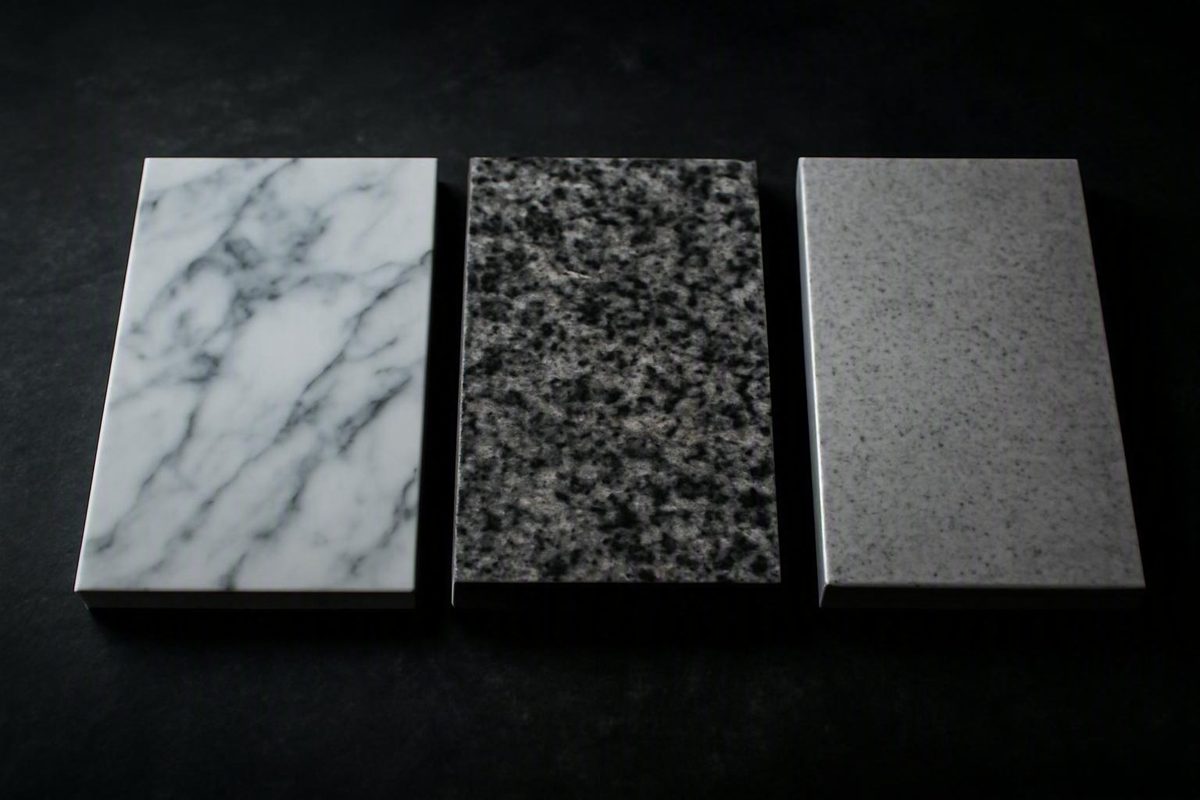
The marble vs granite vs quartz decision is not about finding a single material with the highest all-purpose durability score. It is about matching a surface to the spills, heat, cleaning habits, appearance preferences, and maintenance demands that matter in your home.
Granite and marble are quarried natural stones. Countertop quartz is an engineered slab made with quartz-rich mineral aggregate, pigments, and a binder, usually resin. That distinction affects visual consistency, porosity, sealing requirements, and response to excessive heat.
A practical starting point is:
- Choose quartz when low upkeep, controlled patterning, and resistance to frequent spills matter most.
- Choose granite when you want natural variation and relatively strong heat tolerance.
- Choose marble when distinctive natural veining outweighs concerns about acids, scratches, stains, and visible aging.
These are category-level tendencies, not guarantees. The exact stone or quartz product, finish, sealer, fabrication, installation, and care routine can materially affect performance. Most available comparison guidance also comes from countertop sellers, suppliers, fabricators, and design publishers rather than standardized independent testing. Use this guide to build a shortlist, then obtain written instructions for the product you intend to buy.
The short answer: compare priorities, not a single durability score
“Durability” can mean resistance to stains, moisture, heat, acids, scratches, chips, impacts, or cracks. A surface may perform well in one category while requiring more caution in another.
Granite, for example, generally handles heat exposure better than engineered quartz. Quartz is generally nonporous and normally requires no sealing. Marble is more vulnerable in typical countertop use to acidic ingredients, absorbed stains, and visible scratching. Commercial countertop comparisons support these broad distinctions, but they do not establish one universal winner. Seacoast Stone separates porosity, heat, acid, and impact concerns rather than treating durability as one property.
| Comparison point | Marble | Granite | Engineered quartz |
|---|---|---|---|
| Composition | Quarried natural stone | Quarried natural stone | Quartz-rich aggregate, pigments, and resin or another binder |
| Appearance | Natural, often vein-led, with substantial slab variation | Natural grains, flecks, veins, and irregular variation | More controlled colors and generally more repeatable patterns |
| Sealing | Commonly benefits from periodic sealing | Commonly benefits from periodic sealing | Normally does not require sealing |
| Stains and moisture | Often more vulnerable to absorption; prompt cleanup matters | May absorb liquids when sealing is inadequate | Generally lower absorption concern because the surface is nonporous |
| Acid sensitivity | High; acidic ingredients can etch the surface | Does not have marble’s characteristic calcite etching risk | Does not react like calcite-rich marble, but cleaner restrictions vary |
| Heat precautions | Use trivets or heat pads | Generally stronger heat tolerance, but heat protection remains prudent | Excessive heat can damage the resin-containing surface |
| Scratch concerns | More prone to visible scratching in typical use | Generally more resistant than marble | Generally resistant in ordinary use, but not scratch-proof |
| Impact concerns | Edges and corners may be vulnerable | A substantial impact can chip or break the stone | Edges may chip; product and fabrication details matter |
| Routine upkeep | Gentle cleaning, rapid spill response, and sealing when needed | Routine cleaning and sealing when needed | Routine cleaning without periodic sealing |
| Common fit | Appearance-led islands, vanities, or baking areas where wear is acceptable | Kitchens prioritizing natural stone and heat tolerance | Busy kitchens, rentals, bathrooms, and consistency-led designs |
Quartz or granite is usually more practical than marble in a heavily used kitchen. Neither is invulnerable: quartz still needs protection from excessive heat, while granite can absorb spills when its sealer is ineffective and may break under a sufficiently heavy impact.
The useful question is therefore not “Which countertop is best?” but “Which forms of damage are most likely here, and which maintenance tasks will actually be completed?”
- For frequent spills and little appetite for sealing, begin with quartz.
- For natural variation and frequent handling of hot cookware, begin with granite—but still plan to use trivets.
- For distinctive veining, consider marble only after deciding that etching, scratches, prompt cleanup, sealing, and visible aging are acceptable.
What marble, granite, and countertop quartz actually are
Granite and marble are natural materials extracted in blocks and cut into slabs. Mineral content, grain, veining, color, fissures, and porosity can vary between stone types and between individual slabs.
Engineered quartz is manufactured rather than cut as an intact natural-stone slab. Producers combine quartz-rich mineral aggregate with pigments and a binder, usually resin, and form the mixture into slabs. Formulations vary, so no single mineral-to-resin percentage should be assigned to every product. An interior-design guide developed with stone-supplier input likewise distinguishes natural marble and granite from engineered quartz made with aggregate, pigment, and binder.
Engineered countertop quartz is also not quartzite. Quartzite is a quarried natural stone; countertop quartz is a manufactured composite. Their names may sound similar, but their care, heat, sealing, fabrication, and warranty instructions should not be treated as interchangeable.
How composition affects performance
The binder in engineered quartz helps create a nonporous surface and permits controlled colors and relatively repeatable patterns. It also creates a heat-related limitation: excessive or prolonged heat may discolor, scorch, crack, or otherwise damage a quartz surface. Because formulations and warranties vary, use the manufacturer’s written heat guidance for the exact product rather than relying on a universal temperature limit.
Marble behaves differently because it contains calcite. Acids can react with that mineral. Lemon juice, vinegar, wine, citrus, and acidic cleaning products may leave a dull, rough, or lighter mark called an etch.
Granite and marble can absorb liquids to different degrees, particularly when a surface is unsealed, inadequately sealed, or naturally more porous. A compatible sealer can slow absorption. Engineered quartz is generally described as nonporous and normally needs no sealing. Laurysen Kitchens’ material guide summarizes these composition, porosity, and sealing distinctions.
Porosity alone does not determine complete countertop performance. The particular stone, finish, existing sealer, quartz formulation, fabrication, seams, and installation all matter.
Appearance: natural variation versus controlled patterning
Granite does not have one uniform visual identity. A slab may contain fine mineral flecks, large crystalline grains, flowing veins, bands, swirls, or abrupt color changes. That irregularity is part of choosing natural stone, but it can make slab matching and seam placement more complicated.
Marble is also naturally variable and is often selected for vein-led compositions. Some slabs show quiet lines and limited contrast; others have strong directional movement. These are visual characteristics, not measurable performance advantages.
Quartz offers greater design control. Manufacturing can produce solid colors, fine speckling, textured effects, or patterns intended to resemble granite or marble. Slabs sold under the same product name will generally coordinate more closely than unrelated natural-stone slabs, but the actual material should still be reviewed before fabrication. Appearance alone may not conclusively identify a surface, especially when quartz is made to imitate stone. UMI Stone describes granite’s irregular mineral variation in contrast with quartz’s more predictable manufactured patterning.
Never approve natural stone from a small sample alone
A hand sample can indicate general color and finish, but it cannot show the full movement, fissures, vein direction, or tonal range of a granite or marble slab. Before fabrication:
- Inspect the complete slab under lighting reasonably similar to the intended room.
- Identify strong color changes, fissures, inclusions, pits, or other visible irregularities.
- Ask how the slab will be divided among the countertop runs.
- Confirm which areas will surround the sink and cooktop.
- Review vein direction at corners, seams, backsplashes, and waterfall edges.
- Decide whether adjoining pieces should continue a pattern or simply coordinate.
- Record the approved layout before cutting begins.
Photographs are useful records, but they should not replace a clearly agreed fabrication layout when vein placement is important.
Finish changes what you notice
On marble, a polished finish emphasizes reflection, color depth, and veining. It may also make an etched patch conspicuous because the dull area interrupts the reflection. Honed marble has a matte appearance and may make some minor wear less noticeable, but it does not prevent etching, staining, or scratching.
Do not assume that the same finish behaves identically on every granite or quartz product. Textured, matte, or honed surfaces may have product-specific cleaning requirements and warranty conditions. Ask for instructions tied to the exact selection.
Marble’s changing appearance is ultimately a preference question. One owner may appreciate accumulated etches, softened gloss, and small scratches as patina. Another may regard the same changes as damage. Settle that question before buying rather than after the first acidic spill.
Durability by damage type: heat, stains, acids, scratches, and impacts
No defensible comparison can reduce all forms of countertop damage to one score.
| Damage type | Marble | Granite | Engineered quartz |
|---|---|---|---|
| Heat | Heat protection recommended | Generally the strongest heat candidate of the three, but direct exposure still creates avoidable risk | Generally the greater heat concern because excessive heat can affect the resin-containing surface |
| Absorbed stains | Higher concern, especially without suitable sealing | Possible when sealing is absent or ineffective | Generally lower concern because the surface is nonporous |
| Acid etching | Major concern | Not the characteristic risk it is for marble | Not subject to marble’s calcite reaction |
| Scratching | More vulnerable and likely to show wear | Generally more resistant than marble | Generally resistant in routine use, but not scratch-proof |
| Heavy impact | Edges and corners may chip | A heavy falling object can chip or break the stone | Edges may chip; performance varies by product and fabrication |
| Cracking | Possible; the cause requires project-specific assessment | Possible; the cause requires project-specific assessment | Possible; the cause requires product- and project-specific assessment |
Heat
Granite generally offers stronger heat tolerance than engineered quartz. Quartz has the clearer category-level vulnerability because excessive heat can damage its resin-containing surface. Marble may tolerate ordinary kitchen warmth, but that is not a reason to use it as a built-in trivet. A commercial fabricator comparison warns that excessive heat may discolor or crack quartz and recommends heat-resistant mats. Its guidance presents granite as the stronger heat candidate while still supporting countertop protection.
Use trivets or insulated heat pads on all three materials. This avoids testing how the selected slab, finish, sealer, seam, or repaired area responds to concentrated or prolonged heat.
Heat-producing countertop appliances also deserve attention. Ask the appliance and countertop manufacturers what clearance or insulation they require.
Do not rely on a universal temperature limit for granite or quartz. Actual risk depends on the product, exposure time, cookware or appliance, and installation. Written guidance for the exact product controls.
Stains and moisture
Quartz is generally the more forgiving candidate for frequent spills because it is nonporous. That does not mean it is stain-proof or immune to marks. Follow the manufacturer’s instructions for routine cleaning and persistent residues rather than applying an improvised chemical treatment.
Granite can absorb liquids when its sealer is absent, worn, unsuitable, or ineffective. Prompt cleanup remains sensible even when the stone has been sealed.
Marble calls for the most attentive spill response of the three. Its absorption risk is joined by a separate acid-etching risk. Oils, wine, cosmetics, food coloring, and other strongly pigmented substances should not be left standing.
Etching is not the same as staining
A stain is discoloration that has entered or adhered to the material. An etch is a chemical alteration of marble’s calcite-rich surface.
The distinction matters because the responses are different.
Sealing marble can slow liquid absorption and provide more cleanup time. It cannot prevent acid from reacting with calcite. Countertop Shop’s marble guidance similarly states that marble can absorb liquids, acids can etch it, and sealing does not make it completely stain-resistant. The same guide identifies edges, corners, and busy work areas as places where wear may become especially visible.
Scratches
Marble is softer and generally more prone to visible scratching than granite or engineered quartz in typical countertop use. A honed finish may make some marks less conspicuous, but it does not prevent them.
Granite and quartz should still be treated as countertops rather than cutting boards. Quartz should not be described as universally scratch-proof; results can vary with product, finish, color, and type of contact.
Chips, impacts, and cracks
Hardness does not mean immunity to breakage. A heavy falling object can chip or break granite. Marble edges and corners may be vulnerable because impact force is concentrated over a small area. Quartz edges can also chip.
The evidence does not support a universal ranking for chip, impact, or crack resistance across all three categories. Nor does it support diagnosing every crack from the material name alone. Ask the fabricator about the exact product, edge profile, sink area, seams, overhangs, support plan, and repair options.
The practical implications are straightforward:
- Spill-heavy households may find quartz easier to live with.
- Heat-intensive cooks may prefer granite but should still use heat protection.
- Marble owners must be prepared to manage acids, clean spills promptly, and accept or address visible wear.
Maintenance and cleaning: what ownership requires
Quartz is lower maintenance because it normally does not require sealing. “Lower maintenance” does not mean “maintenance-free.” Quartz still requires routine cleaning, approved products, attention to persistent marks, and protection from excessive heat.
Granite commonly benefits from periodic sealing, but there is no defensible annual schedule that applies to every slab. Marble also commonly benefits from sealing and usually requires greater attention to spills. Timing depends on the stone, finish, existing treatment, intensity of use, cleaner selection, and instructions supplied with the sealer or installation.
| Care task | Marble | Granite | Engineered quartz |
|---|---|---|---|
| Daily cleaning | Soft cloth and gentle, non-acidic cleaner | Soft cloth and mild cleaner approved for the stone and sealer | Mild manufacturer-approved cleaner |
| Spill response | Blot promptly, especially acids, oils, wine, and cosmetics | Wipe promptly rather than relying entirely on the sealer | Wipe promptly and follow product guidance for persistent marks |
| Heat protection | Use trivets or heat pads | Use trivets or heat pads | Protect the surface from hot cookware and heat-producing appliances |
| Sealing | May reduce absorption; frequency varies | Seal when the stone and existing treatment require it | Normally not required |
| Products to avoid | Acidic and abrasive cleaners; unapproved harsh chemicals | Abrasives, acids, or chemicals not approved for the stone and sealer | Abrasives, strong chemicals, or solvents not approved by the manufacturer |
| Written guidance to obtain | Cleaner, sealer, stain response, and etch response | Cleaner, sealer, assessment method, and resealing guidance | Cleaner list, heat guidance, mark removal, and warranty restrictions |
For marble, use a soft cloth and a gentle, non-acidic cleaner. Avoid vinegar mixtures, acidic bathroom cleaners, abrasive powders, and aggressive scouring pads. Marble.com’s comparison likewise describes quartz as nonporous and normally seal-free while warning that acids and harsh cleaners can damage marble and excessive heat can affect quartz resin. Its overview illustrates why the three materials require different care routines.
Do not reseal merely because a calendar reminder appears. Review the fabricator’s instructions, the sealer specification, and the condition of the surface first. If the proper assessment method is unclear, ask the installer or sealer manufacturer rather than applying another product by default.
Before installation is complete, obtain written care instructions for the exact slab or quartz product. General category advice cannot override manufacturer cleaner restrictions, sealer instructions, or warranty terms.
Cost: compare complete installed quotes, not headline slab prices
The available evidence does not establish a universal price order for marble, granite, and quartz. Published figures differ by date, region, grade, rarity, and project scope, and they do not always state whether fabrication or installation is included. Rare granite may cost more than an ordinary marble; premium quartz may exceed entry-level natural stone; and demanding vein placement can increase material use and fabrication work.
For that reason, old seller-specific square-foot prices are poor national benchmarks. Compare current local quotes based on identical specifications.
Material variables that change the price
Ask bidders to account for:
- Stone rarity, origin, grade, and local availability
- Quartz manufacturer and product line
- Color and pattern
- Slab thickness
- Finish
- Slab dimensions and number of slabs required
- Usable material after cutouts and layout decisions
- Natural features or damaged areas excluded from the layout
- Additional material needed to achieve a specified vein arrangement
Natural-stone selection can affect yield. A design guide addressing natural and engineered countertop materials identifies rarity, transportation, finish, fabrication, seams, and installation as cost variables. That project-level framing is more useful than treating one square-foot figure as a complete price.
Fabrication and installation variables
The installed quotation may also change with:
- Edge profile
- Sink and cooktop cutouts
- Faucet and accessory holes
- Seam quantity and complexity
- Vein alignment
- Backsplashes and upstands
- Waterfall ends
- Delivery access
- Removal and disposal of existing countertops
- Cabinet preparation or project-specific support work
- Plumbing and appliance coordination
- Installation and return visits
Marble ownership may also involve sealing and professional assessment of stains, etching, chips, or accumulated wear. Granite may require sealing and occasional repair. Quartz avoids routine sealing, but any heat, impact, chip, or crack repair should be evaluated for the specific product. Repairability and cost are local and damage-specific; ask for them rather than assuming a standard outcome.
Quote-comparison worksheet
Require every bidder to price the same scope:
| Item | Specification to give every bidder |
|---|---|
| Exact material | Named stone and slab, or quartz manufacturer, product line, and color |
| Grade or selection | Same grade, selection criteria, and accepted natural features |
| Thickness | Identical finished thickness and built-up edge details |
| Finish | The same polished, honed, textured, or other finish |
| Layout | Same drawings, dimensions, overhangs, and backsplash |
| Edge | Same profile on the same exposed runs |
| Cutouts | Same sink, cooktop, faucet, outlet, and accessory openings |
| Seams | Proposed quantity, locations, and pattern expectations |
| Sink | Same mounting method and division of responsibilities |
| Supports | Same assumptions for cabinetry, reinforcement, brackets, and overhangs |
| Removal | State whether demolition and disposal are included |
| Delivery | Include access constraints, stairs, lifts, and site protection |
| Installation | Define templating, fabrication, fitting, caulking, and completion |
| Sealing | State whether initial natural-stone sealing is included |
| Warranty | Record material and workmanship coverage separately |
Ask whether tax, templating, plumbing disconnection, sink mounting, appliance coordination, disposal, sealing, and return visits are included. These are quote-comparison questions, not universal inclusions.
Do not justify a countertop by assuming a fixed lifespan, guaranteed resale increase, or specific return on investment. Those outcomes depend on the product, installation, use, local buyers, and the rest of the property.
Best material by room, household, and working habits
The right surface changes with the room and the people using it.
Busy family kitchen
Quartz is often the practical starting point when spills are frequent and the household wants to avoid routine sealing. Its nonporous surface reduces absorption concerns, while controlled patterning can simplify coordination across a large kitchen.
The condition is consistent heat protection. Keep trivets where hot pans, baking sheets, or heat-producing appliances are used, and follow the product’s written heat instructions.
Heat-intensive cooking
Granite is the stronger candidate when heat tolerance and natural stone lead the brief. It still deserves heat pads. The goal is not to discover how a particular slab, sealer, seam, or installed detail reacts to concentrated heat.
Workflow matters as much as material. If cookware repeatedly moves from the cooktop to one counter location, create a designated landing area with readily available heat protection.
Appearance-first kitchen or island
Marble can work in an active kitchen when the owner knowingly accepts:
- Prompt spill cleanup
- Sealing when required
- Acid etching
- Greater scratch visibility
- Possible stains and edge wear
- An appearance that evolves with use
If the goal is a permanently uniform, highly polished surface, marble may create more concern than enjoyment. If natural wear is welcome, its developing patina may suit the design.
Bathroom vanity
Quartz is a practical low-absorption option for water, cosmetics, soap, and routine cleaning. Marble is an appearance-led alternative requiring more careful cleaner selection and prompt attention to spills.
Bathrooms are not risk-free. Confirm compatibility with the exact countertop rather than assuming the absence of cooking heat makes every product suitable.
Baking area
Marble is commonly valued for its naturally cool working surface, which may appeal to people preparing pastry or dough. A real-estate company’s comparison notes that use while also identifying marble’s susceptibility to staining, scratching, and etching. Its room-based overview balances the baking benefit against marble’s care demands.
The tradeoff is exposure to lemon, fruit, wine, food coloring, oils, and other ingredients that may stain or etch. A dedicated marble section may suit some kitchens better than marble on every worktop.
Rental or maintenance-averse household
Consider quartz when routine sealing is unlikely to happen. Its lack of a normal sealing requirement simplifies the care routine.
Do not call it tenant-proof. Hot cookware, unsuitable chemicals, sharp impacts, and improper appliance use can still damage the surface.
Design-consistency priority
Quartz is usually the better fit when controlled color, predictable patterning, and close coordination across several slabs matter. Review the actual supplied material before fabrication, particularly for a large island, full-height backsplash, or pattern-sensitive design.
Natural-material priority
Choose between granite’s broad mineral variation and marble’s often vein-led movement. Neither should be selected from a product name or small sample alone. Inspect the complete slab and approve its planned layout before cutting.
A five-question decision tree
-
Will the counter frequently receive hot cookware? If yes, put granite near the top of the shortlist, while retaining a trivet habit.
-
Are spills frequent, or is cleanup sometimes delayed? If yes, quartz will generally be the more forgiving candidate.
-
Are you willing to monitor and periodically seal natural stone? If no, quartz has a meaningful upkeep advantage.
-
Would etching, scratches, and developing patina bother you? If yes, remove marble from heavily used work areas.
-
Do you prefer one-off natural variation or controlled patterning? Choose granite or marble for natural slab variation; choose quartz for greater predictability.
Before ordering: a slab, fabricator, and installation checklist
A countertop is not just a material. It is a fabricated and installed assembly involving slabs, seams, cabinets, cutouts, supports, appliances, and site conditions. Because the evidence does not support universal structural or installation rules for all products, use the following points as questions for the manufacturer, fabricator, installer, or project engineer where appropriate.
Confirm what you are buying
Record whether the surface is:
- Natural granite
- Natural marble
- Engineered quartz
- Natural quartzite
- Another stone or composite
Use the exact trade name, manufacturer, product line, color, finish, thickness, and slab identification when available. Do not accept “quartz” without establishing whether the quote means engineered quartz or natural quartzite.
For granite and marble
Inspect the complete slab and agree on:
- Vein or grain direction
- Overall color variation
- Visible fissures, inclusions, pits, or irregularities
- Placement around sinks and cooktops
- Corner transitions
- Backsplash and waterfall orientation
- Edge placement
- Seam locations and appearance
- Areas to feature or avoid
A small sample cannot represent the complete movement or variation of a natural slab.
For engineered quartz
Record or request:
- Manufacturer and product line
- Color and finish
- Identifying product or slab information
- Warranty
- Approved cleaners
- Heat guidance
- Requirements for trivets and countertop appliances
- Restrictions for the proposed installation location
- Approved repair procedures
- Exclusions applying to unusual, outdoor, or commercial uses
Do not generalize sunlight behavior, repairability, or location restrictions across the entire quartz category. Ask whether the selected product is approved for the proposed setting and obtain the answer in writing.
Ask the fabricator about the complete assembly
Ask how the proposed material, layout, sink, cooktop, corners, overhangs, cutouts, and seams affect fabrication and support. Do not rely on a universal support rule for every material, thickness, cabinet layout, and opening.
Confirm who is responsible for:
- Final measurements
- Digital or physical templates
- Cabinet leveling and readiness
- Determining whether reinforcement is required
- Delivery access and site protection
- Plumbing disconnection and reconnection
- Appliance removal or coordination
- Sink mounting
- Installation and final fitting
- Initial natural-stone sealing
- Handling material issues discovered during fabrication
- Repairs to walls, paint, or tile disturbed during installation
- Removal and disposal of old countertops
Request written instructions covering routine cleaning, sealing, heat protection, stain response, repair options, and warranty exclusions. Ask whether chips, stains, etching, scratches, cracks, or heat damage can be treated on the exact surface, what the likely visual result would be, and who is authorized to do the work.
If the supplier permits it, ask whether an approved sample can be used to evaluate color, finish, and cleaner compatibility. Remember that a sample cannot fully represent the variation of a granite or marble slab.
Frequently asked questions
Does quartz need to be sealed?
Engineered quartz normally does not require sealing because its manufactured surface is nonporous. That is a maintenance advantage, not proof that the surface is maintenance-free.
Quartz still requires routine cleaning, approved cleaning products, attention to persistent marks, and protection from excessive heat. Do not apply a stone sealer unless the quartz manufacturer specifically instructs you to do so.
Can hot pans be placed directly on granite, marble, or quartz?
Use a trivet or insulated heat pad on all three.
Granite generally offers the strongest heat tolerance of the three, but direct exposure creates unnecessary uncertainty involving the particular slab, finish, sealer, seam, or installed condition. Marble should receive the same precaution.
Direct hot-pan contact is a greater category-level concern for engineered quartz because excessive heat can damage its resin-containing surface. Arch City Granite attributes quartz’s lower heat tolerance to its resin and advises against direct hot-pan exposure on all three materials. Its comparison identifies quartz as having the greatest potential for heat damage.
Why can sealed marble still etch?
A sealer primarily slows liquid absorption into the stone. Etching is a chemical reaction between acid and marble’s calcite-rich surface, so sealing cannot reliably prevent it.
Lemon juice, vinegar, wine, citrus, and acidic cleaning products may leave dull or rough marks even on recently sealed marble. Prompt cleanup can reduce exposure, but it does not make marble acid-resistant.
How often should granite or marble be resealed?
There is no universal interval. Appropriate timing depends on the stone, finish, existing sealer, quality of application, cleaning products, intensity of use, and professional guidance.
Follow the instructions for the installed stone and sealer. Ask the fabricator or sealer manufacturer how to assess the existing treatment rather than assuming that every granite must be resealed annually or that every marble follows the same schedule.
Is engineered quartz the same material as quartzite?
No. Engineered quartz is a manufactured slab made from quartz-rich aggregate, pigments, and a binder, usually resin. Quartzite is a quarried natural stone.
Because they are different materials, do not transfer heat limits, sealing advice, cleaner recommendations, fabrication assumptions, or warranty terms from one to the other. Confirm the exact material name in writing before approving the quote or care plan.
The final selection rule is priority-based, not winner-based: choose quartz when minimizing sealing and managing frequent spills matter most; granite when natural variation and stronger heat tolerance lead the brief; or marble when distinctive veining outweighs concerns about etching, scratches, stains, and patina. Before ordering, inspect the actual slab or product, obtain written care and heat guidance, and compare complete local installation quotes based on identical specifications.