
LEGO Technic 8443 Log Loader: When Specs Differ
LEGO's listing gives 320 pieces. Reviews and inventories reveal two-cylinder pneumatics, a geared grapple, suspension and turntable-based steering.
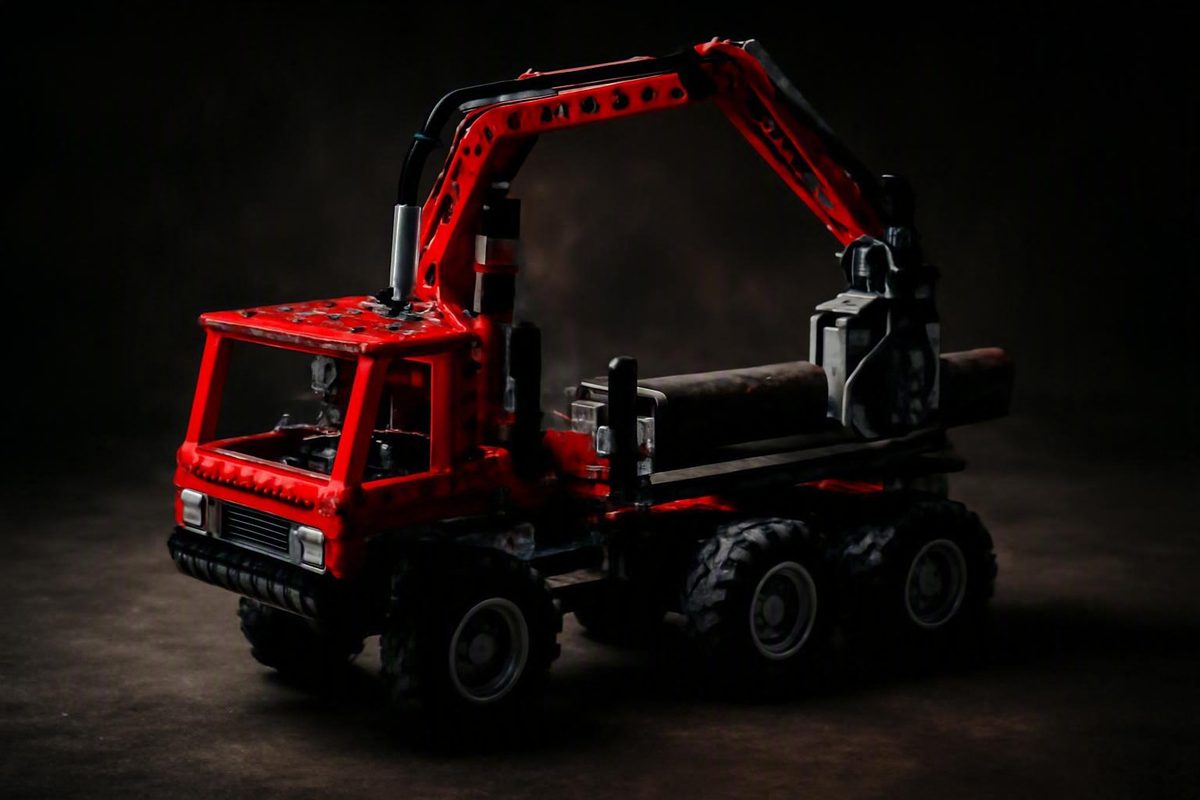
LEGO Technic set 8443 is a pneumatic, six-wheel log-handling vehicle from 1996. Its studded red, gray, and black structure carries a crane boom and two-jaw grapple, but the model is more mechanically ambitious than its size suggests. Steering involves both the front wheels and rotation through a central turntable, two pneumatic cylinders operate the working equipment, and paired gears coordinate the grapple jaws.
Researching the set requires care because its documented names, availability dates, cylinder count, and parts totals do not agree across every source. The most reliable approach is to use LEGO’s metadata and LEGO-hosted manual for official facts, then consult inventories and hands-on reviews for component-level and mechanical details.
LEGO Technic 8443 at a glance
Set 8443 represents a specialized forestry or crane vehicle rather than an ordinary road truck. Its six wheels, elevated bodywork, pneumatic crane, and closing grapple suggest machinery intended to lift logs or similar loads. A third-party instruction archive reports that the set has no minifigures and describes its instruction booklet as 52 pages. BrickInstructions records the booklet, set name, and absence of minifigures.
| Specification | Documented information |
|---|---|
| Set number | 8443 |
| Database identifier commonly used | 8443-1 |
| Theme | LEGO Technic |
| LEGO-listed year | 1996 |
| LEGO-listed piece count | 320 |
| LEGO-listed age range | 10–16 |
| Common documented names | Pneumatic Log Loader; Pneumatic Logger |
| Configuration | Six-wheel pneumatic log-handling or crane vehicle |
| Main colors | Red, gray, and black |
| Minifigures | None reported by BrickInstructions |
LEGO’s support metadata establishes the principal official specifications: Technic theme, set number 8443, year 1996, 320 pieces, and an age range of 10–16. The page provides one instruction download but does not display a descriptive model name or explain the functions. See LEGO’s official building-instructions listing for set 8443.
A completed model is recognizable by its six-wheel layout, predominantly red studded body, exposed gray and black Technic structure, crane boom, pneumatic hoses, and two-jaw grapple. Its beams, bricks, and plates reflect the studded Technic construction used during the period rather than the predominantly studless liftarm construction associated with many later vehicles.
Throughout this profile, “official” refers to information established by LEGO’s support metadata or the LEGO-hosted manual. Archived enthusiast pages, inventories, reviews, instruction archives, and marketplace records provide useful supporting evidence, but their claims remain third-party information. That distinction is particularly important when discussing regional names, retail dates, pneumatic components, and parts totals.
Why the set appears under several different names
The set number is the safest identifier. “8443” remains consistent even when the descriptive title changes, while collector databases commonly list the release as “8443-1.” Searches and used listings may therefore use either form.
An archived Technica entry records three regional names: Pneumatic Logger for the United Kingdom, Pneumatic Log Loader for the United States, and 6 Wheel Crane for New Zealand. Because the page is an archived enthusiast reference rather than an official LEGO catalog, those labels should be treated as documented search terms rather than proof that each title appeared universally on packaging or in every catalog. The archived Technica page preserves the reported regional names.
The three names emphasize different aspects of the same model:
- Pneumatic Log Loader identifies both the air-powered functions and the material-handling role.
- Pneumatic Logger presents the vehicle more broadly as forestry equipment.
- 6 Wheel Crane describes its visible layout without restricting it to log handling.
Rebrickable combines the first two names in one record, listing 8443-1 as “Pneumatic Log Loader / Pneumatic Logger.” That combined form is useful for database searches, but it does not establish one worldwide official product name. Rebrickable shows the combined title and 8443-1 identifier.
LEGO’s current instructions page is more neutral. It identifies the item by set number and theme without displaying any of the three descriptive titles. The instruction cover uses the broader wording “LEGO Technic Pneumatic” together with 8443.
Useful search phrases include:
- LEGO Technic 8443
- LEGO Technic 8443-1
- 8443 Pneumatic Log Loader
- 8443 Pneumatic Logger
- 8443 6 Wheel Crane
- LEGO Technic Pneumatic 8443
The regional names should not be used to construct a definitive market-by-market release chronology. The archived Technica record contains an internal conflict concerning the United States: its narrative says the set was released there in 1997, while its US name entry is marked 1996. The dating problem is best addressed as part of the broader release history.
Release date and the limits of the 1996–1998 timeline
The primary year for LEGO Technic set 8443 is 1996, the year assigned in LEGO’s support metadata. Third-party databases and reviews also place the initial release in 1996.
The uncertainty concerns how long the set remained available and whether all markets followed the same schedule. Rebrickable provides a database window from August 1, 1996, through December 31, 1998. Those exact dates are third-party fields rather than worldwide launch and withdrawal dates supplied by LEGO, so they should not be treated as a confirmed global retail schedule. Rebrickable reports the August 1996–December 1998 window.
Marketplace catalog data also identifies 1996 as the release year and 1998 as the retirement year. That is useful for broad orientation, but a marketplace retirement field cannot prove that every retailer or national market stopped selling the set at the same time.
The archived Technica page describes a broader 1996–1998 period and associates different names or years with particular countries. Its contradictory US references—1997 in the narrative but 1996 in the name entry—show why those dates must remain attributed rather than presented as settled history. (Archived Technica entry for set 8443.)
A cautious timeline is therefore:
- 1996: LEGO’s assigned year and the best-supported initial-release year.
- 1997: Reported as the US release year in one part of the archived Technica page, but contradicted elsewhere on that page.
- 1998: Reported by third-party sources as the end of the availability window or the retirement year.
The evidence does not establish an exact worldwide launch day, simultaneous international availability, original retail prices, production quantities, or the date when the last store stock was sold. It also does not establish rarity. Age, restoration difficulty, and scarcity of complete examples are not substitutes for production data.
How the steering, suspension, crane, and grapple work
Set 8443 is built as two principal structural sections connected around a large Technic turntable. That connection is functional: hands-on reviews describe steering that combines front-wheel movement with rotation between the main sections.
RacingBrick reports that the forward structure carries four wheels, two of which steer, while the rear structure carries two non-steering wheels. The rear section rotates relative to the front through the turntable as part of the steering action. The review also documents a simple suspension and the broad order of construction. RacingBrick illustrates the suspension, turntable connection, and steering behavior.
Because the evidence comes from observation of the completed model rather than an official LEGO mechanism name, turntable-based steering or articulated-style steering is preferable to asserting a more specific designer-defined classification. The model does not steer solely by pivoting a conventional axle: the relationship between the two chassis sections also changes.
The principal working elements are:
- A rear-mounted manual pneumatic pump
- Two pneumatic switches
- Pneumatic tubing and connectors
- A crane boom
- A two-jaw grapple
- One larger pneumatic cylinder
- One small pneumatic cylinder
- Paired gears coordinating the grapple jaws
- A large turntable incorporated into the steering structure
A Eurobricks pictorial review identifies one pneumatic cylinder as the actuator that raises and lowers the main boom. It also reports that paired 16-tooth gears make the claw close symmetrically. The same review notes a rear hitch and a P43S-marked decoration, both useful reference points when comparing a used model with photographs of the documented build. The Eurobricks review documents the boom actuator, 16-tooth grapple gears, hitch, and P43S detail.
The geared grapple is a compact but effective mechanism. Meshing equal gears transfers movement from one side of the claw to the other, allowing the jaws to mirror each other. In a correctly assembled model, they should move together rather than closing at unrelated rates.
These are general troubleshooting possibilities, not source-confirmed diagnoses for any particular copy. The mechanism should be inspected before assuming that poor claw movement is caused by an air leak.
Reviews document the broad construction sequence as follows:
- Build the forward structure and simple suspension.
- Install the front steering components.
- Assemble the pneumatic controls and begin routing the tubing.
- Construct the rear structure and pump area.
- Join the principal sections through the large turntable.
- Complete the steering connection between those sections.
- Add the upper bodywork.
- Build the crane arm and fit its pneumatic elements.
- Assemble and gear the grapple.
- Install the six wheels and complete the external details.
A restorer working from loose parts should check free movement, gear engagement, and hose placement as each mechanism is assembled rather than waiting until the model is complete.
The rear hitch and P43S decoration do not determine whether the mechanical functions work, but they help distinguish a functional reconstruction from a cosmetically faithful one. Sticker wear and substituted decorated elements are therefore best recorded separately from mechanical completeness.
The pneumatic system has two cylinders, not one
The strongest component-level evidence supports two pneumatic cylinders: one larger cylinder and one small cylinder. The documented pneumatic equipment also includes one manual pump, two switches, two T-pieces, and multiple hoses.
A detailed inventory records a medium-labeled yellow cylinder, a small yellow cylinder, one yellow pump, two light-gray switches, two T-pieces, and several cut hose lengths. “Larger cylinder” is the clearest neutral description because inventory terminology for the actuator may vary. The Scribd-hosted inventory lists both cylinders and the supporting pneumatic components.
| Pneumatic component | Quantity supported by the detailed inventory |
|---|---|
| Larger cylinder | 1 |
| Small cylinder | 1 |
| Manual pump | 1 |
| Pneumatic switches | 2 |
| T-pieces | 2 |
| Hoses | Multiple lengths |
The Eurobricks build review independently identifies one small cylinder, one larger cylinder, one pump, and two switches. It confirms that one of the cylinders raises and lowers the main boom. The available evidence does not justify assigning a precise function to the second cylinder without checking the illustrated routing or the completed model directly. (Eurobricks pictorial review of set 8443.)
This evidence conflicts with the archived Technica page, which reports only one pneumatic cylinder. The two-cylinder description is better supported because it appears in both a component-level inventory and a sequential hands-on review. The archived entry provides only a summary count and does not explain its methodology. The evidence does not establish whether that figure resulted from an error or a difference in terminology.
The pneumatic parts should be counted by function:
- The pump creates air pressure.
- The cylinders convert pressure differences into linear movement.
- The switches direct airflow.
- The T-pieces divide or join air paths.
- The hoses connect the system.
The pump should not be counted as a cylinder. A used listing that mentions “one pump and one cylinder” therefore does not describe the full pneumatic complement supported by the detailed sources.
A practical inspection can be kept simple and non-destructive:
- Examine each hose end for cracking, hardening, stretching, or a loose fit.
- Confirm that hoses are connected rather than positioned only for appearance.
- Operate each switch separately while applying moderate pressure to the pump.
- Observe whether both cylinders move.
- Check that the boom structure moves without obvious mechanical binding.
- Open and close the grapple through its available range.
- Verify that the geared jaws remain synchronized.
- Pause after actuation and note any immediate, substantial drift.
It does not prove factory condition, identify a specific worn component, or establish that every seal is healthy.
Older hoses should be handled conservatively. Diagnose one circuit at a time and avoid forcing the pump, switch levers, cylinders, or grapple.
Why sources report 320, 327, 334, or 335 pieces
LEGO’s official listed piece count is 320. That is the correct figure when answering the official piece-count question. Higher totals are third-party review, catalog, or inventory figures rather than alternative official LEGO counts. LEGO’s support listing gives 320 pieces.
| Source type | Reported total | Appropriate interpretation |
|---|---|---|
| LEGO support metadata | 320 | Official listed piece count |
| Archived Technica entry | 320 | Third-party figure matching LEGO |
| eBay catalog | 327 | Marketplace catalog field |
| Eurobricks review | 327 | Reviewer-reported total |
| BrickInstructions | 327 | Third-party instruction-archive count |
| Rebrickable | 334 | Database inventory total |
| Scribd-hosted inventory | 335 regular parts | Component-list total with other categories separated |
The archived Technica figure of 320 matches LEGO’s metadata, but the page remains a third-party record. The eBay catalog, Eurobricks review, and BrickInstructions archive each report 327 pieces. The eBay product record displays the 327-piece catalog figure. The Eurobricks and BrickInstructions totals are likewise source-specific third-party figures rather than LEGO metadata.
Rebrickable labels its figure as an inventory of 334 parts. That wording is important: a database inventory maintained for collection management may apply different counting conventions from an official retail total.
The Scribd-hosted inventory reports 335 regular parts across 98 regular-item lots. It also displays four extras and separate quantities for counterpart and alternate-item entries. Those categories cannot simply be added together. A decorated counterpart can represent a stickered form of a regular element, while an alternate entry can represent a substitution rather than another required component. The inventory separates 335 regular parts from four extras and other entry types.
Several explanations are possible:
- One system may include expected spare parts while another excludes them.
- Alternate molds or element versions may be represented differently.
- Stickered pieces may be recorded as decorated counterparts.
- Hose lengths may be cataloged under different conventions.
- Inventories may have been revised independently.
- Reviews and marketplace catalogs may have inherited totals from other databases.
The evidence does not provide a complete part-by-part reconciliation. It would therefore be misleading to claim that seven, fourteen, or fifteen specifically identified pieces conclusively explain the differences.
For rebuilding, a consistent inventory is more useful than selecting the largest headline number. Choose one documented inventory and maintain separate columns for:
- Required regular parts
- Expected extras
- Alternate items
- Decorated counterparts
- Sticker sheet or unapplied stickers
- Parts physically present
- Replacement parts still needed
Use the official 320 figure when describing LEGO’s listed piece count. Use the line items in the chosen inventory when ordering replacements. Combining the headline total from one database with alternate, extra, or counterpart categories from another can create apparent shortages or duplicates that do not reflect the physical model.
Official instructions, additional builds, and the 8443+8720 section
LEGO continues to host the official instructions for set 8443. The support page lists one 16.56 MB PDF, and the document itself carries identifier 4101174. Download LEGO’s official instruction PDF for set 8443.
Rebrickable lists what appears to be the same instruction file under the title “BUILDING INSTR. 8443 IN.” with a displayed size of 15.8 MB. The evidence does not establish why the displayed file sizes differ, so the variation should not be assigned to compression, rounding, or a different file revision without further verification. Rebrickable displays the 15.8 MB instruction listing.
The manual is highly visual. It uses numbered construction steps, part-quantity callouts, 1:1 references, and centimeter measurements for selected axles and pneumatic hoses. These length guides are especially useful when several similar components are mixed together in a loose collection.
BrickInstructions describes the physical or scanned booklet as 52 pages. That is a reasonable reference point for checking whether a booklet appears substantially intact, but scan numbering may count covers or image files differently. OCR pagination alone should not be used to certify completeness.
The archived Technica page claims that the instructions cover the main model, an alternate container crane, and motorization of the crane truck. That report is useful as a research lead, but the available evidence does not establish the alternate model’s exact appearance, where every relevant step begins, or which motor and electrical components would be required.
What can be confirmed directly from the LEGO-hosted manual is a later construction sequence labeled 8443+8720, beginning around the portion corresponding to page 44. It documents a combined build involving both set numbers. The extracted text does not name the finished subject, so the model should not be assigned a speculative name.
The evidentiary distinction is:
- The main 8443 model is documented in the official manual.
- An 8443+8720 combined sequence is visible in that manual.
- An alternate container crane and motorization guidance are reported by the archived Technica page.
- The precise relationship among those descriptions is not established by the available text extraction.
The manual’s OCR is suitable only as a navigation aid. It cannot reliably confirm colors, exact spatial relationships, every illustrated element, or the routing of all components. The unexplained value “149” in the extraction should not be treated as a piece count. When extracted text and a diagram appear to conflict, the visual instruction page is the relevant assembly guide.
For restoration, use the manual in two passes. First, read ahead to identify hoses, axles, gears, and linkages that will become enclosed. Then compare the physical model step by step, checking mirrored parts, axle lengths, gear orientation, and hose routing. An inventory establishes that a component belongs to the set; the manual establishes where and how it is installed.
Used-set and restoration checklist
Terms such as “complete,” “working,” “sealed,” and “original” are seller claims until independently verified. For set 8443, inspections are most useful when divided into pneumatic, mechanical, cosmetic, and documentation categories.
Pneumatic components
Check for:
- One larger pneumatic cylinder
- One small pneumatic cylinder
- One manual pump
- Two pneumatic switches
- Two T-pieces
- All required hoses in usable lengths
- Secure connections at every pump, switch, T-piece, and cylinder port
These quantities are supported by the detailed inventory, although sellers may name or group the parts differently. In particular, the larger actuator may be cataloged under different size terminology.
Inspect hose ends closely. Confirm that both switches direct airflow and that both cylinders respond. A mechanism that operates only while a hose is manually held in place should not be treated as fully functional.
Mechanical parts
Verify the presence and condition of:
- The large central Technic turntable
- Steering rack and steering arms
- Steering links and axles
- The paired gears operating the grapple
- Other required gears, pins, bushes, and axle joiners
- Structural Technic bricks and liftarms
- Crane-arm pivots and supports
- Rear hitch
Move the steering slowly through its range. Front-wheel steering and rotation between the principal structural sections should cooperate rather than resist each other. If the mechanism binds or reaches one limit prematurely, inspect alignment, axle placement, bushes, connectors, and the turntable before applying more force.
Open and close the grapple several times. Both jaws should move together because the Eurobricks review identifies paired 16-tooth gears as the synchronizing mechanism. If one side leads or remains stationary, inspect gear engagement and obstructions before diagnosing the pneumatic circuit.
Wheels and tires
The detailed inventory records six white wheels and six black balloon tires. Those quantities should be checked directly when auditing a used copy.
Confirm that all six wheel-and-tire assemblies match. Substituted wheels may allow the vehicle to roll while reducing visual and inventory fidelity. Inspect the tires for splitting, hardening, flattening, or inconsistent profiles, and check that wheel axles and attachment points have not been bent or forced.
Cosmetic elements
Look for:
- The sticker sheet, if unused
- Correct decorated or stickered counterpart elements
- Pneumatic control markings
- Corrugation-style decorations
- The P43S-marked detail
- Consistent red, gray, black, yellow, and white elements
- Discoloration, bite marks, stress whitening, deep scratches, or cracks
A model can be mechanically complete while missing stickers or using undecorated replacement parts. Decide whether the goal is functional rebuilding, accurate display, or strict inventory fidelity before buying replacements. Each standard creates a different definition of “complete.”
The rear hitch and P43S detail are useful visual checks because they can be absent from an otherwise recognizable model. Sticker wear does not necessarily indicate mechanical damage, but a decorated replacement may be harder to source than a common structural element.
Documentation and packaging
Confirm whether the sale includes:
- The original instruction booklet
- A replacement printout or digital-only instructions
- The original box
- Inner packaging, if relevant to the asking price
- An unapplied sticker sheet
- A written record of missing or substituted parts
Use the LEGO manual and one chosen inventory database together. The manual supplies assembly context, including lengths, gear placement, hose measurements, and structural order. An inventory is faster for auditing loose pieces and recording replacements.
Before treating a built copy as functionally complete, test:
- Front-wheel steering
- Rotation through the central turntable
- Suspension movement
- Pump action
- Each pneumatic switch independently
- Movement of both cylinders
- Boom raising and lowering
- Grapple opening and closing
- Symmetrical jaw movement
- Pneumatic connections under moderate hand pressure
Seller wording alone cannot verify seals, authenticity, completeness, or box condition. Request clear photographs of the pneumatic parts, wheel assemblies, stickered elements, instruction cover, seals, and disclosed packaging damage. For a built set, a short video showing the steering and both pneumatic controls is more informative than a static claim that the model “works.”
Price requires the same discipline. An active listing or asking price is not a completed sale and does not establish market value. The captured eBay record displayed an example with asking-price options and no completed transaction, so it cannot support a general valuation. The eBay record illustrates the limits of active marketplace pricing.
A working loose model, an incomplete restoration project, a boxed example, and a genuinely sealed set are not equivalent comparables.
LEGO Technic 8443 is best understood through its documented mechanisms rather than any single database total. LEGO establishes a 1996 Technic set with an official listed count of 320 pieces, while reviews and inventories reveal the two-cylinder pneumatic equipment, geared grapple, simple suspension, and turntable-based steering. Owners and buyers should use the LEGO-hosted manual, select one consistent inventory, and inspect the model component by component instead of relying on unresolved totals, seller descriptions, or active asking prices.
Frequently asked questions
What is the official piece count for LEGO Technic set 8443?
LEGO’s official listed piece count is 320. Third-party sources report 327, an inventory of 334, or 335 regular parts, but those are not alternative official LEGO totals.
Does LEGO Technic 8443 have one pneumatic cylinder or two?
The strongest detailed evidence supports two cylinders: one larger cylinder and one small cylinder. A component inventory and the Eurobricks build review also document a pump, two switches, T-pieces, and hoses. The Eurobricks review identifies the two cylinders and related controls.
Where can I download the official LEGO 8443 instructions?
LEGO hosts the official manual as document 4101174. LEGO lists the PDF at 16.56 MB; Rebrickable’s instruction record displays what appears to be the same file at 15.8 MB.
What can be built with LEGO sets 8443 and 8720 together?
The official 8443 manual includes a construction sequence labeled 8443+8720. The available text extraction does not identify the finished combined model, so its subject should not be inferred without checking the complete diagrams.
How much is LEGO Technic set 8443 worth?
The available evidence does not support a reliable current value range. Active listings and asking prices are not completed-sale evidence. Estimate a specific copy by comparing recent completed transactions with similar parts completeness, pneumatic function, instructions, sticker condition, box condition, and verified seal status. (eBay marketplace record for set 8443.)