
How Did LEGO Technic Evolve?
From experimental gears to pneumatics, motors, liftarms, robotics and app-connected controls, each period expanded what a LEGO model could do.
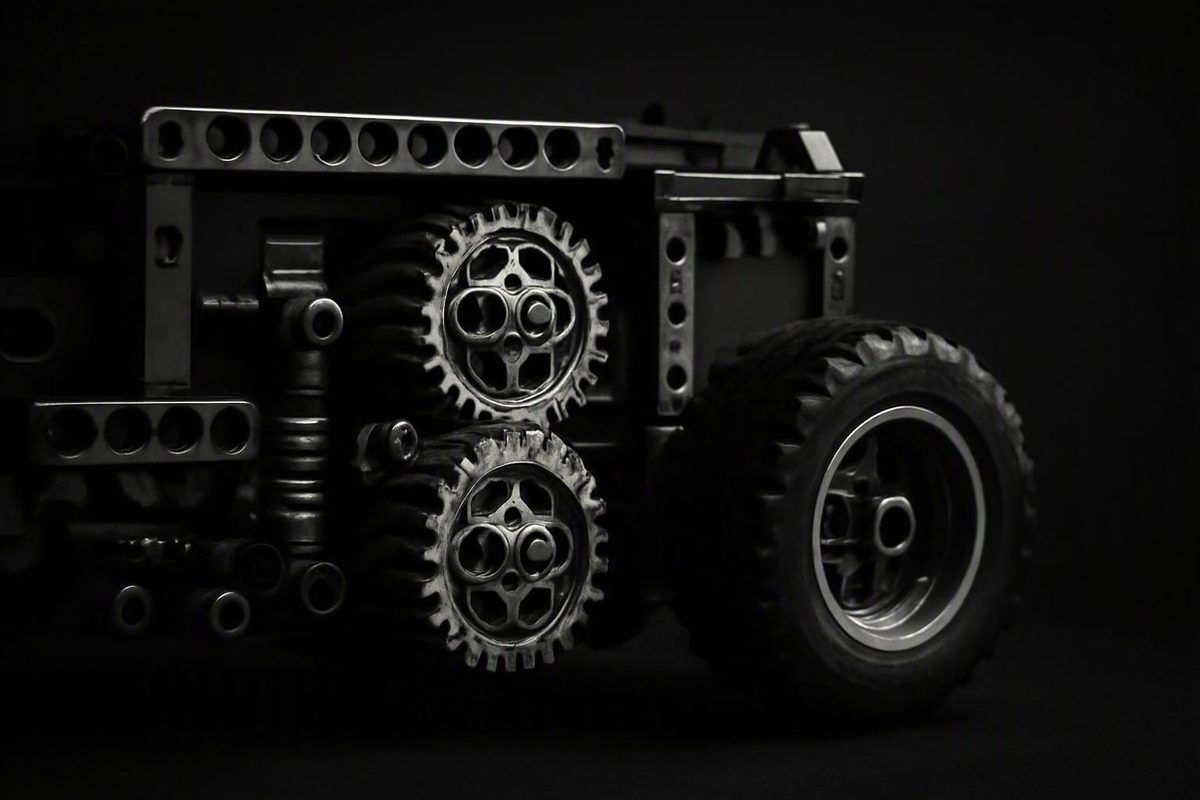
LEGO Technic history is not simply a succession of increasingly large vehicles. It is the story of an expanding mechanical language. Gears and axles made motion transferable, pneumatics introduced air-powered linear movement, motors supplied continuous power, liftarms changed how models were structured, and programmable or connected controls made mechanisms responsive.
That history begins before products consistently carried the Technic name. The dedicated mechanical range later known as Technic debuted in Europe in 1977, but early boxes used regional identities such as Technical Sets and Expert Builder. Modern databases may classify those products as Technic even when their original packaging did not.
The range’s development is best understood through five overlapping capabilities:
- Mechanical: gears, axles, steering, linkages, pistons, suspension, and transmissions.
- Pneumatic: compressed-air systems producing controlled linear movement.
- Electrical: motors supplying powered motion.
- Programmable: instructions and sensors controlling a model’s behavior.
- Connected: wireless hubs and apps coordinating motors and user input.
Throughout this account, four kinds of evidence remain distinct: a product’s release date, its regional debut, its package branding, and its later database classification. A collector database can reasonably place a 1977 product in a Technic category without proving that the original box displayed a Technic logo.
*This is an independent historical overview and is not affiliated with, endorsed by, or authorized by the LEGO Group. *
What LEGO Technic Is—and Why Its History Starts Before the Name
Technic is an engineering-focused building system for functional vehicles and machines. Vehicles dominate the range, but a model is not Technic merely because it has wheels. Its defining characteristic is the use of structural and mechanical elements to produce functions: steering wheels, moving pistons, lifting booms, working suspension, multi-speed gearboxes, or powered drivetrains.
Its vocabulary includes beams, pins, axles, gears, universal joints, steering parts, suspension components, engine cylinders, transmission elements, pneumatic pumps and cylinders, motors, hubs, and controls. These pieces can reproduce selected features of real machinery, but they also constitute an abstract kit for inventing mechanisms.
Conventional LEGO System construction derives much of its visible order from bricks and plates stacked through studs. Early mechanical models retained that logic by using perforated Technic bricks. Builders could stack those bricks conventionally while passing pins or axles through their side holes.
Modern Technic relies more heavily on studless beams—usually called liftarms—joined with pins, axles, and specialized connectors. That method creates a three-dimensional structural framework rather than a primarily stacked shell. A specialist parts guide accordingly describes Technic as a distinct system centered on pin-and-axle connections, while noting that studded Technic parts continue to connect it with conventional System construction (Brick Architect’s Technic parts guide).
The European debut of the dedicated mechanical range in 1977 is therefore a product-line milestone, not proof of uniform Technic branding. Four questions must be kept separate:
- When was the product released?
- In which region did it appear?
- What name or logo appeared on its packaging?
- How do later catalogs classify it?
The same rule applies to later turning points. The appearance of one liftarm did not instantly end studded construction. Likewise, Technic’s adoption of a connected hub does not necessarily establish the launch date of the wider electronic platform. New and old systems generally coexisted before the newer method became dominant.
1965–1980: From Experimental Gears to Expert Builder
The mechanical prehistory commonly begins with Samsonite set 001 Gears from 1965. Because the later beam-and-axle system did not yet exist, its gears were essentially modified plates with studs and anti-studs. They enabled rotational interaction, but not the supported axle framework that would become central to Technic.
A closer precursor arrived in 1970 through Universal Building Sets containing gears, axles, and bricks designed to accept those axles. That combination was decisive. A gear becomes much more useful when it can be positioned on a shaft, held in a supporting structure, and meshed reliably with another gear. BrickNerd traces this progression from the 1965 Samsonite experiment through the 1970 gear-and-axle products to the dedicated European range introduced in 1977 (BrickNerd’s history of pre-Technic products).
The 1977 European range
The four European models cataloged for 1977 already demonstrated considerable functional breadth:
- 850 Fork Lift used a lifting mechanism.
- 851 Tractor applied the system to an agricultural vehicle.
- 852 Helicopter used transmitted rotation for a rotor function.
- 853 Auto Chassis emphasized steering, vehicle structure, and exposed mechanical assemblies.
The models did not attempt to reproduce every exterior surface. Their mechanisms remained visible and legible as part of the design. A chassis could communicate its purpose through wheels, steering, seating position, and structural layout without requiring an enclosed body.
Accessory products show that the range was conceived as more than a collection of individual vehicles. 870 Power Pack offered motorization, while 871 Gear Parts supplied reusable mechanical components. BrickLink catalogs those accessories and the four launch models as 1977 Expert Builder products within its later Technic category (BrickLink’s Technic reference catalog).
The range’s identity varied by market. Third-party histories report Technical Sets in the United Kingdom and Expert Builder in the United States. Corresponding American models followed in 1978 under different set numbers. The surviving secondary record does not establish a legal or strategic reason for those regional names, so none should be inferred.
Products cataloged from 1978 through 1980 broadened the mechanical vocabulary. They included 855 Mobile Crane, 856 Bulldozer, steering and piston packs, chain-and-gear components, 880 12V Motor, and 858 Auto Engines (BrickLink catalog listings for 1978–1980).
Together, those products expanded the system in several directions:
- Steering packs isolated a mechanism for reuse.
- Pistons and engine assemblies made reciprocating motion visible.
- Chains transferred motion between separated shafts.
- Motors converted hand-operated assemblies into powered machines.
This established a durable Technic pattern. Complete models demonstrated what the components could do, while accessory packs exposed the same components as a reusable engineering kit.
Calling these products “early Technic” is convenient when discussing the lineage. Calling every one of them “officially Technic-branded” would confuse later classification with original packaging.
1980–1990: A Name, Pneumatics, Figures, and a Broader Mechanical Vocabulary
During the 1980s, the range accumulated a more recognizable identity and several new kinds of movement.
An archived enthusiast chronology lists an Idea Book in 1980, second-generation sets in 1981, and Technic Universal Sets in 1982. It then associates pneumatics with 1984, Arctic Action with 1986, and 9V electrics with 1990.
That chronology is useful but limited. It is a third-party index captured in 2006, covers milestones only through 1999, and supplies labels rather than detailed documentation. Its dates should therefore be treated as period chronology, not as an official LEGO record.
The unresolved naming date
The date on which the range became Technic remains disputed. One specialist fan history reports that a Technic name and logo appeared in 1982, while also acknowledging uncertainty about the branding of an individual set from that year. Other fan and commercial databases say the range was renamed in 1984.
Those statements may describe different events: an initial logo appearance, a wider catalog identity, a regional change, or a formal renaming. That is a plausible reconciliation, but it is not established by surviving primary documentation in the record used here.
Accordingly, neither 1982 nor 1984 should be treated as conclusive. Brickipedia represents the later-date account, stating that the line was renamed in 1984 (Brickipedia’s Technic history).
Pneumatics add another kind of motion
Third-party histories place the introduction of LEGO pneumatic components in 1984. Functionally, pneumatics mattered because they added controlled linear movement to a system previously centered on gears, axles, and rotating motors.
That made the system particularly suitable for excavator arms, crane functions, claws, tipping beds, and other mechanisms that needed to push or pull through a limited stroke.
Pneumatics did not replace mechanical transmission. They complemented it. A model could use gears for steering or engine simulation while using pneumatic cylinders to operate an arm. Builders could now choose among rotary transmission, powered rotation, and air-driven linear actuation.
Arctic Action and Technic figures
The 1986 Arctic Action range introduced larger articulated Technic figures, according to the secondary histories consulted. These were not conventional minifigures. Their larger size and greater articulation suited the scale of Technic vehicles and provided visible operators for machines too large for ordinary minifigure proportions.
The same histories report that Technic figures remained in use until 2001, but they do not establish why the figures were discontinued. Their significance lies in the way they temporarily connected engineering models with character-centered play.
The first liftarm and the 9V transition
The original liftarm, identified in secondary accounts as part 2825, appeared in 1989. This is an important dated marker, but it is not the year in which the entire range became studless. A single component can introduce a structural idea long before that idea reorganizes a product line.
The electrical system changed at approximately the same point. Histories report that the early dedicated 4.5V motor system gave way in 1990 to a square 9V motor and a new Electric System. Wikipedia’s overview groups the 1984 pneumatic introduction, 1986 figures, 1989 liftarm, and 1990 electrical change within this broader development (overview of Technic components and systems).
By 1990, the range supported several distinct functional languages: studded structural construction, gears and axles, pneumatic actuation, articulated figures, and a revised electrical system. The next transformation concerned how those elements were assembled.
From Studded Beams to Studless Liftarms
Early Technic construction was structurally bilingual. A perforated Technic brick could be stacked through its studs like an ordinary brick, while its side holes supported pins and axles. Builders could combine walls, plates, and slopes with a mechanical chassis without leaving the familiar LEGO System grid.
A liftarm changes that logic. It is a primarily studless beam whose holes receive pins and axles. Instead of stacking one beam on another through studs, the builder joins members from their sides, braces them across several planes, and uses connectors to create angles and offsets.
| Element | Primary connection | Typical structural role |
|---|---|---|
| Studded Technic brick | Studs plus side holes | Connects stacked System construction with mechanisms |
| Liftarm | Pins and axles through holes | Forms studless frames and linkages |
| Connector | Multiple pin or axle interfaces | Joins beams across angles, offsets, and planes |
| Exterior panel | Pin connections to a frame | Shapes a surface without serving as the entire structure |
The reported appearance of liftarm part 2825 in 1989 marks the beginning of a new structural vocabulary, not an immediate conversion. Studded bricks and liftarms coexisted throughout much of the 1990s, often within the same model.
BrickNerd identifies 8480 Space Shuttle from 1996 as an important step toward increasingly studless construction. It is best treated as a transitional example, not as an uncontested first fully studless set. That stronger claim would require an agreed definition of “fully studless” and a systematic comparison with every earlier model.
Sources describe the later transition in different ways. Some place the establishment of predominantly studless construction around 2000. Another identifies a five-product wave from 2003 as the first all-studless wave. Those positions can coexist:
- Around 2000 can describe when the overall design language became predominantly studless.
- The 2003 wave can identify a complete release group built consistently in that language.
- Individual models could adopt extensive studless methods earlier without representing a range-wide conversion.
The 1990s and early 2000s are therefore better understood as a continuum. Liftarms first supplemented studded bricks, then assumed more of the structural load, and eventually became the normal framework for most models.
Each construction method offers different practical qualities. Studded building makes the relationship with ordinary LEGO bricks immediately visible. Stacking can be intuitive, surfaces align readily with System elements, and a mechanical frame can merge directly into a brick-built body.
Studless construction encourages a different kind of planning. Beams, pins, axles, and angled connectors can form a rigid three-dimensional skeleton with mechanisms threaded through it. Builders must consider pin depth, axle alignment, bracing, and access to moving components as well as conventional layers.
Neither method is inherently superior for every purpose. They produce different structural possibilities, visual characters, and building rhythms. Hybrid construction remains useful when a model benefits from both.
Connectors and panels became increasingly important as the studless language matured. Connectors establish relationships between beams that are neither simply parallel nor perpendicular. Panels attach to the resulting frame and suggest wheel arches, doors, roofs, fenders, or curved bodywork. The exterior can become more complete while the functional identity remains in the frame, steering, suspension, drivetrain, or gearbox beneath it.
How Technic Power and Control Systems Evolved
Technic’s electrical history is easiest to understand as a sequence of control systems rather than an exhaustive list of motorized sets. The central question is not merely whether a motor existed, but how builders powered, directed, and coordinated it.
From direct power to connected control
The dedicated 4.5V motor reported for 1977 supplied an early source of continuous powered motion. The motor provided rotation, but the resulting function still depended on mechanical design. Gearing exchanged speed for torque, axles transmitted power, and linkages converted rotation into another form of movement.
The square 9V motor and Electric System reported for 1990 represented a later electrical generation. They did not make gears, axles, or strong frames less important. Electrical power remained one layer within a mechanical model.
Its chronological position before Mindstorms is useful, but proximity alone does not prove that particular components or capabilities transferred directly from one system to the other.
Set 8275 Motorized Bulldozer is reported as the 2007 Technic debut of Power Functions. The precise claim matters: it was a debut for that system within Technic, not necessarily the first remote-controlled Technic product of any kind. Power Functions added a later generation of motors and remote-control components to the range.
Technic’s later connected phase is associated with sets 42099 and 42100. Here, Powered Up denotes the broader connected platform, while Control+ is the branding used for relevant Technic app experiences. The evidence supports treating those sets as Technic adoption milestones, not assigning one universal launch date to every part of the wider platform.
| System | Supported date or period | Representative product | New capability |
|---|---|---|---|
| Early dedicated motor power | 1977 | 870 Power Pack and early 4.5V products | Continuous powered rotation |
| 9V Electric System | 1990 | Square 9V motor | Revised electrical generation |
| Code Pilot | 1997 | Code Pilot | Programmable control milestone |
| Power Functions | 2007 | 8275 Motorized Bulldozer | Later motors and remote-control components |
| Control+ within the connected platform | Later Technic adoption | 42099 and 42100 | Bluetooth hubs and app-based operation |
The motor dates and connected-control sequence are summarized in third-party histories of the system, including Wikipedia’s account of 4.5V, 9V, Power Functions, Powered Up, and Control+ (Technic motor-system overview).
Each stage added a control layer without making earlier mechanics obsolete. A remote can reverse a drivetrain, but steering geometry still governs how a vehicle changes direction.
The systems also create different relationships between user and model:
- Manual functions invite direct contact with cranks, levers, gears, and linkages.
- Switched motor functions automate motion while leaving control physically attached to the model.
- Remote systems separate the user’s command from the mechanism.
- App-based systems coordinate multiple outputs through an on-screen interface.
These are different forms of play and demonstration, not a simple hierarchy in which the newest system is automatically best.
Code Pilot, Mindstorms, and the Wider Technic Family
The archived chronology places Code Pilot in 1997 and Mindstorms in 1998 (archived chronology through 1999). That ordering establishes sequence, not direct technical inheritance.
Mindstorms is a separate product line that uses many Technic elements and construction methods. Its robots require precisely the qualities Technic supplies: beams for frames, pins for joints, axles for transmitting motion, gears for changing speed or direction, motors for movement, and stable attachment points for sensors.
Technic geometry is particularly useful in robotics because structure and movement must be organized together. The same pin-and-axle system that creates a vehicle chassis can therefore become the skeleton of a programmable machine.
Related action and robotics lines
Secondary histories connect Technic’s parts and geometry with several lines around the turn of the millennium:
- Slizers, also known as Throwbots, appeared in 1999–2000.
- RoboRiders followed in 2000.
- BIONICLE began in 2001.
- Spybotics and parts of Racers are also identified as related developments.
These relationships need careful labels. A line may depend heavily on Technic elements without being a core Technic theme. BIONICLE developed its own identity even though its construction drew extensively on Technic-derived joints and structural components. Mindstorms likewise uses Technic as a structural foundation while adding programmable electronics and sensors.
A practical Technic taxonomy
Core Technic sets: Products sold under the main Technic identity, including functional vehicles and machines.
Accessories and educational products: Motors, gear packs, component assortments, programmable resources, and classroom products that support Technic construction without necessarily being conventional retail models.
Technic subthemes: Named groups sold within Technic, such as Arctic Action and certain competition-oriented ranges.
Separate or related lines using Technic elements: Mindstorms, BIONICLE, Spybotics, and other products with distinct identities but substantial reliance on Technic construction.
System sets containing Technic functions: Conventional brick-built models using gears, pins, axles, or beams for movement, interactive features, or reinforcement.
This taxonomy explains why set counts differ. Brickipedia’s incomplete set index combines chronological groups with systems, subthemes, licensed products, accessories, and supplementary packs, while directing BIONICLE to a separate list (Brickipedia’s categorized Technic index). Two databases can therefore follow internally consistent rules and still produce different totals.
Technic’s influence also extends into ordinary System models. Technic elements can strengthen a large brick-built structure, hinge a moving section, drive an interactive feature, or connect assemblies at unusual angles. In that role, Technic is not primarily a package identity. It is a mechanical and structural toolkit operating inside another building system.
2001–2004: Contraction, All-Studless Models, and the Return of the Brand
The early 2000s can resemble a disappearance if the history is measured only by boxes carrying the standard Technic identity. A more careful reading reveals an underdocumented transition in package branding, product classification, and construction.
BrickNerd reports 34 Technic sets in 2000, nine in 2001, three re-releases in 2002, and one Technic-branded set in 2003. The same account describes five unbranded products from 2003 as the first all-studless Technic wave and says four new studless sets restored standard Technic branding in 2004 (BrickNerd’s account of the early-2000s transition).
Those counts must remain attributed. A database has to decide whether to include accessories, educational products, regional variants, reissues, value packs, or related themes. Altering those rules alters the total.
Even on that accounting, the reduction in Technic-branded releases did not mean the underlying system disappeared. Studless beams, pins, axles, connectors, and other Technic-derived components continued in unbranded or related products.
The period is best understood through three separate layers:
- Building system: The elements, geometry, and techniques used to create functional structures.
- Package brand: The name and logo displayed to buyers.
- Later classification: The category assigned by collectors, databases, or historians.
A product can clearly belong to the first layer without carrying the second. It may then be included or excluded from the third according to a database’s editorial rules.
The five unbranded models reported for 2003 matter because they formed a coherent all-studless wave. Their construction anticipated the structural language of later Technic models even though their packaging did not present them as a conventional annual Technic range.
The four reported releases from 2004 then joined that studless method to the familiar brand identity. This makes 2003–2004 a useful endpoint for one definition of the construction transition: not the first liftarm, and not necessarily the first individual model dominated by liftarms, but an all-studless wave followed by the return of standard branding.
The historical record considered here does not establish a corporate, financial, or marketing cause for the contraction. The defensible conclusion is narrower: the number of products carrying conventional Technic branding fell sharply, related mechanical construction continued, and branded studless models followed in 2004.
Modern Technic and the Milestones That Define the Full Story
After 2004, Technic continued the structural language established during the long transition. Studless beams formed the principal framework, specialized connectors organized increasingly complex geometry, and panels shaped more complete exteriors.
This is particularly visible in high-detail and licensed vehicles. Panels can suggest curved fenders, doors, roofs, engine covers, and aerodynamic surfaces. Underneath, the familiar functional vocabulary remains: pin-connected frames, axles, gears, steering racks, suspension, engine simulations, transmissions, and, in some models, powered functions.
Panels are therefore not a rejection of mechanical Technic. They add an exterior layer to it. Early models often treated the exposed frame as the finished appearance; many modern models distinguish more clearly between an internal mechanism and an external body.
The specialist parts literature describes this movement toward studless frames, specialized connectors, and extensive paneling as a broad design trend rather than a change tied to one exact year (Brick Architect on Technic beams, connectors, and panels).
Licensed subjects are an especially visible application because Technic can represent both the outline of a real vehicle and selected aspects of its operation. A steering system, suspension assembly, gearbox, or piston engine remains an abstraction, however. It must work within the available parts, model dimensions, structural requirements, and intended building experience.
From Power Functions to app-based operation
The best-supported modern control milestone is narrow but important: set 8275 Motorized Bulldozer is reported as the 2007 Technic debut of Power Functions. This introduced that motor-and-remote system into Technic; it should not be generalized into a claim that the set invented remote-controlled Technic.
Power Functions changed how a completed model could be demonstrated. Motors could be directed remotely, allowing a vehicle or mechanism to operate without the builder touching its controls. Yet the electrical command still depended on a properly designed mechanical path from motor to function.
The later connected phase added another layer. Sets 42099 and 42100 are associated with Technic’s adoption of Bluetooth-connected Control+ experiences. Motors connected to a hub could be coordinated through an app rather than only through a conventional handheld controller. Brickipedia’s system history traces this broad sequence from early voltage-based systems through Power Functions to Bluetooth-connected control (Brickipedia’s motor and Control+ overview).
Connected control did not replace mechanical engineering with software. It made sound mechanical design more consequential:
- Motors still needed secure bracing.
- Axles and gears still required correct alignment.
- Drivetrains still had to manage friction.
- Frames still had to carry operational loads.
- Gear ratios still determined the relationship between speed and output force.
The continuity is therefore stronger than the change. Whether motion begins with a hand crank, a switched motor, a remote command, or an app, Technic functions remain dependent on the structure transmitting that motion.
Compact LEGO Technic history timeline
The following timeline condenses the documented and attributed milestones discussed above. “Regional,” “disputed,” and “approximate” are evidence qualifications, not minor details.
| Date or period | Milestone | Qualification |
|---|---|---|
| 1965 | Samsonite set 001 Gears used modified plate-like gears | Attributed to a specialist fan history |
| 1970 | Universal Building Sets added gears, axles, and axle-compatible bricks | Attributed precursor |
| 1977 | Dedicated mechanical range debuted in Europe with sets 850–853 | Regional; later classified as Technic |
| 1978 | Corresponding Expert Builder products appeared in the United States | Regional; set numbers differed |
| 1980 | Idea Book milestone | Archived enthusiast chronology |
| 1981 | Second-generation sets | Archived enthusiast chronology |
| 1982 or 1984 | Technic name or branding adopted | Disputed; may represent different branding events |
| 1984 | Pneumatics introduced | Reported by multiple secondary histories |
| 1986 | Arctic Action and larger articulated Technic figures | Reported by multiple secondary histories |
| 1989 | Original liftarm part 2825 appeared | Reported component milestone |
| 1990 | Square 9V motor and new Electric System | Reported electrical transition |
| 1997 | Code Pilot | Archived chronology milestone |
| 1998 | Mindstorms | Separate line using Technic construction |
| 1990s–early 2000s | Gradual move from studded bricks to liftarms | Approximate transition |
| 2003 | Five unbranded products described as the first all-studless wave | Attributed to BrickNerd |
| 2004 | Four new studless sets restored standard Technic branding | Attributed to BrickNerd |
| 2007 | Power Functions debuted in Technic with set 8275 | Technic system-adoption milestone |
| Later connected era | Sets 42099 and 42100 associated with Control+ adoption | Technic milestone, not necessarily the launch of the wider platform |
The chronology remains provisional. The available historical record is dominated by enthusiast histories, collaborative wikis, and collector databases rather than a complete archive of original LEGO catalogs, packaging, advertisements, and official retrospectives. The branding date and the endpoint of the studless transition consequently remain qualified rather than settled.
Technic’s strongest continuity is not one logo, model, or construction style. It is functional building. From experimental gears and axle-supported mechanisms to pneumatics, motors, liftarms, robotics, and app-connected controls, each period expanded what a LEGO model could mechanically do.
Was LEGO Technic originally called Expert Builder or Technical Sets?
Both names are reported, depending on region. The early mechanical range was marketed as Expert Builder in the United States and Technical Sets in the United Kingdom. European products appeared in 1977, with corresponding American releases following in 1978.
These are best described as regional identities for the range later known as Technic. Modern catalog classification does not prove that the original packages displayed Technic branding.
Did the LEGO Technic name first appear in 1982 or 1984?
The secondary sources disagree. One account places the appearance of the Technic name and logo in 1982; other databases state that the range was renamed in 1984. BrickEconomy provides one example of the 1984 account (BrickEconomy’s Technic overview).
The discrepancy may reflect a difference between an initial logo appearance and a wider regional or catalog renaming, but that explanation remains unproven. Until original packaging, catalogs, or advertisements resolve the question, 1982 versus 1984 should remain disputed.
When did LEGO Technic change from studded to studless construction?
There was no single changeover date. The first liftarm is reported in 1989, after which liftarms and studded Technic bricks coexisted during much of the 1990s. The 1996 Space Shuttle is commonly treated as a significant transitional model rather than an uncontested first.
Predominantly studless construction became established around 2000, while one account identifies the five-model 2003 wave as the first entirely studless wave. Standard Technic branding then returned with four studless releases in 2004.
The most accurate summary is therefore that the transition began with the 1989 liftarm, developed through the 1990s, and became range-defining in the early 2000s.
When were pneumatics, 9V electrics, Code Pilot, and Mindstorms introduced?
The commonly reported milestones are:
- Pneumatics: 1984
- Square 9V motor and new Electric System: 1990
- Code Pilot: 1997
- Mindstorms: 1998
The archived chronology places those systems in that sequence, although it should be read as a third-party index rather than an official history. Each milestone represents a different capability: air-powered linear movement, revised electrical power, programmable control, and a separate robotics line using Technic-based structures.
Are Mindstorms and BIONICLE part of LEGO Technic?
Not automatically. Mindstorms is a separate product line that makes extensive use of Technic beams, pins, axles, gears, motors, and structural methods.
BIONICLE is likewise better described as a separate, Technic-derived line. Its figures and creatures relied heavily on Technic geometry and jointed mechanical elements, but the line developed its own identity and is frequently cataloged separately. Brickipedia’s Technic index, for example, directs BIONICLE products to a separate list (Brickipedia’s categorized set index).
The same distinction applies to Slizers, RoboRiders, and Spybotics. They matter to Technic history because they reused or extended its construction language, not because every one of their products must be counted as a core Technic set.