
Kiln Bricks Differ by Type, Grade, Shape and Use
Matching external dimensions and thickness is not enough when grooves, penetrations, controls, holders, or element routing differ.
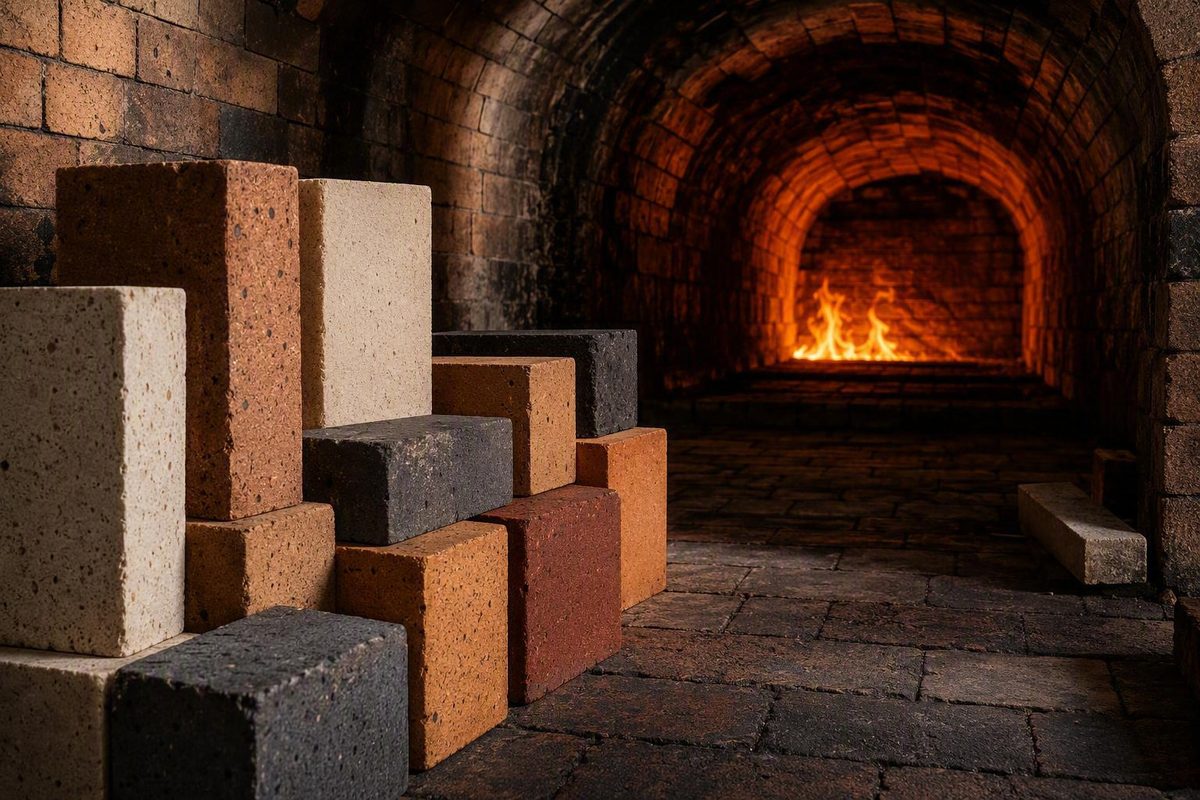
Choosing kiln bricks is not simply a matter of finding a product rated above the kiln’s setpoint. The correct brick depends on what that position in the lining must do: insulate the chamber, resist abrasion, support a load, retain an electric element, form an arch, or replace a factory-machined part.
That distinction creates three different buying workflows:
- Building a kiln: select the refractory class, grade, thickness, shape, joint system, and lining arrangement.
- Replacing a brick in an existing kiln: match the kiln model, brick position, dimensions, grooves, openings, and element routing.
- Assessing localized damage: determine whether the defect can be monitored, may accept a manufacturer-approved patch, needs temporary stabilization pending service, or requires replacement.
This is an introductory selection and inspection guide, not a kiln-design or electrical-service procedure. Thermal calculations, structural loads, expansion allowances, electrical clearances, and severe-service linings require product data and, where appropriate, advice from the kiln manufacturer, refractory supplier, or a qualified kiln professional.
In every case, begin with the brick’s role. Temperature rating matters, but it cannot compensate for incorrect dimensions, inadequate wear resistance, unsupported loads, incompatible machining, or an unsuitable atmosphere.
What kiln bricks are—and why the name covers different materials
A firebrick is a ceramic refractory unit used to line kilns, furnaces, fireboxes, fireplaces, and other high-temperature equipment. Unlike ordinary masonry brick, it is manufactured for exposure to high temperatures and thermal cycling.
Terminology can be confusing because firebrick is the broad category, while kiln brick is often used more narrowly for the porous insulating brick found in many electric and natural-gas kilns. The two principal categories considered here are:
- Insulating firebrick, also called IFB, soft brick, or insulating kiln brick
- Dense refractory firebrick, commonly called hardbrick
Insulating firebrick contains a large volume of pores. This makes it lightweight, comparatively easy to saw or shape, and effective at reducing heat transfer through a lining. Its low thermal mass means the lining generally absorbs less heat during firing and releases it more quickly during cooling.
Those benefits come with a mechanical penalty. Soft brick is readily dented or chipped by shelves, tools, ware, and other hard objects. Point loads and repeated abrasion can crush or erode it. A product that performs well as clean chamber insulation may therefore be unsuitable beneath a concentrated load or in a zone exposed to ash, fuel, vigorous flame, or frequent handling.
Dense hardbrick makes the opposite tradeoff. It is heavier, harder to cut, and generally more conductive. It stores more heat in its mass, but an appropriate dense refractory can provide greater resistance to impact, abrasion, and loading. Its actual suitability for flame, ash, slag, vapor, or other chemical exposure still depends on its formulation and technical data.
Neither category is universally better. A lightweight electric kiln may rely heavily on insulating brick, while a fuel-fired kiln may use dense refractory in its lower structure or firebox and insulating material elsewhere. Layered linings can also place different materials where their particular properties are useful.
Before comparing grades or prices, identify the buying situation:
- For a new kiln, define the duty of every lining position and have the complete assembly evaluated.
- For a factory-built kiln repair, treat the brick as a model-specific component until the manufacturer confirms otherwise.
- For localized damage, assess the location and function of the defect rather than reacting only to its apparent size.
Insulating firebrick versus dense hardbrick
The practical difference between insulating and dense brick extends beyond weight. It affects insulation, firing response, structural behavior, installation, and service life.
| Property | Insulating firebrick or soft brick | Dense refractory firebrick or hardbrick |
|---|---|---|
| Typical role | Clean-duty chamber lining or backup insulation when the selected grade and design permit it | Floors, fireboxes, wear surfaces, and other demanding working faces when the product specification supports the exposure |
| Insulation | Higher relative insulating value | Lower insulating value; backup insulation may be needed |
| Thermal mass | Low; generally heats and cools more quickly | High; absorbs and stores more heat |
| Mechanical durability | Comparatively fragile and vulnerable to impact, abrasion, and point loading | Generally stronger and more resistant to impact, abrasion, and loading |
| Ease of cutting | Relatively easy to saw, carve, and groove | More difficult to machine and may require specialized equipment |
| Principal limitations | Concentrated loads, aggressive wear, impact, and molten-material contact | Weight, heat storage, greater heat conduction, and difficult machining |
Appropriately rated IFB can serve as a clean-duty hot face; it is not restricted to hidden backup layers. Electric kiln chambers are a common possible application because low thermal mass is useful and the lining may not encounter fuel or ash. The qualification is important: shelves, posts, elements, doors, ware, and fixtures still require adequate support and clearance.
Dense refractory becomes a stronger candidate as mechanical or chemical severity increases. Selection signals include:
- Floors exposed to dragging or repeated loading
- Fireboxes and fuel-entry areas
- Zones of direct or high-velocity flame impingement
- Areas exposed to ash, slag, glaze, or other fluxes
- Door sills and frequently handled openings
- Surfaces carrying concentrated loads
- Replaceable hearth or wear courses
These are not automatic prescriptions. Dense bricks vary in composition, strength, thermal behavior, and chemical resistance. Density alone does not establish that a product can withstand a particular atmosphere, load, or contaminant.
Porous IFB should generally be protected from impact, repeated abrasion, heavy point loads, and molten materials unless the complete lining was designed for that exposure. It should not be assumed to support shelves, kiln posts, arches, doors, or other concentrated loads without product-specific engineering data.
A hybrid lining may place a durable dense-brick working face in front of insulating brick. That arrangement still requires assessment of:
- Temperatures at each depth
- Joint type and thickness
- Differential thermal expansion
- Expansion space
- Casing and external restraint
- Anchors or other supports
- Chemical interaction between layers
- Repair access and replaceable wear components
Supplier comparisons broadly describe insulating brick as favoring low weight and low heat transfer, while dense refractory favors mechanical durability and load resistance. Exact performance must come from the technical datasheet for the specific product being considered, not from the category name alone (Firebird Refractory comparison).
The useful question is therefore not “Which brick is best?” but “What must this location withstand?”
Temperature grades: what 23, 26, 28, and 30 do—and do not—mean
Numbers such as 23, 26, 28, and 30 commonly appear in insulating-firebrick catalogs. They are useful supplier labels, but similarly numbered products from different manufacturers should not be assumed to have identical composition, density, strength, conductivity, shrinkage, or allowable service conditions.
For its own range, Vitcas lists the following specifications:
| Vitcas grade | Supplier-listed maximum service temperature | Supplier-listed density |
|---|---|---|
| Grade 23 | 1260°C | 600 kg/m³ |
| Grade 26 | 1430°C | 800 kg/m³ |
| Grade 28 | 1530°C | 900 kg/m³ |
| Grade 30 | 1650°C | 1000 kg/m³ |
These values are supplier-specific. Vitcas lists all four at a nominal size of 230 × 114 × 76 mm and advises selecting by lining temperature, atmosphere, position, and mechanical conditions rather than temperature alone (Vitcas grade specifications).
A maximum service temperature is a material limit. It is not necessarily:
- A recommended continuous operating temperature
- A promise of acceptable shrinkage over a particular service life
- A guarantee of strength at operating temperature
- A safe setpoint for every kiln using that brick
- Proof of resistance to reduction, corrosive vapor, ash, salt, glaze, glass, metal, or slag
- A substitute for evaluating hot spots or process upset
The programmed chamber temperature may differ from the temperature reached by a brick close to a burner, element, port, or thin section of the lining. Conversely, backup insulation farther from the hot face may operate at a substantially lower temperature than the chamber.
Use the following questions to organize a discussion with the brick supplier or kiln designer:
- Calculated lining temperature: What temperature is expected at the brick’s actual depth and position?
- Hot spots: Could burners, elements, ports, leaks, or geometry produce localized overheating?
- Firing cycle: How quickly and how often will the lining heat and cool?
- Process upset: What temperatures could follow controller failure, burner imbalance, or an extended hold?
- Atmosphere: Will the kiln operate in oxidation, reduction, or another chemically active environment?
- Lining position: Is the brick at the hot face, in a backup layer, on the floor, or around an opening?
- Flame impingement: Will high-velocity flame strike the surface?
- Abrasion: Will fuel, ware, shelves, tools, or maintenance activity scrape it?
- Chemical exposure: Could glaze, ash, vapor, salt, glass, metal, or slag contact it?
- Mechanical load: Must it support posts, shelves, an arch, a door, or casing?
- Adjacent materials: Are the mortar, coating, anchors, and backup insulation compatible?
- Manufacturer approval: Does the kiln maker permit this grade and configuration?
This checklist identifies information that must be resolved; it is not a thermal, structural, or expansion-design method.
Do not simply buy the highest available rating. A higher-temperature IFB may be denser, heavier, more expensive, or unnecessary for a moderate-temperature backup layer. It may still lack the wear or load resistance required at a floor or firebox.
Likewise, a higher-rated refractory mortar does not raise the brick’s temperature limit, strengthen its porous structure, or make it abrasion resistant. The assembly remains constrained by unsuitable components and details.
For a new build, obtain the exact technical datasheets and have the lining evaluated against documented operating conditions. For an existing kiln, consult the kiln manufacturer before substituting grades. The available evidence does not establish one universal temperature margin for every kiln, atmosphere, firing schedule, and brick formulation.
Sizes and shapes: straights, splits, arches, wedges, and grooved bricks
A common cataloged kiln-brick face is approximately 9 × 4.5 inches, with 2.5- and 3-inch thicknesses recurring in supplier listings. Metric products near 229–230 × 114 mm have a broadly similar format, but they are not necessarily dimensionally interchangeable. Sheffield Pottery, for example, lists straights, splits, arches, wedges, dense refractory, and insulating grades in several thicknesses (kiln-building brick catalog).
Useful conversions are:
- 9 inches = 228.6 mm
- 4.5 inches = 114.3 mm
- 2.5 inches = 63.5 mm
- 3 inches = 76.2 mm
A supplier may round nominal dimensions, work to different tolerances, or measure a taper differently. Small differences can accumulate across several courses or stop a replacement part from seating correctly.
| Shape | Typical description | Catalog example or distinction | Selection concern |
|---|---|---|---|
| Straight | Basic rectangular brick | Commonly listed around a 9 × 4.5-inch face | Confirm actual dimensions, grade, density, and tolerance |
| Split | Thinner rectangular brick | One cataloged example is 9 × 4.5 × 1.25 inches | Do not assume a thin unit is suitable as a structural facing or floor |
| Arch | Brick tapered in one direction for curved work | Sold in multiple taper numbers and thicknesses | Match the taper to the intended radius and joint geometry |
| Wedge | Tapered form for radiating or circular work | Offered in several grades and tapers | Not interchangeable with an arch merely because both are tapered |
| Model-specific grooved or penetrated brick | Factory-cut replacement for an existing kiln | May contain element grooves, peep holes, terminal openings, thermocouple ports, or kiln-sitter openings | Must match the model, position, machining, and element routing |
A straight is the basic rectangular unit used for walls and general lining work. The familiar shape does not reveal whether the brick is insulating or dense, what temperature class it belongs to, or whether it is suitable for a hot face.
A split is a thinner brick. One dense refractory split is listed at 9 × 4.5 × 1.25 inches. The reduced thickness does not by itself establish where or how the brick can be used.
Arches and wedges are tapered bricks for curved or radiating masonry. Neither term defines a universal taper. Choosing a taper by appearance can leave excessively open joints or produce the wrong curve.
Soaps are another cataloged refractory shape, but the available evidence does not provide enough dimensional or engineering detail to prescribe their use. Treat “soap” as a shape designation that requires a supplier drawing and application data.
Generic kiln-building shapes must also be distinguished from machined replacement bricks. A factory-built electric-kiln brick may contain:
- Element grooves
- Recesses for element holders
- Return or connection channels
- Peep openings
- Terminal openings
- Thermocouple ports
- Kiln-sitter openings
- Coated faces
- Position-specific edge cuts
Nominal length, width, and thickness establish only the outer envelope. Actual cuts, groove profiles, tapers, coatings, tolerances, and installed orientation determine whether the part will fit and perform its intended function.
How to match a replacement brick to an existing kiln
Buying a replacement brick for a factory-built electric kiln is fundamentally different from purchasing straight IFB for a new lining. The original brick may have been cut for a particular model, ring, wall thickness, element layout, and control position.
Begin with a pre-order worksheet.
| Identification field | What to record |
|---|---|
| Manufacturer | Full kiln-maker name |
| Exact model | Include suffixes and series designations |
| Serial number | Copy and photograph the rating plate |
| Kiln geometry | Round, oval, square, top-loading, or front-loading; number of sides where relevant |
| Wall thickness | Measure and verify the specified brick thickness |
| Brick position | Lid, floor, sidewall, ring number, terminal area, peep area, or control location |
| External dimensions | Length, width, thickness, tapers, and stepped edges |
| Groove count | Count every element groove |
| Groove direction | Record which face and edge each groove reaches |
| Channel position | Note element returns, connections, and holder recesses |
| Penetrations | Peep, terminal, thermocouple, vent, or kiln-sitter opening |
| Coating | Identify coated faces and their orientation |
| Element orientation | Photograph how the element enters, exits, turns, and connects |
| Existing part number | Copy labels, invoices, drawings, or stamped markings |
Retail catalogs distinguish 2.5- and 3-inch brick, different kiln geometries, and functional configurations such as straight, peep, terminal, thermocouple, and kiln-sitter bricks. These descriptions are consequential: a channel or opening can determine whether the kiln can be assembled and whether the element is retained in its intended position.
L&L’s catalog illustrates why a kiln family name alone may be insufficient. Its parts vary by kiln series, thickness, groove count, inclusion of element holders, and the location of element connections or returns. Listings are tied to selected Easy-Fire, Jupiter, School-Master, Quad, and Econo models (L&L model-specific brick listings).
Before ordering:
- Photograph the complete kiln and rating plate.
- Photograph the damaged brick straight on and from each accessible edge.
- Include adjacent bricks and the element path in the photographs.
- Record the brick’s installed orientation before removal.
- Measure the brick and wall thickness at more than one point.
- Count all grooves, channels, recesses, and openings.
- Locate the manufacturer’s part number, if one exists.
- Send the worksheet and photographs to the manufacturer or authorized supplier.
- Obtain explicit confirmation for the model, serial range, and brick position.
Matching external dimensions and thickness is not enough when grooves, penetrations, controls, holders, or element routing differ.
This guide does not provide a universal procedure for machining a generic brick around electric elements. The supplied evidence does not establish general requirements for reproducing grooves, preserving electrical clearances, supporting hot elements, reconnecting wiring, testing, or recommissioning every kiln design.
Final order-verification checklist
Mark every item as either confirmed or assumed:
- Manufacturer and exact model
- Serial number or production range
- Brick location and orientation
- Wall thickness
- Overall dimensions
- Number and profile of element grooves
- Holder or channel configuration
- Element connection or return position
- Ports and penetrations
- Coated and uncoated faces
- Included hardware or element holders
- Manufacturer part number
- Manufacturer installation instructions
- Current stock status
- Return eligibility if the part does not fit
Do not place the order while a critical compatibility field remains an assumption.
Patch, monitor, or replace: assessing kiln-brick damage
Insulating kiln brick is mechanically fragile and is commonly chipped when shelves or ware strike the lining. A small superficial defect does not automatically mean that insulation or kiln function has been materially compromised.
Kiln Arts reports that most minor chips and dings do not affect brick performance. It identifies lids, element grooves, and floors as areas requiring closer attention because gravity, falling debris, element retention, or shelf-post stability can change the consequence of damage (Kiln Arts brick-maintenance guidance).
Assess damage by location and function.
Sidewall surface
A shallow, stable chip away from elements, ports, joints, and supports may be suitable for monitoring. Sidewall patches can be difficult to retain because they must adhere to a vertical porous surface through repeated thermal cycling. A patch that later detaches may create more debris than the original chip.
Lid or lid underside
A lid defect deserves closer attention because loose material can fall onto ware or exposed elements. Patching the underside is difficult because gravity works against the repair. Some consumer-kiln lids are factory-coated with refractory cement to limit brick dust, but that does not mean an arbitrary patch or broad interior coating is suitable.
Element groove
An element groove supports the heating element as it softens and tends to move at operating temperature. If part of the groove has broken away and the element is no longer securely retained, brick replacement is generally favored.
Kiln Arts describes forming a small “fence” with element pins only as a temporary way to retain an element until proper brick or element service can be completed. It is not presented as a permanent repair.
Floor or shelf-post area
Material loss beneath a shelf post can create an uneven or partly unsupported bearing surface. A manufacturer-approved binder-and-brick-dust patch may be useful in some floor repairs, but the product, permitted thickness, preparation, drying, and firing requirements must come from the kiln or repair-material manufacturer.
Door or frequently handled opening
Door jambs, sills, and loading openings receive repeated contact. Recurrent damage may indicate that the location needs a product or design intended for greater wear.
Structurally important masonry
A through-crack, displaced brick, sagging, lost arch support, or failure in a load path is not equivalent to a cosmetic sidewall chip. It calls for prompt review by the kiln manufacturer, refractory supplier, or an appropriately qualified kiln professional.
| Observed condition | Typical outcome | Reason |
|---|---|---|
| Stable, shallow sidewall chip away from elements and supports | Monitor | Many superficial chips do not materially affect performance |
| Localized floor loss affecting a post surface, with sound surrounding brick | Seek product-specific patch guidance | An approved patch may restore an even bearing surface |
| Damaged element groove with the element at risk of moving | Temporary stabilization pending service | Temporary retention does not restore the failed groove |
| Crumbling brick, through-crack, displacement, structural loss, unstable support, or non-retaining groove | Replace or obtain prompt manufacturer review | The defect affects support, containment, or continued integrity |
Kiln Frog identifies cracks wider than 2–3 mm as warranting attention, but its figure is retailer guidance rather than a validated universal threshold. A narrow moving crack in an element groove or arch may matter more than a wider, stable surface crack elsewhere. Location, depth, movement, material loss, and function are more useful than width alone (Kiln Frog repair guide).
Do not use this article as an electrical-servicing procedure. The available repair sources do not provide a complete protocol for isolation, grounding, element handling, reconnection, testing, or safe recommissioning. Work involving elements, wiring, controls, or electrical connections should follow the exact kiln manufacturer’s service documentation or be referred to a qualified technician.
Mortar, cement, coatings, and expansion
Ordinary Portland-cement building mortar should not be used as a refractory hot-face joint material. Refractory mortar, brick cement, and patching compounds are distinct products, and their names do not make them interchangeable. General firebrick guidance distinguishes ordinary construction mortar from refractory furnace cement or high-heat mortar intended for elevated-temperature service (firebrick overview).
For any joint or repair product, verify:
- Maximum service temperature
- Compatible brick type and porosity
- Suitable atmosphere and chemical exposure
- Recommended joint thickness
- Wet-, air-, or heat-setting behavior
- Drying and curing requirements
- Expansion characteristics
- Approved application location
- Acceptance by the kiln manufacturer
Vitcas gives a product-specific example: it recommends Silcas M for its Grade 23 IFB and Vitset 45 for its Grades 26, 28, and 30. Those pairings belong to that supplier’s system and should not be transferred automatically across brands. A higher-rated jointing material does not upgrade the brick itself.
Dry joints, thin refractory joints, staggered courses, expansion space, coatings, anchors, and external restraint are design choices rather than universal rules. Their suitability depends on kiln geometry, wall thickness, loading, operating cycle, and casing design.
One documented pottery-kiln build illustrates this variability. The builder used hard firebrick in the lower structure, dry-laid insulating brick in parts of the inner walls so the bricks could move, approximately 1–2 mm fire-clay joints elsewhere, and an external metal frame for support. That account is an example of one coordinated arrangement, not an engineering template for unrelated kilns (documented kiln build).
Coatings require similar caution. In a Ceramic Arts Daily community thread, a homemade electric-kiln owner reported that a refractory coating cracked and flaked from soft brick. Participants suspected differential expansion and questioned the need for broad interior coating. This is anecdotal discussion, not controlled testing or proof that every coating fails on IFB (forum account).
The report does not necessarily conflict with factory-coated consumer-kiln lids. A manufacturer-specified lid coating has a defined material, location, application method, and purpose. It is not equivalent to spreading an arbitrary mortar or refractory coating over an entire soft-brick chamber.
Follow the kiln or refractory manufacturer’s complete instructions for:
- Whether joints are dry or mortared
- Mortar type and joint thickness
- Expansion gaps
- Course staggering
- External bands, frames, or casing
- Anchors and structural restraint
- Coated surfaces
- Drying and initial firing
- Inspection after thermal cycling
Copying one feature from an unrelated kiln without its accompanying expansion, support, and casing strategy can produce a lining that behaves very differently.
Buying kiln bricks: compare specifications before sticker price
Price comparisons are meaningful only after separating generic kiln-building brick from machined model-specific parts.
A generic straight brick is sold primarily by refractory class, grade, size, and shape. A model-specific side brick may include grooves, holders, terminal channels, ports, coatings, or other machining. A matched set may be selected for one ring or element arrangement. These products are not equivalent even when their outer dimensions look similar.
Supplier listings checked on August 19, 2026, showed these approximate price bands:
- About $5–$22 per brick for selected generic dense and insulating bricks in Sheffield Pottery and Bailey Ceramic Supply listings. Sheffield’s examples included a $5.29 dense straight, a $5.63 dense split, and insulating straights up to $11.27; Bailey’s displayed examples ranged from $8.00 to $21.58 (Sheffield kiln-brick listings).
- About $19–$58 for selected model-specific L&L side bricks, depending on thickness, groove or channel configuration, and included holders.
- About $70–$127 for selected matched L&L brick sets (L&L parts prices checked August 19, 2026).
These are catalog snapshots, not current quotations. Bailey marked the bricks shown in the supplied category view as temporarily unavailable, and several Sheffield products were marked out of stock. Catalog presence does not prove that a product can presently be ordered. Prices, stock, lead times, freight, and return terms must be rechecked immediately before purchase (Bailey refractory listings).
Price can vary with:
- Refractory class and grade
- Density and formulation
- Length, width, and thickness
- Straight, split, arch, wedge, or specialty shape
- Taper number
- Groove and channel machining
- Ports and penetrations
- Element-holder inclusion
- Coating
- Package quantity
- Brand and kiln compatibility
- Freight and handling requirements
Normalize quotations with a common template:
| Comparison field | Supplier A | Supplier B | Supplier C |
|---|---|---|---|
| Price per usable brick | |||
| Material class | |||
| Grade and technical datasheet | |||
| Actual dimensions | |||
| Shape or taper | |||
| Grooves and machining | |||
| Package quantity | |||
| Required mortar or patch | |||
| Confirmed kiln compatibility | |||
| Freight and breakage terms | |||
| Delivered unit cost |
“Price per usable brick” matters because a low unit price may apply only to a multipack, while fragile bricks shipped individually may arrive damaged. A product that requires substantial cutting can also create more waste than a correctly shaped unit.
Include the following in the project total:
- Freight and parcel surcharges
- Minimum order quantities
- Full-case or multipack requirements
- Shipping breakage
- Cutting waste
- Spare bricks for later service
- Refractory mortar or patching compound
- Cutting and dust-control equipment
- Measuring tools and templates
- Skilled labor
- Disposal and cleanup
- Downtime while waiting for a model-specific part
For preliminary quantity planning, Vitcas provides theoretical figures of approximately 38.1 bricks per square metre at 76 mm lining thickness, 57.2 at 114 mm, and 115.4 at 230 mm. The supplier states that these figures exclude joints, cuts, openings, arches, and waste, so they are not order quantities. A course-by-course layout and allowance for breakage and cutting are still required (Vitcas quantity and cutting guidance).
The same supplier warns that cutting IFB can create respirable dust. Obtain the current safety data sheet for the exact product and follow its specified engineering controls, ventilation, protective equipment, and cleanup requirements. Generic personal-protective-equipment language is not a complete cutting procedure, and dry methods that merely redistribute fine dust should not be assumed acceptable.
A reliable purchase sequence is:
- Identify the use case: new build, model-specific replacement, or localized damage.
- Determine the material class: insulating brick, dense refractory, or a designed combination.
- Verify the technical grade: temperature, atmosphere, wear, load, and chemical compatibility.
- Record dimensions and machining: include tapers, grooves, channels, ports, and coatings.
- Obtain confirmation: consult the kiln manufacturer or the brick supplier’s technical department.
- Calculate delivered cost: include freight, waste, mortar, spares, tools, and labor.
- Check current terms: confirm stock, lead time, breakage policy, and return eligibility.
Frequently asked questions
Can I replace a kiln brick with any firebrick of the same size?
No. Equal external dimensions do not establish compatibility.
A factory-built kiln brick may differ in grade, wall thickness, groove count, groove profile, holder recesses, terminal channels, peep openings, thermocouple ports, kiln-sitter openings, coating, and element-return position. It may also be specific to one model, serial range, ring, or wall location. Model-specific catalogs associate bricks with particular kiln configurations and functions rather than treating thickness alone as sufficient (Clay-King replacement-brick catalog).
Record the model, serial number, position, dimensions, machining, penetrations, and element orientation. Confirm the part number with the kiln manufacturer or an authorized supplier before ordering.
What is the difference between Grade 23, 26, 28, and 30 insulating firebrick?
They are supplier grade labels commonly associated with increasing temperature classes, but they do not prove that products from different brands are equivalent.
The Vitcas values shown in the table above apply only to that supplier’s products. Grade selection must also consider density, atmosphere, hot spots, cycling, abrasion, flame impingement, chemical exposure, load, and lining position. Use the exact product datasheet rather than relying on the grade number alone.
Do small chips or cracks in kiln brick need to be repaired?
Not necessarily. A stable superficial sidewall chip may be suitable for monitoring, particularly if it is away from an element, opening, joint, and load-bearing surface.
Location and function can matter more than apparent size. Damage deserves closer attention when it affects an element groove, lid underside, floor, shelf-post surface, door, arch, or other structurally important area. Crumbling material, a through-crack, displacement, lost support, or a groove that no longer retains its element warrants manufacturer review and may require replacement.
Can ordinary mortar be used between kiln bricks?
No. Ordinary Portland-cement building mortar should not be treated as refractory hot-face mortar.
Use only a refractory mortar, brick cement, or jointing product whose temperature rating, brick compatibility, atmosphere, joint thickness, curing requirements, and application location suit the kiln. A product labeled “high temperature” is not automatically compatible with every IFB or hardbrick.
Some designs use dry joints, while others use thin refractory joints or different materials in different parts of the lining. Follow the kiln or refractory manufacturer’s complete instructions rather than applying one universal rule.
Can insulating firebrick be used for a kiln floor or other load-bearing area?
Only when product-specific data and the kiln design support that use. IFB is comparatively vulnerable to impact, abrasion, and concentrated loading. It should not automatically be treated as structural support for shelves, posts, arches, doors, or other heavy components.
An appropriately selected insulating product may form part of a clean-duty floor or layered assembly, but high-wear or concentrated-load locations may require dense refractory or another product specifically documented for the duty. Assess the complete load path, temperature, abrasion, chemical exposure, and support arrangement rather than choosing floor brick by temperature rating alone.
The durable selection rule is role first: identify where the brick will sit and what it must withstand, select the appropriate material class and grade, verify every dimension and machined feature, and obtain model-specific confirmation before purchase or repair. The highest temperature rating and lowest sticker price are poor substitutes for compatibility, suitable mechanical performance, and a complete assessment of the lining.