
How Do LEGO Technic Wheels and Tyres Fit Together?
A 56 × 26 label may describe exterior tyre diameter and width; a separate inner-diameter or hub measurement is still needed to establish fit.
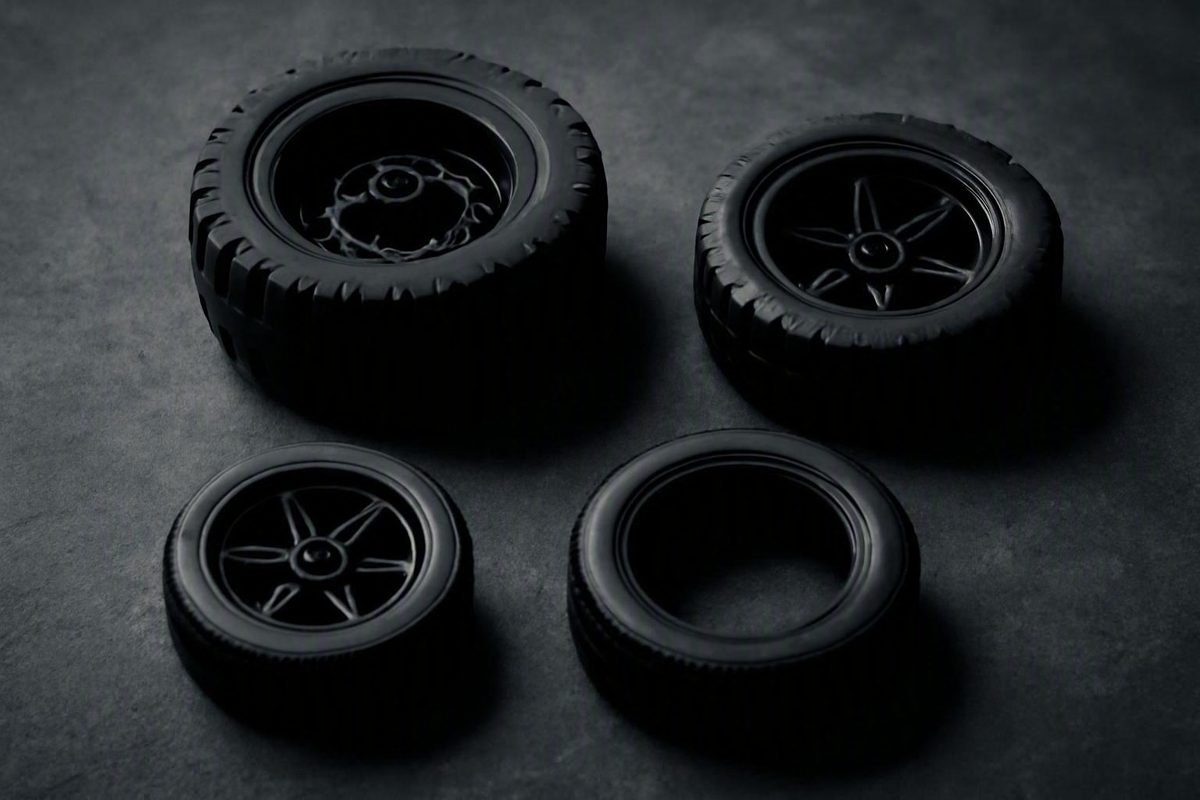
Do not assume that two parts fit because their advertised dimensions look similar. A tyre’s overall diameter is not its mounting diameter, catalog naming conventions can vary, and a combination can fit mechanically without ever having appeared in an official LEGO set.
Start Here: What Determines Whether a Technic Tyre Fits?
Before buying or mounting a replacement, compare four details:
- Exact part numbers: Identify the rim and tyre separately whenever possible.
-
Mating diameters: The tyre’s inner diameter must correspond to the rim or hub’s outer diameter.
-
Connection type: Confirm whether the wheel uses a cross axle, Technic pin, dedicated wheel pin, motorcycle interface or integrated connection.
The essential distinction is between outside size and mounting size. Tyre 55976, for example, is described as a 56 × 26 mm balloon tyre with a 30 mm inner diameter. In that record, 56 × 26 describes the tyre’s approximate exterior diameter and width; it does not mean the tyre requires a 56 mm rim. Brick Architect therefore organizes wheel groups by hub outer diameter rather than total tyre diameter. Brick Architect’s vehicle-parts guide documents these measurements and groupings.
Dimension strings must still be read in their original catalog context. A label such as 56 × 26 may describe diameter followed by width in one tyre record, while older catalog names such as 24 × 43 Technic should be preserved as historical labels rather than automatically reinterpreted. Never use the order of the figures alone to declare compatibility.
This guide uses four evidence labels:
- Catalog-supported description: A catalog identifies a part, dimension, component format or size group.
- Legacy-reference compatibility claim: An archived third-party chart explicitly groups a rim with one or more tyres.
- Community-reported unconventional fit: A builder reports fitting parts in a nonstandard combination without official verification.
- Official-set use not established: Mechanical compatibility may be reported, but the available evidence does not show that LEGO used the combination in a set.
No official LEGO compatibility guide is present in the available evidence. The most explicit rim-and-tyre table is an incomplete third-party archive captured in 2008. Newer catalogs and community charts have different scopes and update dates, so none establishes a complete current standard.
That distinction is especially important during restoration. If the goal is to recreate a set accurately, physical fit is insufficient: check the set inventory for the intended design, color, tread and assembly. For a custom model, a mechanically sound combination may still be useful even when official-set use has not been established.
How LEGO Wheel and Tyre Measurements and Part Numbers Work
Wheel and tyre descriptions become easier to interpret when each measurement is considered separately.
| Measurement | What it describes | Why it matters |
|---|---|---|
| Tyre outer diameter | Distance across the outside of the tyre | Affects approximate ride height, rollout and wheel-well clearance |
| Tyre width | Distance across the tyre along the axle axis | Affects lateral clearance and projection beyond the rim |
| Tyre inner diameter | Diameter of the opening that seats around the rim or hub | Primary dimensional clue when matching a separate tyre |
| Rim or hub outer diameter | Diameter of the surface supporting the tyre | Must correspond to the tyre’s mounting opening |
| Rim width | Width of the rigid wheel body along the axle axis | Influences seating and the mounted tyre profile |
| Complete mounted diameter | Outside diameter after the rim and tyre are assembled | Useful for scale and clearance, but does not prove compatibility |
These axes should not be treated as interchangeable.
A catalog description such as 56 × 26 can identify exterior tyre diameter and width for a specific record, but a separate inner-diameter or hub measurement is still needed to establish fit. Similarly, 43.2 × 22 is a useful nominal size label found in wheel and tyre catalogs, not a universal compatibility code. Check the exact catalog entry to determine whether its figures describe a tyre, rim, fixed assembly or another format.
Component format matters as much as dimensions:
- A separate rim is a rigid wheel component intended to receive a separate tyre.
- A separate tyre is the flexible component mounted around a suitable rim.
- An integrated or fixed wheel-and-tyre part is cataloged as one component rather than as a removable tyre and rim.
- A complete assembly identifier can represent multiple associated components rather than either subpart alone.
The archived wheel helper describes 44293c01 as a 36.8 × 14 ZR wheel with an attached black plastic tyre assembly. In a different catalog format, Brick Architect lists axle-connected hubs 56903 at 18 × 8 mm, 56904 at 30 × 14 mm, 56908 at 43.2 × 26 mm and 15038 at 56 × 34 mm. It also lists integrated wheel-and-tyre parts 65834, 39367 and 49295, plus motorcycle wheel 88517 and tyre 88516. These classifications are documented in the Brick Architect wheel groups.
Catalogs may expose design numbers, element numbers, complete assembly numbers, variant suffixes or historical aliases. Record the identifier exactly as displayed instead of removing suffixes or combining records. The archived material, for example, contains an unresolved discrepancy between 30391 and x142. The evidence does not establish that these are confirmed aliases.
Sariel’s interactive wheel chart distinguishes complete assemblies from subparts by displaying associated rims and tyres. It reported 66 items and a March 8, 2022 update date, so it should be treated as a dated comparison tool rather than a complete modern catalog. The chart states its scope and update date directly.
When searching for a part, try:
- The exact identifier, including any suffix
- The complete assembly number
- The original set number
- Dimensions and tread wording
- Both British and American spellings: tyre and tire
- Terms such as rim, wheel, hub, assembly and Technic
A Practical Identification Workflow for Unknown Wheels and Tyres
A loose wheel is easiest to identify through a controlled process rather than visual guessing.
- Separate the tyre and rim if appropriate. Do not force apart a fixed or integrated assembly.
- Inspect both components for molded markings. Use angled light or magnification for faint characters.
- Record every character exactly. A suffix may identify a variant or assembly.
- Measure the tyre. Record its outside diameter, width and, where practical, inner diameter.
- Measure the rim. Record its supporting outer diameter and width separately.
- Describe the tread. Note whether it is smooth, straight, offset, shallow, directional, balloon-like, tractor-style or motorcycle-specific.
- Identify the connection. Look for a cross-axle hole, Technic-pin opening, dedicated wheel-pin socket, motorcycle arrangement or integrated interface.
- Check the original set. If its source is known, compare the inventory and instructions.
- Cross-check catalogs. Confirm that the identifier, image, dimensions and component format describe the same object.
Search by exact part number first. If that fails, search by set number, dimensions, tread description and component type. Put the identifier in quotation marks where the search service supports exact matching.
ToyPro supports searches by part number or by the set in which a component appears, together with category, subcategory, color and dimension filters. It can help locate a product record or listing, but it is a third-party retailer rather than an official compatibility authority. ToyPro documents its available search and filtering options.
BrickLink’s broader Wheel, Tire & Tread catalog identifies components by item number and descriptive name. Examples include 3740, listed as Tire 24 × 43 Technic, Solid, and 55976, listed as Tire 56 × 26 Balloon. Other catalog wording includes shallow tread, offset tread, tractor, racing and balloon. These descriptions can narrow a search, but the category is broader than Technic and does not provide a complete rim-to-tyre matrix. BrickLink’s category shows the part numbers and descriptive labels.
Inclusion in a general wheel or vehicle category does not prove that a part is Technic-specific. Confirm the exact catalog record and connection rather than relying on the surrounding category name.
Photographing an unidentified part
Take clear photographs of:
- The front face
- The rear face
- The axle, pin or wheel-pin opening
- The side profile
- The complete tread pattern
- Every molded identifier
- The part beside a ruler or caliper
Use diffuse light and a plain background. A square, side-on photograph beside a measurement scale is particularly useful when two tyres have similar diameters but different widths.
Documented Legacy Rim-and-Tyre Compatibility Table
Every entry below is a legacy-reference compatibility claim from the archived third-party Visual LEGO Wheel Helper captured on May 13, 2008. The archive places rims in the left column and tyres said to fit those rims in the right. It is not an official LEGO matrix.
| Rim number | Tyre number | Archived description or size | Evidence status | Identifier notes | Official-set use established? |
|---|---|---|---|---|---|
| 3739 | 3740 | 24 × 43 Technic | Legacy-reference compatibility claim | Historical size label preserved as written | No; not established by compatibility alone |
| 2994 | 6578 | 30.4 × 14 VR Balloon | Legacy-reference compatibility claim | Separate rim and balloon tyre | Not established |
| 6580 | 6579 | 43.2 × 28 Balloon Small | Legacy-reference compatibility claim | Rim and tyre share the archived description | Not established |
| 55982 | 30648 | 24 × 14 Shallow Tread | Legacy-reference compatibility claim | Shallow-tread grouping | Not established |
| 32247 | bb180 | Directional tread | Legacy-reference compatibility claim | The linked Peeron record identifies an assembly as 32246cx1; the identifiers should not be merged | Not established |
| 30285 | x142 or 30391; 30648 | Archived small-wheel grouping | Legacy-reference compatibility claim | The source does not reconcile x142 and 30391 | Not established |
| 51377 | x142 or 30391; 30648 | Archived small-wheel grouping | Legacy-reference compatibility claim | The same x142/30391 discrepancy remains unresolved | Not established |
| 56145 | 55976; 55978 | 56 × 26 Balloon; 37 × 22 ZR | Legacy-reference compatibility claim | Claim is limited to the grouping displayed in the archive | Not established |
| 54087 | 55976; 61481 | Archived compatibility grouping | Legacy-reference compatibility claim | Do not extrapolate to similarly sized tyres | Not established |
Some parts appear in more than one group because the archived guide says they fit into more than one group. That does not make every cross-combination within or between those groups interchangeable.
The archive also warns that not every displayed mechanical combination was used in an official LEGO set. A historically accurate restoration therefore requires the inventory for the particular set, not just a compatibility table.
Legacy-table limitation: The supplied archive ends partway through the original table, predates later releases and contains unresolved identifier differences. It is a useful historical reference, not a complete current compatibility matrix.
Connection Types and Tyre Styles for Different Builds
Classify the connection before evaluating tread or appearance.
Axle-connected wheels
Catalog-supported examples include:
- 56903 — 18 × 8 mm hub
- 56904 — 30 × 14 mm hub
- 56908 — 43.2 × 26 mm hub
- 15038 — 56 × 34 mm hub
These figures describe the wheel or hub record, not the finished tyre diameter.
Technic-pin wheels
These mount on a Technic pin rather than directly on a cross axle. A pin-connected wheel and an axle-connected wheel therefore cannot be treated as automatic substitutes, even when their outside dimensions are similar. Inspect the actual opening and the model’s retention arrangement.
Dedicated wheel-pin systems
Some smaller wheels use specialized wheel pins. The catalog evidence distinguishes these from larger wheel groups that use Technic pins and axles.
Motorcycle systems
Motorcycle wheels and tyres should be checked separately from ordinary car and truck systems. Catalog-supported examples include wheel 88517, described as a 75 × 17 mm axle-connected motorcycle wheel, and tyre 88516, with a 75 mm inner diameter and 94.2 × 22 mm exterior measurements.
Integrated wheels
Integrated parts combine the wheel and tyre form in one component or fixed assembly. Examples in the supplied catalog evidence include 65834 at 35 × 14 mm, 39367 at 56 × 14 mm and 49295 at 87 × 14 mm. When replacing one, search for the integrated part or assembly identifier rather than assuming that a separate replacement tyre exists.
Tyre-style glossary
| Style | Visible geometry |
|---|---|
| Balloon | Broad, rounded profile extending beyond the supporting rim |
| Low-profile | Shallow sidewall relative to the tyre’s overall width |
| Shallow tread | Low tread blocks or restrained grooves |
| Straight tread | Regular ribs or grooves arranged in straight lines |
| Offset tread | Tread elements staggered across the surface |
| Directional tread | Pattern visibly oriented in one rotational direction |
| Slick | Smooth surface with little or no molded tread |
| Tractor | Large agricultural-style lugs |
| Solid | A catalog label that must be interpreted from the exact part record; it does not by itself establish material or fit |
| Racing | A catalog style label associated with the part’s visible road or motorcycle form |
| Motorcycle | Narrow, rounded format associated with a motorcycle wheel system |
These labels describe visible form or catalog wording. They can narrow a search, but they do not independently prove compatibility, construction, grip, durability or terrain performance.
Selection checklist by model type
Road car
- Check wheel-well diameter and steering clearance.
- Choose a profile consistent with the model’s scale.
- Confirm the axle, pin or wheel-pin connection.
- Ensure the mounted width does not contact suspension parts.
Off-road truck
- Check clearance throughout the suspension’s vertical travel.
- Compare tread form and sidewall profile.
- Verify that wide tyres clear steering links and bodywork.
- Confirm even seating on the chosen rim.
Crawler
- Check steering articulation and axle support.
- Measure mounted radius before finalizing gearing.
- Inspect for rubbing at full steering lock and suspension movement.
- Treat aftermarket traction claims as unverified unless directly tested.
Racing model
- Compare total mounted diameter, width and body clearance.
- Select a slick, shallow-tread or racing appearance only after confirming fit.
- Verify that the wheel connection suits the steering and hub arrangement.
Motorcycle
- Treat the motorcycle wheel and tyre system as a separate category.
- Check front and rear dimensions independently.
- Confirm fork, swingarm and drivetrain clearance.
- Do not substitute a car tyre solely because its outside diameter is close.
Large Technic-Compatible Tyres: Diameter Is Not the Whole Story
“Largest” can mean:
- Largest tyre outer diameter
- Greatest tyre width
- Largest complete mounted assembly
- Greatest mass
- Largest part compatible with a particular connection
Those definitions can produce different answers.
A community Q&A identifies tyre 71722 at 139 × 37 mm as the largest by diameter among the later examples discussed. The same later answer lists motorcycle tyre 71721 at 132.6 × 27 mm. These are dated community comparisons, not proof that 71722 remains the largest current option under every definition or catalog scope. The reported dimensions and historical comparisons appear in the Bricks Stack Exchange discussion.
The same discussion records an older Power Puller combination using wheel 22969 and tyre 32298, reportedly measured at approximately 110 × 63 mm as a complete assembly. It is much wider than the two later motorcycle examples, demonstrating why diameter and width should be ranked separately.
Another community answer estimated tractor tyre 23798 at approximately 107 mm in diameter and Power Puller tyre 32298 at approximately 106 mm. These are user-reported figures rather than normalized catalog measurements. They can also differ from the approximately 110 mm Power Puller assembly measurement because contributors were not necessarily measuring the same object or using the same method.
Dates matter. An answer that identified a leading option when written may be superseded by a later release. Before comparing records, determine whether each figure describes:
- A bare tyre
- A bare wheel
- A mounted wheel-and-tyre assembly
- Official LEGO parts only
- Third-party compatible products
- Parts available at the time of the comparison
Do not infer traction, RC suitability, availability or motor compatibility from diameter alone.
For a large-tyre model, check:
- Wheel-well clearance at full suspension compression
- Steering clearance at full lock
- Axle, pin or hub connection
- Complete mounted width
- Tyre retention and seating
- Rollout per revolution
- Whether gearing should be reconsidered
- Potential drivetrain demand associated with the larger effective radius
- Interference with bodywork, steering links and chassis members
These checks are more useful than declaring one tyre universally best.
How to Buy Replacement Wheels and Tyres Without Ordering the Wrong Part
Separate identification tools from sales channels. Use catalogs and comparison charts to determine what the part is, then search retailers or marketplaces for availability.
A practical buying workflow is:
- Search the exact molded design or part number.
- Confirm whether the record describes a tyre, rim, integrated part or assembly.
- Compare the listing image, dimensions, tread and connection with the identified record.
- Check the quantity and included hardware.
- If restoring a set, compare the listing with that set’s inventory before ordering.
BrickLink provides item numbers and descriptive names, but its Wheel, Tire & Tread category does not provide a complete rim-to-tyre compatibility matrix. Use it to identify a component record or naming clue, not to assume that adjacent or similarly named parts fit.
ToyPro offers searches by part number, set, color, dimensions and component category. Its listings can help locate individual parts, but stock and prices are temporary retailer data.
eBay presents mixed new and used Technic tyre listings. Marketplace titles, dimensions, condition, authenticity and theme classifications may be supplied by sellers, so verify those details against a catalog record before ordering. The marketplace category itself shows the mixed listing and filter structure.
Quantity deserves particular attention. Some specialist retailers state that tyres are sold individually, while other listings may cover a pair, a set of four or a complete assembly. A displayed unit price may therefore be insufficient for one axle or a four-wheel vehicle. Retail collections can also mix separate tyres with fixed assemblies. One such retailer explicitly describes individual sales while listing both tyres and assemblies.
Pre-purchase checklist
Before paying, verify:
- Exact part, element or assembly number
- Tyre only, rim only or complete assembly
- Number of pieces included
- Rim and tyre color
- Exact tread variant
- New or used condition
- Whether authenticity claims come from the seller
- Visible cracking or surface deterioration
- Tread wear
- Stretching or loose fit
- Flat spots or permanent deformation
- Included pins, axles, hubs or other hardware
- Shipping cost
- Return terms
Search the exact identifier in quotation marks where possible. Repeat the search with the dimensions, set number, tread wording and both tyre and tire. If a suffix appears in one catalog, search the complete identifier and the base number separately, but do not assume that the resulting records are identical.
Prices, currencies, stock, shipping charges and listing totals change. Treat them as storefront snapshots, not evergreen recommendations.
Most importantly, do not rely on visual similarity or a broad seller label such as “Technic” when an exact identifier is available. General vehicle-parts categories can contain motorcycle, pulley, City, Model Team and other components alongside Technic parts.
Mounting, Wobble, and Unofficial Alternatives
Once you have a documented compatible pair, mount it evenly:
- Press the tyre onto the rim without sharp tools.
- Inspect contact around the full circumference on the front face.
- Repeat the inspection on the rear face.
- Squeeze or massage raised and recessed sections into an even position.
- Mount the wheel on a straight axle.
- Spin it slowly and observe the tread and sidewall for wobble.
The MyBrick mounting tutorial demonstrates this full-circumference inspection, massage adjustment and axle-and-spin test. It also shows that balloon tyres can be harder to center because the tyre is wider than its supporting rim. The mounting sequence is demonstrated in the 2020 tutorial.
If wobble remains after reseating, investigate possible causes separately:
- Bent axle
- Damaged or distorted rim
- Used tyre with a flat spot
- Permanently stretched or deformed tyre
- Unverified mismatched combination
- Loose wheel connection
The tutorial directly demonstrates correcting uneven seating. It does not establish that all wheel wobble originates with mounting.
Unconventional combinations made from LEGO parts
Builders sometimes combine LEGO rims and tyres outside documented pairings to change width, profile, axle support or appearance. Community reports include doubled wheels, Power Puller combinations and arrangements intended to support cross axles. Reported drawbacks include tyre overlap and visually unsatisfactory results. These remain community-reported unconventional fits rather than official combinations or systematic durability tests. The examples and reported limitations appear in a Eurobricks discussion.
Third-party RC tyres
In a 2012 Eurobricks post, user efferman reported that Ansmann 211000224 RC tyres measured approximately 108 × 40 mm, used soft balloon construction with internal foam and nearly fitted Unimog-style rim 44772. Only two tyres had been obtained, and no completed-vehicle test had been performed in the cited post. The report therefore does not establish vehicle performance, current availability or universal compatibility. The dimensions, construction and test limitation are stated in the forum post.
Treat third-party dimensions as a starting point for inspection, not a guarantee.
Custom 3D-printed rims
A downloadable rim by Matteo Cristini is presented by its creator as fitting LEGO 43.2 × 22 tyres. It is a third-party custom design, not an official LEGO component, and the supplied listing provides no independent structural verification for drivetrain loads. The fit claim and model details come from the creator’s Printables listing.
Creator-asserted fit should remain separate from catalog-supported compatibility.
Conservative fit-check for any unofficial option
Before applying drivetrain load:
- Measure the rim and tyre independently.
- Check that the tyre seats evenly on both faces.
- Confirm that it remains retained during hand rotation.
- Look for sidewall bulging, bead distortion or overlap.
- Test body and suspension clearance.
- Turn the steering through its complete range.
- Check axle support and wheel retention.
- Spin the assembly freely by hand.
- Stop if the tyre rubs, slips, deforms excessively or pulls the wheel out of alignment.
Frequently Asked Questions
Which tyre fits LEGO Technic rim 3739?
The archived legacy guide pairs rim 3739 with tyre 3740, preserving the historical description 24 × 43 Technic for both parts. This is a legacy-reference compatibility claim, not evidence that every variant or color was used in a particular set. The pairing appears in the archived Visual LEGO Wheel Helper.
For a restoration, check the relevant set inventory to confirm the intended color, variant and assembly.
What does a LEGO tyre size such as 56 × 26 mean?
For tyre 55976, the catalog evidence describes an approximate 56 mm exterior diameter, 26 mm width and 30 mm inner diameter. The 30 mm inner measurement is the relevant clue for the supporting hub.
Do not apply that interpretation automatically to every historical label. Dimension order and terminology can vary by catalog and part family, so check the exact record before deciding which figure represents diameter, width or mounting size.
Does a tyre-and-rim combination that fits physically count as an official LEGO combination?
No. Mechanical fit and official-set use are separate evidence questions. A tyre may mount on a rim without the combination having appeared in an official set.
For an exact restoration, verify the set inventory. For a custom model, describe an undocumented pairing as mechanically tested or community-reported rather than official.
How can I fix a LEGO tyre that wobbles after mounting?
Remove drivetrain load and inspect both faces of the wheel. Check whether the tyre contacts the rim evenly around its complete circumference. Squeeze or massage uneven sections into position, place the wheel on a straight axle and spin it again.
If wobble remains, inspect the axle, rim and tyre for bending, damage, stretching or flat spots. Also reconsider whether the combination has actually been documented as compatible.
What is the largest LEGO Technic-compatible tyre?
There is no single durable answer until “largest” is defined. Largest diameter, greatest width and largest complete assembly are different comparisons.
In the cited community discussion, tyre 71722, reported at 139 × 37 mm, was the largest by diameter among the later examples discussed. Tyre 71721 was reported at 132.6 × 27 mm, while the older Power Puller wheel 22969 and tyre 32298 combination was reportedly approximately 110 × 63 mm as a complete assembly. These are dated community comparisons, not proof of a permanent current record.
The Five-Step Replacement Rule
For any replacement, follow five steps:
- Find the exact part or assembly number.
- Distinguish exterior tyre size from rim or hub diameter.
- Confirm the axle, pin, wheel-pin, motorcycle or integrated connection.
- Check whether the pairing is catalog-supported, a legacy claim or an unconventional community report.
- Inspect quantity, condition and included components before buying.
Documented legacy pairings are useful starting points, not a complete modern standard. For newer or unidentified LEGO Technic wheels and tyres, cross-check current catalog records and the relevant set inventory instead of inferring compatibility from appearance or nominal dimensions alone.