
Estimate How Heavy a Brick Is by Type and Size
Even a small per-brick difference becomes significant across a large order. Cores and product design matter. Delivered loads can include pallets and packaging.
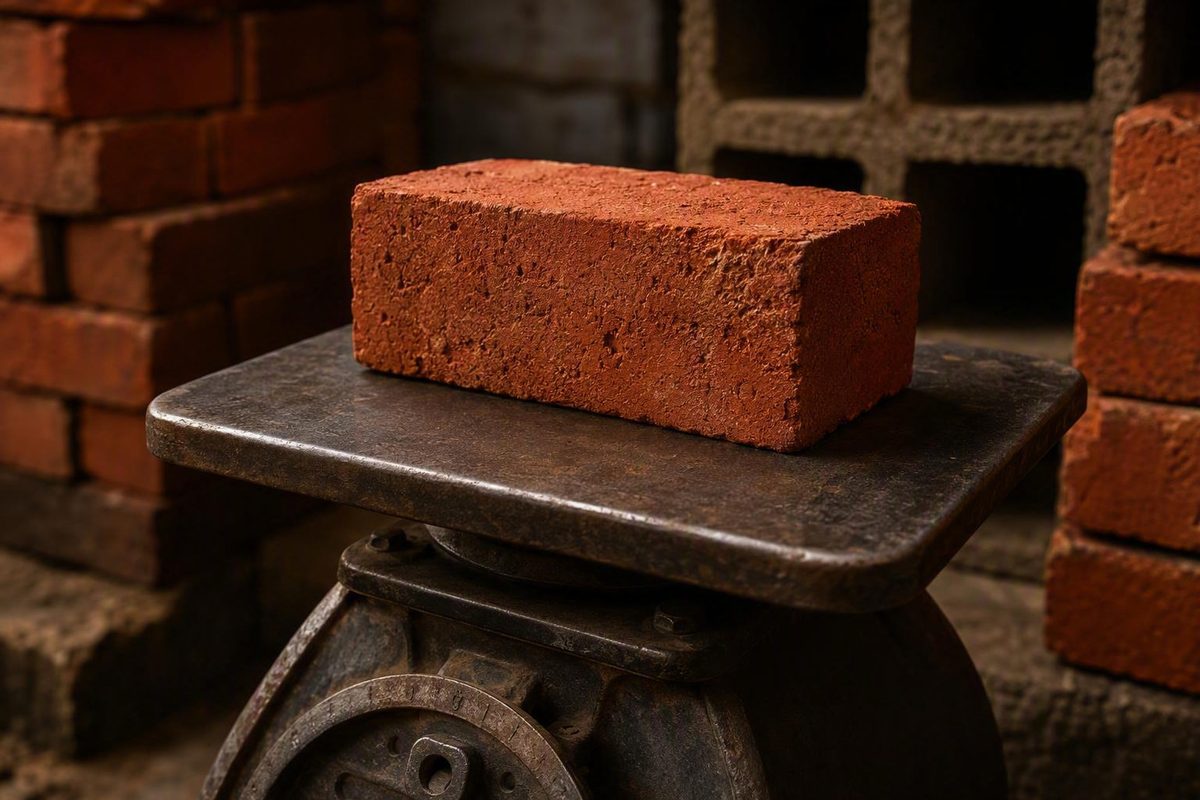
A typical standard clay face brick weighs approximately 4.4–4.5 lb, or about 2.0 kg. A third-party comparison gives the rounded standard red-brick figure as 4.5 lb (2.04 kg).
That is a practical benchmark for the ordinary red masonry brick many people picture. It is not a universal weight for every product described as a brick.
The short answer: about 4.4–4.5 pounds for a standard face brick
For a manufacturer-specific example, Belden lists its standard face brick at 3-5/8 × 2-1/4 × 8 inches and approximately 4.40 lb (2.00 kg) in its brick dimensions and approximate-weight guide.
The difference between 4.4 and 4.5 lb is only one-tenth of a pound. It is consistent with ordinary rounding, different product designs, and the fact that published figures are usually approximate. Either value can support an early estimate if the assumption is stated clearly.
Quick reference
- One ordinary clay face brick: about 4.4–4.5 lb, or roughly 2.0 kg
- Loose bricks: brick count multiplied by the assumed unit weight
- A palletized delivery: bricks plus the pallet, wrapping, straps, and other packaging
- An installed wall: bricks plus mortar and any other assembly components
These figures describe different things. A brick-only calculation is not automatically the delivered or installed weight.
For a general question, “about 4.5 pounds” is a concise answer. For ordering, transportation, lifting, cost estimation, or design, use the specified weight of the exact product.
Brick weight chart by size and product category
The most useful comparison begins with conventional clay face bricks. Dimensions matter because names such as “standard” and “modular” do not identify every product sold under those labels.
All Belden figures in this section are manufacturer-specific approximate values, not guaranteed weights for every similarly named brick. The dimensions, face-brick weights, and paver examples come from Belden’s manufacturer dimensions guide.
Common clay face-brick benchmarks
| Clay face-brick description | Dimensions, W × H × L | Approximate weight | Appropriate use |
|---|---|---|---|
| Belden modular face brick | 3-5/8 × 2-1/4 × 7-5/8 in | 4.20 lb (1.90 kg) | Manufacturer-specific estimate |
| Belden standard face brick | 3-5/8 × 2-1/4 × 8 in | 4.40 lb (2.00 kg) | Manufacturer-specific estimate |
| Rounded standard-brick benchmark | About 3-5/8 × 2-1/4 × 8 in in the cited comparison | 4.5 lb (2.04 kg) | General planning estimate |
At these dimensions, the modular example is slightly shorter and about 0.2–0.3 lb lighter than the standard benchmark. That is a small difference for one unit but a meaningful difference across a large order.
The manufacturer’s 4.40 lb figure and the rounded 4.5 lb estimate serve essentially the same rough-planning purpose. Neither should override the specification for the product being purchased.
Larger face bricks: a manufacturer-specific snapshot
Larger face-brick formats can weigh substantially more than the ordinary 4.4–4.5 lb benchmark.
| Belden face-brick name | Approximate weight |
|---|---|
| Queen | 5.70 lb |
| Norman | 6.40 lb |
| Utility | 10.20 lb |
| Monarch | 13.50 lb |
These are approximate Belden product figures, not universal weights attached to the names queen, Norman, utility, or monarch. Belden also notes that some of its naming conventions differ from wider industry conventions.
A disagreement between two tables does not necessarily mean that one is wrong. A queen brick from one manufacturer may have different dimensions, cores, or shaping from a queen brick sold elsewhere. Compare the physical specifications, not just the catalog name.
Clay pavers
Clay pavers belong in a separate comparison because they are intended for paving applications and may have different proportions and product designs from wall-facing brick.
Belden’s examples extend from approximately 2.50 lb (1.10 kg) for a split paver to 11.00 lb (5.00 kg) for a standard 8 × 8 paver. This is the range within the cited manufacturer guide, not a universal range for every clay paver.
Do not substitute a paver weight when estimating an ordinary wall brick. First confirm that the products belong to the same category and have reasonably comparable dimensions.
Why two bricks with the same name may not weigh the same
Exterior dimensions have a strong influence on weight. A larger brick will generally contain more material than a smaller brick of similar construction, but outside measurements do not tell the whole story.
Weight can also vary because of:
- Material and density: Clay bodies and other masonry materials do not all have the same density.
- Cores and holes: Openings reduce the amount of material in the unit.
- Pits and air pockets: Internal or surface features can alter how much material is present.
- Shape: Frogs, recesses, molded profiles, rounded edges, and special forms change volume.
- Product design: Bricks with similar exterior dimensions may be engineered differently.
- Manufacturing variation: Individual units may differ slightly from an advertised average.
- Moisture condition: Absorbed moisture may affect a measured weight, but the evidence does not establish a standard adjustment or specify the moisture condition behind every published benchmark.
In simple terms, consider two boxes with identical outside dimensions. If one is solid and the other contains openings, they will not necessarily weigh the same. Brick cores and perforations work on that principle: they remove material and can make a unit lighter than a solid unit of comparable size. Brick references similarly note that holes can reduce the amount of material in a brick.
Published weights should therefore be read as product averages or planning figures unless the manufacturer says otherwise. Individual bricks from the same product line need not have exactly identical mass.
Names add another source of uncertainty. Terms such as standard, queen, jumbo, king, and monarch are useful catalog labels, but they are not substitutes for measurements. Manufacturers may use a familiar name for different dimensions or use their own term for a format known by another name elsewhere.
Use this order of reliability when interpreting a brick weight:
- Exact product specification: Current information for the named manufacturer and product line.
- Dimensions, material, and construction: Width, height, length, composition, and the presence of cores or holes.
- Generic size name: A useful initial clue, but insufficient by itself.
A generic average may be adequate for a classroom calculation or preliminary budget. It is not enough for a consequential shipping, payload, lifting, or structural decision.
Face brick, thin brick, paver, fire brick, and concrete block are different categories
The 4.4–4.5 lb benchmark applies to a conventional clay face brick used in full-depth masonry. It does not apply to every rectangular masonry product.
Face brick
Standard examples may weigh around 4.4–4.5 lb, while larger formats can weigh considerably more. “Face brick” still describes a broad product class rather than one fixed size or weight.
Thin brick veneer
Thin brick is a veneer product rather than a full-depth face brick. Its reduced thickness can make each piece much lighter than a conventional unit.
One commercial source lists a thin-brick product measuring 7-5/8 × 2-1/4 × 3/8 inch at 0.88 lb (400 g). It also lists source-specific concrete-block examples of 16 lb for a lightweight block and 32 lb for a dense block, illustrating why unlike categories should not be combined into one generic weight range in a comparison of masonry-product weights.
The 0.88 lb value applies to that listed thin-brick example. It is not a universal veneer weight; dimensions, thickness, material, and manufacturer still matter.
Clay pavers
Their formats can range from small split products to broad square units, so they should be compared with other pavers of known dimensions.
The manufacturer examples from 2.50 to 11.00 lb show the variation possible within one paver catalog. They do not redefine the weight of an ordinary face brick.
Fire brick
Its composition, density, dimensions, and grade may differ from those of ordinary face brick.
A commercial comparison may assign a single weight to “standard fire brick,” but that should not be treated as a universal specification without an applicable product sheet. For a fireplace, kiln, furnace, or another heat-exposed application, identify the exact refractory product and use its technical data.
Concrete masonry units
A concrete masonry unit, or CMU, is not an ordinary clay face brick.
The 16 lb lightweight-block and 32 lb dense-block examples cited above are source-specific examples—not lower and upper limits for bricks or for all concrete blocks. The available Isodomos listing identifies a separate reference about CMU dimensions and block weights but supplies no numerical values in the evidence available here, so no additional CMU weight should be inferred from it.
Keeping these categories separate avoids a common mistake: treating thin veneer, face brick, pavers, refractory products, and concrete blocks as interchangeable because they may all be rectangular.
How to calculate the weight of 100, 500, or 1,000 bricks
Use this formula:
Number of bricks × approximate weight per brick = approximate brick-only load
For the first examples, assume each standard brick weighs 4.5 lb (2.04 kg). The cited comparison also uses this assumption and calculates 500 bricks at approximately 2,250 lb in its brick-weight examples.
| Quantity | Calculation | Approximate brick-only weight |
|---|---|---|
| 100 bricks | 100 × 4.5 lb | 450 lb, or about 204 kg |
| 500 bricks | 500 × 4.5 lb | 2,250 lb, or about 1,021 kg |
| 1,000 bricks | 1,000 × 4.5 lb | 4,500 lb, or about 2,041 kg |
| 1,000 bricks in short tons | 4,500 ÷ 2,000 | 2.25 short tons |
These are calculated estimates. Their accuracy depends on whether 4.5 lb is a suitable average for the actual brick.
Why the selected unit weight matters
Using the manufacturer benchmark of 4.2 lb (1.9 kg) for a modular brick gives different totals:
- 100 modular bricks: 100 × 4.2 = 420 lb, or about 190 kg
- 500 modular bricks: 500 × 4.2 = 2,100 lb, or about 950 kg
- 1,000 modular bricks: 1,000 × 4.2 = 4,200 lb, or about 1,900 kg
For 1,000 units, changing the assumption from 4.5 to 4.2 lb reduces the estimate by 300 lb. A small difference per brick becomes significant when multiplied across a large order.
Important: these are brick-only calculations.
They do not separately add pallets, wrapping, straps, other packaging, mortar, tools, passengers, or other cargo. No moisture adjustment has been calculated, and the moisture condition represented by the published unit-weight benchmarks is unspecified.
Do not call 2,250 lb the exact delivered weight of a pallet of 500 bricks. The calculation does not establish that a pallet contains 500 units or determine the weight of the pallet and packaging.
Where verified information is available, use:
Estimated delivered load = brick-only weight + pallet and packaging weight + other cargo
Obtain each added value from the relevant supplier, product documentation, shipment record, or scale reading. If packaging weight is unknown, label it as unresolved rather than treating it as zero.
Why brick weight matters for handling, delivery, and construction
A single brick may seem manageable, but its mass scales quickly across hundreds or thousands of units. Weight affects material movement, delivery planning, labor, and the load introduced by masonry.
An average can help with:
- Comparing brick formats during early planning
- Estimating the approximate mass of an order
- Identifying when closer verification is necessary
- Comparing the brick-only weight of two product options
- Preparing questions for a supplier or manufacturer
A generic average cannot by itself establish:
- A safe manual-handling quantity
- A vehicle’s allowable load
- The capacity of lifting equipment
- The complete delivered weight of a pallet
- The weight of a finished wall
- Whether an assembly can support masonry
Those decisions require documentation and expertise beyond a general brick-weight estimate.
Delivery and payload planning
For delivery planning, compare the complete load with the vehicle’s documented payload limit. The complete load may include bricks, pallets, packaging, people, tools, and other cargo.
This article cannot determine a safe number of bricks for a car, van, trailer, or truck. Vehicle limits, packaging weights, loading arrangements, and required safety margins are situation-specific. Consult the vehicle documentation and obtain the supplier’s shipment weight where possible.
A rough calculation can indicate that verification is needed. It cannot validate a loading procedure.
Manual handling and lifting
Individual unit weight affects repeated handling, but it does not determine how many bricks a person should carry. The task, grip, carrying method, distance, environment, and individual circumstances also matter.
Likewise, lifting equipment must be selected and operated according to its applicable documentation and the complete verified load. A brick-only estimate does not establish safe equipment capacity or procedure.
Installed wall weight
Installed wall weight is not the same as the combined weight of loose bricks. A completed assembly may contain mortar and other components in addition to the masonry units.
No numerical mortar allowance or wall-weight estimate is provided here because those values depend on the units, joints, wall geometry, and assembly details. Multiplying the brick count by 4.5 lb produces only a brick estimate, not the verified dead load of a finished wall.
Whenever weight affects shipping cost, lifting, payload, or structural capacity, replace the average with exact product data and supplier-confirmed package information. Seek the applicable engineering or safety documentation for the decision being made.
A reliable way to identify and verify an unknown brick
If you have an unidentified stack, do not assume every red rectangular unit weighs 4.5 lb. Work through the product systematically.
1. Determine the product category
First decide whether the unit appears to be:
- Full-depth clay face brick
- Thin brick veneer
- Clay paver
- Fire brick or another refractory product
- Concrete brick or concrete masonry unit
- Another specialty masonry product
This classification narrows the relevant comparisons. A thin veneer should not be matched to a face-brick table, and a CMU should not be assigned a clay-brick average.
2. Measure width, height, and length
Record all three exterior dimensions. Use a consistent order, such as width × height × length, and include the units of measurement.
Do not rely only on an informal or generic size label. Two products called “standard” may have different dimensions and weights.
3. Inspect the construction
Check for:
- Cores or holes
- A frog or recessed area
- Unusual molded profiles
- Large surface pits
- Solid or hollow construction
- Veneer-like thickness
These features may explain why a unit differs from the expected weight of a solid rectangular piece with the same outside dimensions.
4. Identify the manufacturer and product line
Look for information on packaging, order records, invoices, stamps, markings, or supplier paperwork. A verified product identity is more useful than appearance alone.
Color is not sufficient. A red appearance does not establish dimensions, density, composition, core pattern, or exact weight.
5. Consult the relevant product data
Ask the manufacturer or supplier for:
- Approximate or specified unit weight
- Exact dimensions
- Package quantity
- Pallet or package weight
- Conditions or qualifications attached to the published figure
Always identify whose specification is being quoted. Isodomos describes a comparable sourcing approach: its reference tables use published masonry standards and manufacturer data, and it identifies whose specification supports a quoted dimension or strength figure on its About page. The same principle is useful for weight.
6. Weigh a representative group if no specification is available
If the product cannot be identified, weigh several bricks together and divide by the number of units:
Measured group weight ÷ number of bricks = working average per brick
For example, weigh ten bricks and divide the total by ten.
Use a scale appropriate for the measured load and keep the weighing conditions consistent. If moisture may be relevant, record the observed condition; do not apply an unsupported percentage adjustment.
7. Label what the number represents
Record whether the result is:
- Unit-only weight
- Loose brick total
- Palletized weight
- Complete delivered weight
- Installed assembly weight
This prevents a unit or brick-only figure from later being mistaken for a delivery or wall weight.
The practical decision rule is straightforward: use 4.4–4.5 lb, or about 2.0 kg, as a rough estimate for a standard clay face brick. Identify the category and dimensions, multiply a verified unit weight by the quantity, and add delivery components separately. Replace the benchmark with exact manufacturer or supplier data whenever the result affects cost, transportation, lifting, payload, or design.
Frequently asked questions
How much does a standard red brick weigh in pounds and kilograms?
A typical standard red clay face brick weighs approximately 4.4–4.5 lb, or about 2.0 kg. A commercial masonry-product comparison also lists an ordinary standard red brick at 4.5 lb (2.04 kg).
Treat that value as a planning estimate, not a universal specification. Exact weight depends on dimensions, material, cores, shape, product design, and manufacturer.
How much do 500 standard bricks weigh?
Assuming 4.5 lb (2.04 kg) per brick:
500 × 4.5 lb = 2,250 lb, or about 1,021 kg.
That is a brick-only calculation. Pallets, packaging, tools, other cargo, and installed assembly components are not separately added. The moisture condition behind the published unit benchmark is unspecified, so no separate moisture adjustment should be inferred.
Do holes or cores make a brick lighter?
They can. Holes and cores remove material, so a cored unit may weigh less than a solid brick with similar exterior dimensions.
The actual difference depends on the number, shape, and size of the openings, as well as the material and overall product design.
Does a calculated brick load include the pallet, packaging, or mortar?
No—not unless those items are explicitly included in the calculation.
Multiplying brick count by unit weight gives a brick estimate. Pallets, wrapping, straps, packaging, and other cargo must be added for a delivered-load estimate. Mortar and other components must be considered when evaluating an installed assembly.
Is a concrete block the same as a brick for weight comparisons?
No. A concrete masonry unit is a separate product category from an ordinary clay face brick. Its weight depends on its dimensions, aggregate, density classification, and internal configuration.
Use a CMU specification for concrete block and a face-brick specification for clay brick. Do not combine the two into one generic brick-weight range.