Meet the Black Hills Spruce, South Dakota’s Official Tree
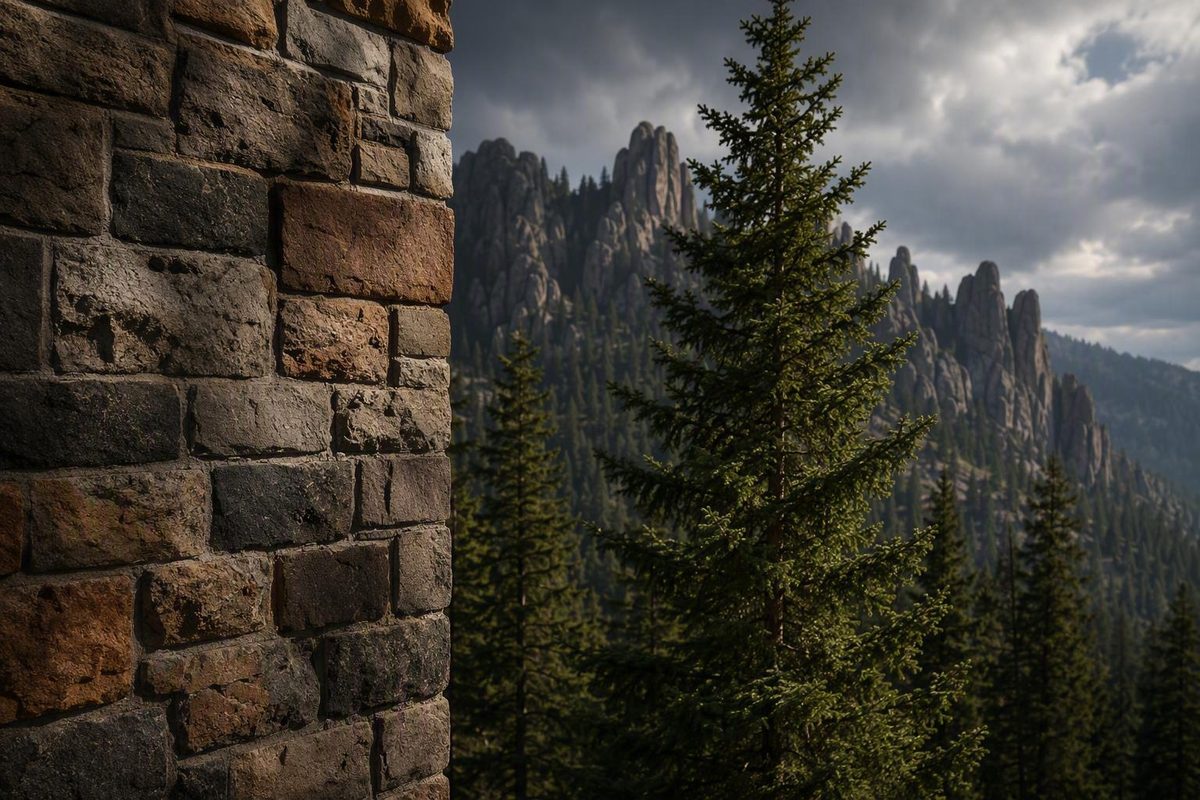
The short answer: South Dakota’s state tree is the Black Hills spruce
South Dakota’s official state tree is the Black Hills spruce. The designation dates to 1947, and the state forestry program reports that the tree officially received that status on March 10, 1947. It is an evergreen form of white spruce associated especially with the Black Hills of western South Dakota.
Its scientific name requires more explanation than its common name. State law preserves the historical wording Picea Glauca Densata. Modern botanical and horticultural references may instead use Picea glauca, Picea glauca var. densata, or Picea glauca ‘Densata’. These labels reflect different taxonomic treatments, not different official state trees.
South Dakota state tree: quick facts
Fact Answer Official common name Black Hills spruce Broader species name Picea glauca Scientific name in state law Picea Glauca Densata Designation year 1947 Reported designation date March 10, 1947 Legal authority South Dakota Codified Law 1-6-11 Native South Dakota region The Black Hills in western South Dakota Growth habit Dense, slow-growing evergreen conifer
The designation date, growth habit, Black Hills association, and state-tree history are documented in the South Dakota forestry program’s account of the state tree.
The legal designation and the statute’s historical scientific wording appear in South Dakota Codified Law 1-6-11.
The names should not be treated as unexplained synonyms. White spruce is the broader species, Picea glauca, which occurs across a large part of northern North America. Black Hills spruce is South Dakota’s official common name and refers to the geographically isolated population associated with the Black Hills. Some references also use Black Hills white spruce, but that name is clearest when its relationship to the broader white spruce species is explained.
For most purposes, the safest concise formulation is:
Black Hills spruce is South Dakota’s official state tree and belongs within the white spruce species, Picea glauca.
That wording respects the legal designation while acknowledging that authorities do not all use the same classification below the species level.
The 1947 law that made the designation official
The controlling legal authority is South Dakota Codified Law 1-6-11, titled “State tree.” It names the Black Hills Spruce as South Dakota’s state tree and identifies it with the historical scientific styling Picea Glauca Densata.
The statute explains the choice by referring to the tree’s South Dakota nativity, the direct connection between its name and the state, and what lawmakers called its “noble attributes.” Its source note traces the provision to Session Laws 1947, chapter 266, followed by a reference to the 1960 supplement of the South Dakota Code. Those details appear in the official text and legislative source note.
“Noble attributes” is legislative praise rather than a scientific conclusion. The phrase expresses the symbolic value lawmakers assigned to the spruce; it does not define a measurable botanical trait or establish that the tree is ecologically superior to another candidate.
The statute and the forestry account establish different parts of the history:
- The statute establishes the official designation.
- The statute’s source note connects the designation to the 1947 session law.
- The state forestry program supplies the reported date of March 10, 1947.
That exact date comes from the South Dakota forestry program’s historical account, not from the text of the codified provision itself.
The statute’s capitalization also belongs to its legal and historical context. More importantly, terminology placed in a 1947 law does not determine how botanists must classify the tree today.
Legal names can remain fixed while scientific classifications change. South Dakota’s official common name remains Black Hills spruce even though authorities differ over whether densata is best treated as a botanical variety, a geographic form, or a cultivar-style name.
Why the choice was debated
Black Hills spruce was not the only tree considered during the selection process. The South Dakota forestry account identifies cottonwood and juniper, also called cedar in the historical discussion, as competing proposals.
Each option represented a different idea of what a state tree should symbolize.
Supporters of cottonwood reportedly emphasized its broader distribution across South Dakota. From that perspective, a tree familiar across more of the state could be considered more representative than one associated primarily with the far-western Black Hills.
The argument for Black Hills spruce rested on a different kind of representation. Its native presence in the Black Hills and its state-specific common name created an especially direct connection to South Dakota. Those considerations also appear in the final statute, which emphasizes the tree’s nativity and the way its name identifies the state.
A further objection involved scientific naming. The forestry account says some participants viewed the spruce’s scientific name as difficult or controversial and favored substituting juniper or cedar. That concern remains understandable because the Black Hills population has subsequently been described under several botanical and horticultural notations.
The forestry account says a joint committee researched and dismissed the alternatives and that its report was accepted by both legislative chambers. A secondary state-symbol account describes parts of the process as motions that were voted down. Because the complete committee report and legislative proceedings are not included in the available evidence, a more detailed sequence of committee and floor votes cannot be established confidently.
The debate is therefore best understood as a choice between two broad forms of symbolism:
- Statewide familiarity and distribution, represented by the cottonwood argument.
- A distinctive regional and state identity, represented by Black Hills spruce.
Juniper supplied another evergreen alternative, particularly for participants concerned about the spruce’s scientific name. Black Hills spruce ultimately offered a name and geographic association tied unmistakably to one of South Dakota’s best-known landscapes.
Its selection does not mean that it was the state’s most widespread tree.
One tree, several scientific names
The broad point of agreement is that Black Hills spruce belongs within white spruce, whose species name is Picea glauca. The disagreement begins below the species level.
A simplified history of the terminology is:
- From 1933 into the early 1970s: Black Hills spruce was commonly recognized as Picea glauca var. densata.
- In later treatments: Some authorities stopped recognizing densata as a formal botanical variety because the reported differences were considered subtle or inconsistent.
- In current usage: Sources may describe it as a geographic or regional form of Picea glauca, retain the varietal notation, or use Picea glauca ‘Densata’.
The historical timeline and the explanation that formal varietal recognition was abandoned in some treatments are summarized in a South Dakota botanical field account. The state forestry program likewise says that densata was treated as a distinct variety from 1933 into the early 1970s and explains the name as a reference to the trees’ tendency to form dense stands.
Three naming contexts should be kept separate.
Historical legal context: South Dakota’s statute uses Picea Glauca Densata. That is the wording preserved in state law, not a ruling on current taxonomy.
Older botanical context: Many references used Picea glauca var. densata, treating the Black Hills population as a naturally occurring botanical variety of white spruce.
Contemporary botanical and horticultural contexts: Current sources are not uniform. Some use only Picea glauca or describe the tree as a regional form. Others retain the varietal name or write Picea glauca ‘Densata’. The Nebraska Forest Service’s profile says many experts consider the differences from white spruce insufficient to justify recognition as a distinct variety and therefore use the cultivar-style notation.
The terms variety and cultivar are not interchangeable. The cultivar-style notation can therefore be confusing when Black Hills spruce is being discussed as a naturally occurring regional population rather than solely as a selected landscape plant.
“Geographic form” avoids some of that difficulty. It recognizes that the isolated population has characteristic tendencies without insisting that it holds a universally accepted formal rank.
Black Hills spruce is often described as slower growing, narrower, smaller, or more compact than white spruce elsewhere. Those tendencies may be useful descriptively, but authorities do not agree that they occur consistently enough to require formal varietal recognition.
For general reference, schoolwork, or travel information, Picea glauca is the safest species-level scientific name. The official common name remains Black Hills spruce. When greater precision is helpful, the alternatives can be acknowledged directly:
Black Hills spruce is a regional form of white spruce, Picea glauca, historically classified as Picea glauca var. densata and also written by some modern sources as Picea glauca ‘Densata’.
That wording explains the variation without declaring any one densata notation universally accepted.
Where Black Hills spruce grows naturally
The native South Dakota population occurs in the Black Hills in the far western part of the state. This regional concentration is central to both the tree’s common name and its symbolic importance.
White spruce as a species has a much broader distribution. It is a northern North American conifer associated extensively with boreal forests, ranging across Canada and into parts of the northern United States. The Black Hills population is geographically isolated from much of that larger range, as described by the Nebraska Forest Service.
Two opposite errors should therefore be avoided:
- Black Hills spruce should not be presented as an unrelated species merely because it has a regional common name.
- White spruce should not be described as a tree found only in South Dakota.
The broader species occurs far beyond the state. What distinguishes Black Hills spruce is its geographic association and the growth tendencies reported for that isolated population, not South Dakota’s exclusive possession of the species.
One plant profile extends the natural regional occurrence into northeastern Wyoming as well as the Black Hills of South Dakota. That should be understood as a supported regional extension rather than a precise mapped boundary, because the available evidence does not provide detailed occurrence records defining a sharp range line. The regional description appears in the Black Hills spruce profile from Johnson’s Nursery.
Native distribution must also be distinguished from cultivated distribution. White spruce and trees sold as Black Hills spruce have been planted outside the native Black Hills population in windbreaks, conservation projects, residential landscapes, and community plantings. A planted tree in another Great Plains state does not expand the tree’s natural range; it demonstrates cultivation beyond that range.
This distinction explains how Black Hills spruce can be strongly associated with South Dakota while still being familiar elsewhere. Its name comes from an isolated western population, whereas the broader species and cultivated trees extend well beyond state lines.
Geography also helps explain the tree’s effectiveness as a state symbol. “Black Hills spruce” immediately invokes a particular South Dakota landscape. Cottonwood may have offered broader statewide distribution, but the spruce supplied a more distinctive regional name and identity.
How to recognize a Black Hills spruce
Black Hills spruce is a dense, compact, slow-growing evergreen. Its foliage may appear green, bright green, or bluish green, and established trees commonly develop a narrow, closely branched form.
Color can contribute to an overall impression, but it should not be used alone for identification.
The simplest way to distinguish a spruce from a pine is to examine the needles:
- Spruce needles attach singly to the twig.
- Pine needles grow in bundles. South Dakota pine species have needles grouped in bundles of two to five.
That attachment pattern is generally more useful than judging color or overall shape from a distance. A Black Hills spruce does not have the paired or clustered needles typical of a pine.
The needles are described as approximately 2 centimeters long, although that is an identification estimate rather than an exact length for every needle. Mature female cones hang downward from the branches.
Published cone measurements differ. The botanical field account reports cones reaching approximately 7 centimeters, while the Johnson’s Nursery profile reports a length of 1 to 2 inches. These figures should be retained as separate source reports rather than merged into a single supposedly uniform range. Needle arrangement, approximate needle length, bark, and the larger cone measurement are documented in the botanical identification account.
The bark is generally described as thin, gray, and scaly. On an established tree, that texture supplies another clue, although bark alone is rarely sufficient for confident identification.
A practical field check proceeds from the most useful features to the more variable ones:
- Confirm that the plant is an evergreen conifer.
- Look for short needles attached one at a time rather than in bundles.
- Check for hanging cones that mature to brown.
- Observe the thin, gray, scaly bark.
- Consider the tree’s dense, narrow form and geographic setting.
Black Hills spruce is often characterized as smaller, denser, and more compact than white spruce populations elsewhere. Those are tendencies, not absolute diagnostic rules. Their variability is one reason authorities disagree over whether the population merits recognition as a formal botanical variety.
Size, habitat, and landscape performance
There is no single mature size that applies to every Black Hills spruce. The available evidence does not establish exactly how much each factor contributes to every discrepancy.
The South Dakota forestry program reports a mature size of approximately:
- 30 to 60 feet tall
- 15 to 25 feet wide
Those figures come from the South Dakota forestry profile cited above. Other sources offer different expectations for cultivated trees.
The University of Minnesota reports approximately 20 to 40 feet in height and 10 to 15 feet in width, while the Johnson’s Nursery profile gives the same height range but a spread of 15 to 25 feet. These are best treated as source-dependent expectations, not fixed biological limits.
Black Hills spruce generally prefers full sun and moist, well-drained soil. The South Dakota forestry program identifies acidic, moist loams as favorable but also reports adaptation to soils ranging from gravelly or sandy loams to fine clay.
“Adaptable” does not mean unaffected by site conditions. Drainage, moisture, soil structure, temperature, and exposure can all influence performance. General plant profiles describe tendencies; they do not replace an evaluation of a particular planting site.
Established white or Black Hills spruce is described as fairly or moderately drought tolerant by the South Dakota and Nebraska forestry profiles. That does not mean the tree is immune to drought stress.
Documented site limitations include:
- Intolerance of flooding.
- Sensitivity to soil compaction.
- Sensitivity to road salt or salt spray.
The flooding and compaction cautions come from the South Dakota forestry profile. The University of Minnesota landscape profile warns that Black Hills spruce is intolerant of salt spray and advises against sites near busy roads, highways, and parking lots.
Hardiness ratings also vary. The South Dakota forestry program lists USDA zone 2, while the University of Minnesota lists zones 3–6. Neither should be presented as a universal boundary independent of local climate, exposure, or the context in which the profile was prepared.
For gardeners, the most defensible general summary is that Black Hills spruce is a cold-adapted evergreen favoring sun, adequate drainage, and reliable moisture, with some drought tolerance after establishment. Flood-prone, heavily compacted, and salt-exposed sites present documented concerns.
That is general information rather than a property-specific planting prescription. Selecting a tree for a particular site also requires attention to soil, drainage, winter exposure, available space, utility clearances, and regional guidance.
Ecological, practical, and commemorative importance
Black Hills spruce has practical uses beyond its role as a state symbol. Supported uses include conservation plantings, agroforestry windbreaks, privacy screens, specimen and ornamental planting, dimensional lumber, pulpwood, and Christmas-tree production.
Its dense evergreen growth can provide winter cover. The South Dakota forestry program also reports that its seeds feed birds and small mammals, porcupines may eat the bark, and deer may browse the foliage lightly. These are documented wildlife interactions, not a claim that the tree serves the same ecological role in every habitat or planting.
Landscape use involves tradeoffs. A dense, relatively slow-growing evergreen can be valuable where year-round screening or wind reduction is wanted, but it also needs sufficient long-term space. Its preference for cool conditions and sensitivity to flooding, compaction, and salt can limit appropriate sites.
Black Hills spruce can also experience insects and diseases. The South Dakota forestry profile lists Lirula needle blight, spider mites, spruce needle miner, pine needle scale, yellow-headed spruce sawfly, and aphids. The Nebraska Forest Service identifies additional diseases and insects affecting white spruce more generally. These lists describe possible concerns; they do not predict that every tree will develop every problem or that each pest is equally important throughout South Dakota.
One event gives the state tree a memorable national connection: a 63-foot Black Hills spruce from Black Hills National Forest served as the 1997 National Capitol Christmas Tree, according to the South Dakota forestry program.
Practical value alone, however, does not explain the legislative choice. Windbreak utility, wood products, wildlife interactions, and ornamental use help explain why the tree remains familiar and valued. The statute’s stated reasoning focused more directly on South Dakota nativity, the state-associated name, and the symbolic qualities lawmakers attributed to the tree.
South Dakota’s state tree is therefore significant on several levels. It is a recognizable dense evergreen, a regional expression of a broadly distributed northern species, a useful forestry and landscape tree, and a living reference to the Black Hills.
Its official status rests on South Dakota Codified Law 1-6-11 and the 1947 legislation behind that provision. Its common name has remained stable even as scientific treatment has changed. Readers may encounter Picea glauca, Picea glauca var. densata, Picea glauca ‘Densata’, or the statute’s historical Picea Glauca Densata, but each refers to the Black Hills spruce within the broader white spruce species.
Frequently asked questions
What is South Dakota’s official state tree?
South Dakota’s official state tree is the Black Hills spruce. The designation is established by South Dakota Codified Law 1-6-11.
When did the Black Hills spruce become South Dakota’s state tree?
It became South Dakota’s state tree in 1947. The South Dakota forestry program reports the specific date as March 10, 1947, while the codified law traces the designation to Session Laws 1947, chapter 266.
What is the scientific name of the Black Hills spruce?
The safest species-level name is Picea glauca, the scientific name for white spruce. South Dakota law uses the historical styling Picea Glauca Densata. Other references use Picea glauca var. densata or Picea glauca ‘Densata’, reflecting differing treatments as a variety, regional form, or cultivar-style name.
Is Black Hills spruce the same as white spruce?
Black Hills spruce belongs within white spruce, Picea glauca. The common name refers to the geographically isolated regional population associated with the Black Hills. It is often described as denser, more compact, and slower growing than white spruce elsewhere, although not every authority considers those differences consistent enough to justify a formal botanical variety.
How can you tell a Black Hills spruce from a pine?
Examine the needles. Black Hills spruce has short needles attached singly to the twig, while pine needles grow in bundles. Hanging cones, thin gray scaly bark, and a dense evergreen form provide additional identification clues.