
How to Identify and Choose Parts for LEGO Trees
A complete-tree catalog name cannot be applied automatically to a modular build, and one palm component number does not identify a finished palm.
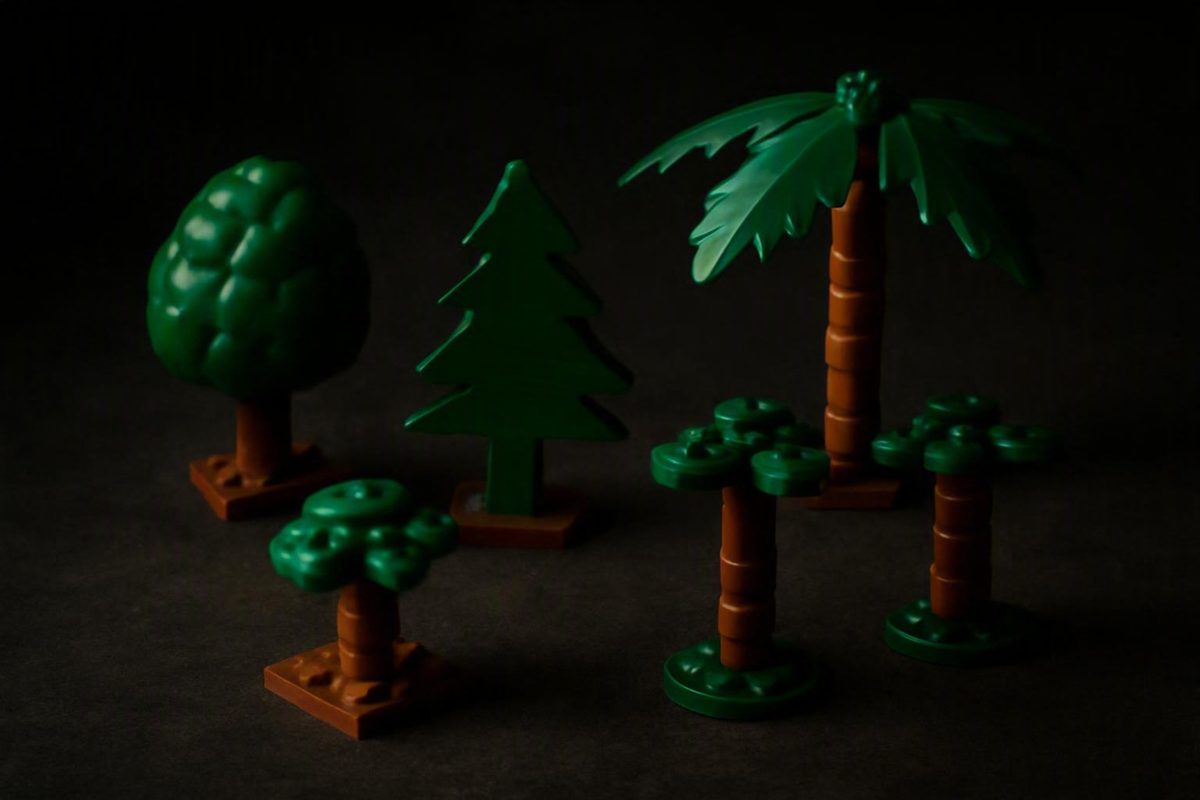
A LEGO tree may be a single molded object, a vintage flat piece, a segmented palm, or a custom assembly of trunk, connectors, and foliage. Identification should therefore begin with visible construction—not a presumed species name.
This LEGO trees parts guide has two purposes:
- Help collectors narrow down vintage trees by form, finish, texture, base, mounting method, and silhouette.
- Help builders choose structural and foliage elements for pine, birch-style, deciduous, palm, bonsai, seasonal, and other custom trees.
It is a selected cross-reference, not a complete inventory. Historical findings come largely from collector research, catalog identifiers come from a third-party marketplace, and building methods come from documented community tutorials or named sets.
How to use this tree-parts guide
Do not treat every green botanical element as the same type of tree part. The useful categories are:
- Complete or largely complete trees: vintage flat trees and later molded forms with integrated trunks and canopies.
- Palm components: separate bases, trunk sections, and fronds intended to form a modular system.
- Loose foliage: leaves, bushes, bamboo, stems, and other botanical elements.
- Structural connectors: clips, bars, hinges, hollow studs, SNOT elements, and tubing that establish branch position.
- Repurposed decorative elements: non-botanical pieces used visually as leaves, needles, blossom, bark, or snow.
A collector cataloging a painted birch needs a different method from a builder planning a flexible branch network. A complete-tree catalog name cannot automatically be applied to a modular assembly, and the number for one palm component does not identify an entire finished palm.
The following evidence labels indicate how claims should be interpreted:
- Marketplace-cataloged: a name or identifier used by BrickLink or another third-party catalog.
- Collector-reported: a historical observation from an enthusiast source rather than primary LEGO documentation.
- Tutorial-derived: a technique demonstrated or recommended by a builder.
- Official-set fact: information published for a named LEGO set or its instructions.
- Subjective: an aesthetic preference rather than an objective comparison.
- Time-sensitive: availability, rarity, price, or catalog coverage that may change.
- Unresolved: a distinction for which the available evidence does not establish origin, sequence, or attribution.
BrickLink names and item numbers are marketplace conventions. They are useful search and identification keys, but the available evidence does not establish them as official LEGO design IDs or element IDs.
The historical framework comes principally from the Visual Lego Tree Helper, a collector-created reference from around 2005 that survives in a May 2006 archive snapshot. It organizes illustrated trees into painted, Samsonite, granulated, and molded round styles, while inviting corrections and additional photographs. It is neither official LEGO documentation nor necessarily a complete catalog. Its chronology should therefore be read as collector-reported. The archived page’s former isodomos.com address does not establish that the current Isodomos site created, maintains, endorses, or is affiliated with the guide. See the archived Visual Lego Tree Helper for the collector’s presentation.
BrickLink is named only to identify its third-party catalog conventions.
Visual identification decision tree: start with form, finish, texture, and base
Use this sequence before trying to match an item number.
1. Is the tree flat or three-dimensional?
Turn the piece sideways.
- If its trunk and foliage form an essentially flat profile, continue with the vintage flat-tree checks.
- If the canopy has substantial depth and molded foliage around it, skip to the molded-round checks.
- If the model separates into a base, trunk sections, leaves, or connected foliage pieces, it may be modular rather than one complete vintage tree.
2. For a flat tree, inspect the surface.
Choose the closest description:
- Painted: foliage color or fruit detail appears applied to the flat form.
- Plain: the surface is unpainted and has no glued granules.
- Granulated: particulate green material is glued over the flat foliage areas.
Do not classify a granulated tree as molded merely because its coating creates depth. Its underlying body remains a flat form; the texture is applied over that substrate.
3. If the tree is painted, inspect the base from below and from the side.
- A solid flat base has a continuous, flat underside.
- A hollow base has an underside cavity designed to fit over studs.
These are different mounting geometries. Check the underside rather than relying only on the foliage silhouette, because similar tree forms may occur with more than one base style.
4. If the tree is plain, distinguish a flat bottom from feet.
The collector guide associates plain bush and pine forms with its Samsonite category. Within that group:
- A plain flat-bottom tree rests directly on its integrated base.
- A footed tree has projections intended to sit between baseplate studs.
A footed tree is not a hollow-base tree. Feet occupy the spaces between studs; a hollow base fits over studs. This is an important distinction when marketplace photographs show otherwise similar plain trees.
5. If the tree is granulated, examine the coating under good light.
The collector reference describes two textures:
- relatively large, cube-like granules;
- smaller, tube-like granules.
This is an unresolved diagnostic detail. The collector did not establish where the two textures originated or which appeared first. Texture can distinguish examples, but it cannot safely assign their chronological order.
6. If the tree is molded and three-dimensional, inspect four features.
- Silhouette: Is the piece tall and conical, narrow and columnar, rounded, or low and bush-like?
- Integral ridges: Are its foliage marks molded into the plastic rather than painted or glued on?
- Flexibility: Does the plastic feel relatively stiff or more yielding?
- Tips: Where applicable, are the foliage extremities square-ended or rounded?
The archived guide reports relatively stiff earlier examples and softer, more flexible later examples. That is a collector observation, not a laboratory test or official date code.
7. Use silhouette as the final narrowing step.
Compare the outline with these broad forms:
- Bush: low, broad foliage, sometimes with multiple visible trunks.
- Birch: a taller, open flat-tree outline with separated branch masses.
- Cypress: narrow and columnar.
- Fruit or apple tree: rounded crown, sometimes with painted apples.
- Pine: triangular or conical foliage profile.
- Elm or oak shade tree: a broad, spreading crown above a trunk.
- Small pine: compact molded conifer.
- Large pine: taller molded conifer, potentially with square or rounded tips.
- Bush extension: a molded foliage component intended to enlarge or combine with a bush form.
Use the specific catalog description to settle the name where possible. The collector guide sometimes discusses a spreading silhouette as “elm or oak,” whereas BrickLink lists separate elm and oak entries. Shape alone may not resolve that catalog distinction.
Absence is not proof. A missing photograph in the collector guide means only that its creator lacked an image. Likewise, an entry missing from a truncated catalog excerpt has not been shown never to have existed.
Painted, Samsonite, granulated, and molded round trees
The four collector categories are best treated as construction families, not as a complete official taxonomy.
| Collector category | Construction | Finish or texture | Mounting method | Illustrated forms | Approximate period |
|---|---|---|---|---|---|
| Painted | Flat tree form | Painted foliage; some fruit variants have painted detail | Solid flat base or hollow stud-fitting base | Bush, birch, cypress, fruit or apple, pine, elm or oak shade tree | Collector-reported: 1950s to early 1970s |
| Samsonite | Flat plain form | Unpainted and without glued granules | Flat bottom or feet fitting between studs | Bush and pine | Collector-reported: associated with Samsonite production and distribution in the 1960s and early 1970s |
| Granulated | Flat tree form | Glued green plastic granules, reported in cube-like and tube-like textures | Integrated flat-tree base | Two-trunk bush, three-trunk bush, fruit tree, pine | Collector-reported: replaced painted trees in the early 1970s |
| Molded round | Three-dimensional solid-plastic form | Unpainted, with integral molded foliage ridges | Integrated connection appropriate to the form | Large pine, snow-covered pine, fruit tree, cypress, small pine, bush, bush extension | Collector-reported: followed granulated trees in the late 1970s |
Table note: All dates, sequence claims, licensing history, and illustrated forms in this section are collector-reported by the archived Visual Lego Tree Helper, not manufacturer-confirmed production records.
Painted trees. These are flat forms with applied foliage decoration. The collector guide reports production from the 1950s through the early 1970s, a new flat-base range in 1960, and hollow-base versions in 1965. Painted examples include bush, birch, cypress, fruit, pine, and a broad elm-or-oak shade-tree form. The dates remain collector-reported.
Samsonite trees. According to the same collector source, Samsonite was a licensed LEGO producer and distributor in the United States and Canada during the 1960s and early 1970s. The illustrated plain forms are limited to bush and pine, each shown with either a flat bottom or feet fitting between studs. The evidence does not establish that every plain vintage tree belongs to this category.
Granulated trees. These retain a flat underlying form but carry glued green plastic granules. Illustrated silhouettes include a two-trunk bush, three-trunk bush, fruit tree, and pine. Large cube-like and smaller tube-like granules are reported, but their origin and sequence remain unresolved.
Molded round trees. These are three-dimensional solid-plastic forms with foliage ridges created by the mold. The collector guide distinguishes relatively stiff examples from later, more flexible ones and notes square versus rounded tips on some pine and fruit-tree variants. These clues are most useful when considered together with silhouette; none is a stand-alone official dating test.
The broad collector sequence is therefore painted, then granulated, then molded round. Samsonite’s plain forms overlap that historical discussion rather than serving as a universal stage between the other three categories.
Vintage tree lookup table: BrickLink names and item numbers
The following table converts visible characteristics into BrickLink search identifiers. These are marketplace-cataloged IDs and descriptions, not official LEGO element IDs.
| Form | BrickLink marketplace ID | Catalog description | Visible identifying trait | Confidence or limitation |
|---|---|---|---|---|
| Birch | FTBirchH |
Flat birch, painted, hollow base | Painted flat tree with cavity under base | Strong match when underside is visible |
| Birch | FTBirch |
Flat birch, painted, solid base | Painted flat tree with continuous base | Strong catalog match |
| Birch | FTBirch1 |
Flat birch, painted, solid base, 1950s version | Birch silhouette with cataloged early-variant distinction | “1950s version” is a marketplace label |
| Bush | FTBushH |
Flat bush, painted, hollow base | Painted bush with stud-fitting cavity | Strong match when underside is visible |
| Bush | FTBush |
Flat bush, painted, solid base | Painted bush with solid underside | Strong catalog match |
| Bush | FTBush1 |
Flat bush, painted, solid base, 1950s version | Painted cataloged early variant | Period label is catalog-specific |
| Bush | FTBushP |
Flat bush, plain | Unpainted bush with flat bottom | Associated with the plain collector category |
| Bush | FTBushPF |
Flat bush, plain with feet | Unpainted bush with between-stud feet | Do not confuse feet with a hollow base |
| Cypress | FTCypH |
Flat cypress, painted, hollow base | Narrow painted silhouette with hollow underside | Strong catalog match |
| Cypress | FTCyp |
Flat cypress, painted, solid base | Narrow painted silhouette with solid base | Strong catalog match |
| Cypress | FTCyp1 |
Flat cypress, painted, solid base, 1950s version | Narrow cataloged early variant | Period label is marketplace-cataloged |
| Elm | FTElm |
Flat elm, painted, solid base | Broad shade-tree crown with solid base | Compare with oak rather than relying on silhouette alone |
| Fruit | FTFruitH |
Flat fruit tree, painted, hollow base | Rounded fruit-tree silhouette with hollow base | Description does not specify painted apples |
| Fruit/apple | FTFruitAH |
Flat fruit tree, painted apples, hollow base | Painted apple detail and hollow base | Apple detail is a key discriminator |
| Fruit | FTFruit |
Flat fruit tree, painted, solid base | Fruit-tree silhouette with solid base | Distinguish from A-labeled entries |
| Fruit/apple | FTFruitA |
Flat fruit tree with painted apples, solid base | Painted apples and solid base | Strong visual and catalog match |
| Fruit/apple | FTFruitA1 |
Flat fruit tree with painted apples, 1950s version | Apple detail plus cataloged early variant | Date is a marketplace descriptor |
| Oak | FTOakH |
Flat oak, painted, hollow base | Broad shade-tree silhouette with hollow base | Compare with the specific catalog entry |
| Oak | FTOak |
Flat oak, painted, solid base | Broad shade-tree silhouette with solid base | Collector terminology may overlap with elm |
| Pine | FTPineH |
Flat pine, painted, hollow base | Painted conical form with hollow base | Strong catalog match |
| Pine | FTPine |
Flat pine, painted, solid base | Painted conical form with solid base | Strong catalog match |
| Pine | FTPine1 |
Flat pine, painted, 1950s version | Cataloged early painted-pine variant | “1950s” is not an official ID system |
| Pine | FTPineP |
Flat pine, plain | Unpainted pine with flat bottom | Plain collector-category form |
| Pine | FTPinePF |
Flat pine, plain with feet | Unpainted pine with between-stud feet | Feet differ from a hollow cavity |
| Granulated bush | GTBush |
Granulated bush with two trunks | Two visible trunks beneath textured foliage | Trunk count separates it from GTBush3 |
| Granulated bush | GTBush3 |
Granulated bush with three trunks | Three visible trunks | Damage may obscure a trunk |
| Granulated fruit | GTFruit |
Granulated fruit tree | Rounded flat form with glued texture | Granule type does not establish date |
| Granulated pine | GTPine |
Granulated pine | Conical flat form with glued texture | Distinguish from painted and molded pine |
Table note: Names and identifiers are taken from the BrickLink Plant, Tree reference catalog. The supplied catalog snapshot reported 45 category items, but its evidence excerpt was truncated and mixed complete trees with components. The table is therefore a targeted lookup, not a complete inventory.
The recurring catalog descriptors mean:
- Hollow base: an underside cavity intended to fit over studs.
- Solid base: a continuous, non-hollow base.
- Plain: an unpainted form in these entries.
- Feet: projections fitting between studs rather than enclosing them.
- Painted apples: applied apple details distinguishing A-labeled fruit entries.
- 1950s version: BrickLink’s description for a cataloged variant, not an official element-number prefix or independently confirmed date.
When buying from photographs, request a clear image of the underside. A frontal image may reveal silhouette and paint while concealing the decisive distinction among solid, hollow, and footed mounting systems.
Complete trees versus modular trunks, foliage, palms, and landscaping parts
A complete vintage tree is usually selected for period appearance, collection matching, or quick placement. A custom tree is selected by anatomy: base, trunk, major branches, smaller twigs, canopy, and ground treatment.
Marketplace-cataloged complete or substantial molded forms include:
30131Hollow Stump3778Cypress3470Fruit Tree
Those names establish that the entries represent a stump or molded tree form. They do not establish every color, date, or connection detail.
The catalog also shows a modular palm system:
2563Palm Base30338Palm Base 4 by 4 with Trunk30339Palm Leaf 42518Large Palm Leaf6148Small Palm Leaf2536uPalm Trunk, with its type cataloged as undetermined
This illustrates why “palm tree” may refer either to a finished model or to a collection of components. A loose leaf or trunk section is not a complete tree, and 2536u should retain its cataloged uncertainty rather than being assigned a more definite type. These molded-tree and palm identifiers appear in the BrickLink Plant, Tree catalog.
For custom builds, group vegetation by function rather than botanical name:
| Function | Useful examples | Documented or practical roles |
|---|---|---|
| Broad canopy or scaffolding | 2417, 2423 leafy branches |
Visible canopy layers, hidden foliage support, shrubs, vines |
| Dense low texture | 6064 bush |
Shrub mass, height, canopy infill, ground vegetation |
| Angled edge detail | 30176 bamboo |
Irregular canopy edges and layered undergrowth |
| Clip- or rod-based detail | 30093 sea grass |
Attachment framework, fine branching impression, ground cover |
| Broad palm accents | 30239, 10884 palm leaves |
Fronds, tall vegetation, broad canopy accents |
| Angled palm mounting | 65578 angled bar-with-stud connector |
Tilting compatible fronds away from a flat plane |
| Fine gap filling | 37695 stem with three leaves |
Twig tips, small clusters, gaps between larger elements |
Leafy branches 2417 and 2423 are especially adaptable because their rod-hole grids can support smaller botanical elements away from the normal stud grid. They can remain visible as foliage or disappear inside the canopy as scaffolding. Bush 6064, bamboo 30176, sea grass 30093, palm leaves 30239 and 10884, connector 65578, and stem 37695 extend the same principle: botanical pieces may become canopy foliage, shrubs, vines, ground cover, or concealed support. These roles are documented in BrickNerd’s builder’s foliage and landscaping guide.
Visual function can matter more than a piece’s original decorative identity. Mini Bonsai Trees 10373 uses butterflies as foliage and bladed claw elements as pine-like growth. Its models also use repeated foliage subassemblies, bars and clips, and sideways-facing trunk construction. These examples demonstrate repurposing, not universal connection compatibility, as shown in New Elementary’s review of Mini Bonsai Trees 10373.
Connection glossary for trunks and articulated branches
Tree shape depends as much on connection geometry as on foliage.
- Stud: the raised circular connection on top of many elements. Stacked studs support straightforward vertical trunks and fixed foliage layers.
- Hollow stud: a stud with an opening through its center. In compatible assemblies, that opening may accept a bar or allow tubing to pass through.
- Rod or bar: a narrow cylindrical connection used with clips, handles, and rod holes. Bars work well for slender branches and offset mounting.
- Clip: a gripping connection attached to a compatible bar. Rotating the clip around the bar changes the branch angle.
- Handle: a bar-like grip point built into a plate or another element, providing a place for a clip to attach.
- Rod hole: an opening sized for a compatible bar. A grid of rod holes permits foliage placement away from the normal stud grid.
- Hinge: an articulated connection used to alter the angle of a larger limb or branch platform.
- SNOT connection: “studs not on top”—construction that turns studs sideways or otherwise departs from vertical stacking.
- Travis brick: the common builder nickname for a 1-by-1 brick with studs on four sides. It directs branches or foliage outward around a central trunk.
- Technic element: a part using holes, pins, axles, or related geometry. Such elements can provide an internal core or alternative branch framework.
- Flex tubing: bendable tubing used to create curved trunk or branch lines through compatible openings.
A narrow trunk can be built by stacking 1-by-1 round bricks. Besides adding height, the bricks act as spacers between foliage layers. More spacing exposes the trunk and creates an open silhouette; tighter spacing makes the canopy appear denser.
Travis bricks and headlight bricks redirect connection points around the vertical core. Clips, handles, and bars then offset or tilt foliage. This can slope a conifer tier downward, rotate a deciduous branch away from the grid, or place foliage between the four main stud directions.
Hinges can articulate major limbs or larger branch platforms. Bar-and-clip assemblies are used in tutorials for finer branches and leaf attachments. The available evidence does not support calling either approach inherently stronger, safer, or capable of holding a specified weight.
Leafy branches 2417 and 2423 provide another geometry. Their rod-hole grids support off-grid botanical placement, while their broad forms bridge gaps between structural branches. They can therefore serve as both visible foliage and concealed framework.
In one tutorial-derived flex-tube method, leaves are threaded onto tubing passing through hollow studs. Round-brick spacers alternate with foliage layers, and a tapered upper trunk exposes a shorter section of tubing near the crown. Smaller leaves reduce visual mass at the top. Stacked trunks, Travis-brick tiers, bar-and-clip branches, woven foliage, and flex-tube construction are demonstrated in the Brickbuilt tree tutorial.
Compact bonsai can reverse the usual vertical logic. Bars and clips can connect a trunk assembly to its pot while SNOT techniques turn trunk surfaces sideways, creating bends and offsets without requiring the whole trunk to follow one vertical stud column.
Treat stability as a design consideration rather than a proven ranking. A wide or asymmetrical canopy may need a broader base, more connection points, or a different branch distribution, but no controlled load or durability data is available for the techniques summarized here. Test the model gently while building and revise it if the base tips or joints rotate.
Parts and techniques for seven common tree styles
The following matrix compares documented approaches. “Parts intensity” is relative, not an exact count.
| Style | Core construction | Scale and density | Movement | Relative parts intensity |
|---|---|---|---|---|
| Layered pine | Round-brick trunk with offset foliage tiers | Medium to tall; sparse to dense | Mostly fixed, with clip adjustment | Medium to high |
| Woven pine | Interlaced leaf rings over a central trunk | Compact to tall; usually dense | Mostly fixed | High |
| Birch-style tree | Round bricks and plates with long bar branches | Slender; open to moderately leafy | Clip-adjustable branches | Medium |
| Articulated deciduous tree | Central bar core, cones, holders, clipped bars, nozzles | Medium to broad; sparse or dense | Highly articulated | High |
| Flex-tube tree | Bent tubing through hollow studs with spaced foliage | Medium to tall; organic and layered | Curved rather than freely jointed | High |
| Palm | Segmented trunk or base with broad fronds | Slender trunk; open crown | Fronds can be angled | Low to medium |
| Compact bonsai | Repeated foliage modules and SNOT trunk shaping | Compact; controlled canopy masses | Limited clip adjustment | Medium to high |
Matrix note: The layered pine, woven pine, birch-style, articulated deciduous, and flex-tube methods are tutorial-derived from Brickbuilt. The matrix describes relative form and complexity rather than tested performance.
Layered pine. Build a central trunk from stacked 1-by-1 round bricks. Insert Travis bricks, headlight bricks, clips, handles, or bars at selected heights to carry foliage tiers. Longer or denser foliage near the bottom and smaller clusters toward the top create a taper. Increasing the space between tiers exposes the trunk; decreasing it creates a fuller profile.
Woven pine. Alternate small leaf elements over and under one another to make a circular foliage assembly. The Brickbuilt tutorial commonly uses a ring of eight leaves and notes that adding leaves can increase its diameter. Slide the assembly over a trunk of 1-by-1 round bricks topped by a centered 2-by-2 round plate. Repeat at different heights, reducing the diameter toward the crown. Repeated woven units make this method relatively parts-intensive.
Birch-style tree. Use round bricks and plates for a narrow segmented trunk, then attach long bars as branches. The tutorial generally uses four long bars while presenting additional branches as a variation. Its practical recommendation is to add foliage to each bar before clipping the completed branch to the trunk, avoiding work deep inside an already crowded canopy.
Articulated deciduous tree. One documented example begins with a round plate with a hole, a round brick, and a central bar, then expands through cones, bar holders, T-bars or clipped bars, and nozzle elements. These are examples rather than mandatory ingredients. The transferable pattern is anatomical: central trunk, major junctions, smaller clipped branches, and foliage at the extremities.
Flex-tube tree. Thread leaves onto flex tubing, pass the tubing through hollow studs, and alternate foliage layers with round-brick trunk spacers. A cone can taper the upper trunk toward an exposed section of tubing, with smaller leaves near the crown. The method supports curved, irregular lines that are difficult to create with vertical stacking alone.
Palm. Combine a base, segmented or dedicated trunk components, and broad palm leaves. Fronds do not all need to occupy one horizontal plane: compatible angled connectors can vary their height and droop. A simple palm has an open canopy and relatively low parts intensity, although a highly segmented trunk increases the count.
Compact bonsai. Design a few repeatable foliage subassemblies, connect them with bars and clips, and use SNOT techniques to bend or offset the trunk. Repetition gives the canopy coherence, while small changes in angle prevent mechanical uniformity. LEGO’s official Bonsai Tree 10281 instructions provide an official, set-specific construction reference. The page identifies the model as a 2021 set for ages 18 and over with 878 pieces; those facts describe set 10281, not a universal bonsai inventory.
Snow-covered or winter variation. Substitute white foliage where connections permit, or place white accents above darker branch layers. One documented winter-pine example uses white 15208, Plate, Adjusted 1 by 2 with 3 Teeth. This is a repurposed visual technique, not evidence that 15208 is officially designated as a pine-tree element.
Choose parts by scale, silhouette, season, and available inventory
Make four decisions before opening a parts catalog:
- Scale: miniature, minifigure-scale scenery, or a larger display model.
- Tree type: conifer, birch-style, spreading deciduous tree, palm, bonsai, or stylized seasonal tree.
- Intended use: background scenery, collectible period detail, dense MOC focal point, or freestanding display.
- Canopy density: sparse and branch-led, balanced, or foliage-heavy.
A collectible period detail may call for one complete vintage tree with the correct base. A minifigure-scale streetscape may favor a compact trunk and standardized foliage units. A dense focal tree may use layered scaffolding and varied branch angles, while a freestanding display needs a base and canopy arrangement that remain manageable when handled.
Translate the desired silhouette into structural choices:
- Use tiered, tapering foliage for a conifer.
- Use long clipped branches around a slender trunk for a birch-style tree.
- Use hinges or articulated bar networks for a spreading deciduous crown.
- Use segmented trunks and broad fronds for palms.
- Use repeated small modules and SNOT trunk offsets for bonsai.
The same trunk can suggest different trees when its proportions change. More exposed trunk creates a taller, more open visual profile. Close foliage layers create a dense conifer; wide gaps emphasize its branch structure. Downward branch angles make the canopy appear heavier, while upward tips produce a lighter outline. These are subjective visual cues rather than fixed botanical rules.
Substitute by function:
- If a specified branch bar is unavailable, use another compatible clipped bar that reaches the required position.
- Change the number of leaves in a woven ring to alter canopy diameter.
- Use hinges where major limbs need adjustment.
- Use smaller leaves or narrower subassemblies near a tapered crown.
- Replace one large foliage unit with several smaller units when they provide comparable coverage and compatible connections.
- Use leafy branches as hidden scaffolding when fine-detail pieces cannot span a gap.
A functional substitute reproduces the required connection and structural role. A visual substitute resembles the intended foliage but may connect differently. For example, a claw may suggest conifer growth while lacking the attachment geometry of a botanical leaf. Before ordering, check whether the candidate part uses a stud, anti-stud, clip, bar, rod hole, or another interface.
Color is a design tool rather than a strict botanical rule:
- Green can suggest summer growth.
- Pink can suggest blossom.
- Yellow or orange can suggest autumn.
- White can suggest snow, frost, or a stylized winter canopy.
Mixed shades can break up a large canopy, while one color may suit a graphic or miniature design. Trunks also need not be exclusively dark brown or reddish brown. Community examples suggest dark gray, pale gray, tan, and mixed palettes for pale-barked, weathered, or stylized trees. These are aesthetic options, not species prescriptions; examples appear in the Eurobricks community tree-building roundup.
Parts intensity rises with dense foliage, articulated branches, and irregular surfaces. One documented MOC uses 183 pieces across 22 part types, but that is a single model rather than a general target. The same commercial article points to a hinge-based adjustable tree and the white 15208 winter-pine technique; see the canonical ToyPro tree-building article.
Before sourcing parts:
- Decide whether you need a complete vintage tree or modular components.
- Verify the marketplace ID against the full catalog name and a clear image.
- Inspect the base: solid, hollow, flat, footed, or modular.
- Check each required interface: stud, hollow stud, clip, bar, rod hole, hinge, or tubing.
- Confirm color and quantity independently rather than assuming they follow from a tutorial.
- Separate functional substitutes from merely visual ones.
- Determine whether the foliage must rotate, hinge, slide, or remain fixed.
- Plan an appropriate base for a tall or asymmetrical model.
- Consult model-specific instructions when available.
- Do not use current price, rarity, or availability as an identification trait.
For vintage identification, inspect form, finish, texture, base, mounting method, and silhouette, then verify the closest marketplace ID. For a custom tree, choose trunk, connector, and foliage parts according to scale, canopy density, and style. The chronology in this guide remains collector-reported, BrickLink terminology remains marketplace-specific, and the guide is a selected practical cross-reference rather than a complete official parts catalog.
What is the difference between a solid-base, hollow-base, and footed vintage tree?
A solid-base tree has a continuous, flat underside. A hollow-base tree has a cavity intended to fit over studs. A footed tree has projections fitting into the spaces between baseplate studs.
Hollow and footed systems are not alternate names for the same geometry. Turn the piece over and inspect how it mounts before selecting a catalog ID.
Are BrickLink tree-part numbers official LEGO element IDs?
No. Identifiers such as FTBirchH, FTPinePF, and GTBush3 are BrickLink marketplace conventions. They are useful for searching and comparing cataloged variants, but the available evidence does not establish them as official LEGO design or element IDs.
How can I tell a painted tree from a granulated or molded round tree?
A painted tree is generally a flat form with applied foliage color. A granulated tree is also flat underneath, but its foliage areas carry glued plastic granules. A molded round tree is three-dimensional, with foliage ridges formed directly in the plastic.
If the distinction remains unclear, inspect the edges. Applied granules sit on a flat substrate, whereas molded ridges are integral to the three-dimensional canopy.
Which pieces can make adjustable or angled LEGO tree branches?
Common options include clips attached to bars or handles, hinges for larger limbs, Travis bricks or headlight bricks for sideways offsets, and foliage pieces with rod holes. Flex tubing can create curved trunk or branch lines when used with compatible hollow openings.
Choose the joint by its geometry and the desired movement. The documented examples do not establish that any one connection is strongest or suitable for a specified canopy weight.
Where can I find official instructions for LEGO Bonsai Tree 10281?
LEGO hosts the downloadable instructions and an additional information booklet on its official building-instructions page for set 10281. Use those documents as a construction reference for that specific model, not as a complete inventory of general-purpose tree techniques.